
Jul 23, 2026History
Back to blogHistory
The Engineer Who Wanted to Kill the Steam Engine: A History of Diesel
The autOracle Team
Jul 14, 2026
Rudolf Diesel never set out to build a truck engine, a train engine, or the powerplant that would one day drive the largest ships ever built. He set out to solve what he saw as an act of genuine waste: steam engines of the 1880s converted barely 10% of their fuel into usable work, throwing away the rest as heat. He believed there had to be a better way. What he built instead reshaped global transport, shipping, and industry — and then, in one of the strangest unsolved mysteries in engineering history, he vanished from a ship in the middle of the night and was never seen alive again.
A childhood shaped by war
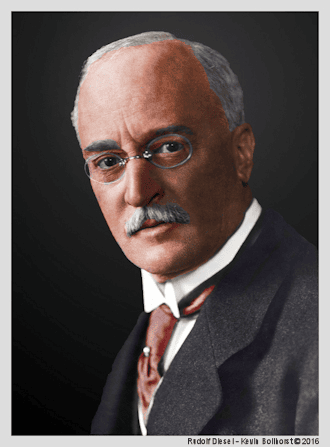
Rudolf Christian Karl Diesel was born in Paris in 1858 to Bavarian immigrant parents. In 1870, at just 12 years old, his family was forced to flee the city when the Franco-Prussian War broke out, and his parents sent him to live with an aunt and uncle in Augsburg, Germany. There he learned German, discovered a fascination with mathematics, and eventually won a scholarship to the Royal Bavarian Polytechnic of Munich, graduating in January 1880 with the highest academic honours in his class. He moved to Paris to work for his former professor, Carl von Linde, where the two of them built an ice and refrigeration plant together — solid, practical engineering experience before Diesel turned his attention to the idea that would define his life.
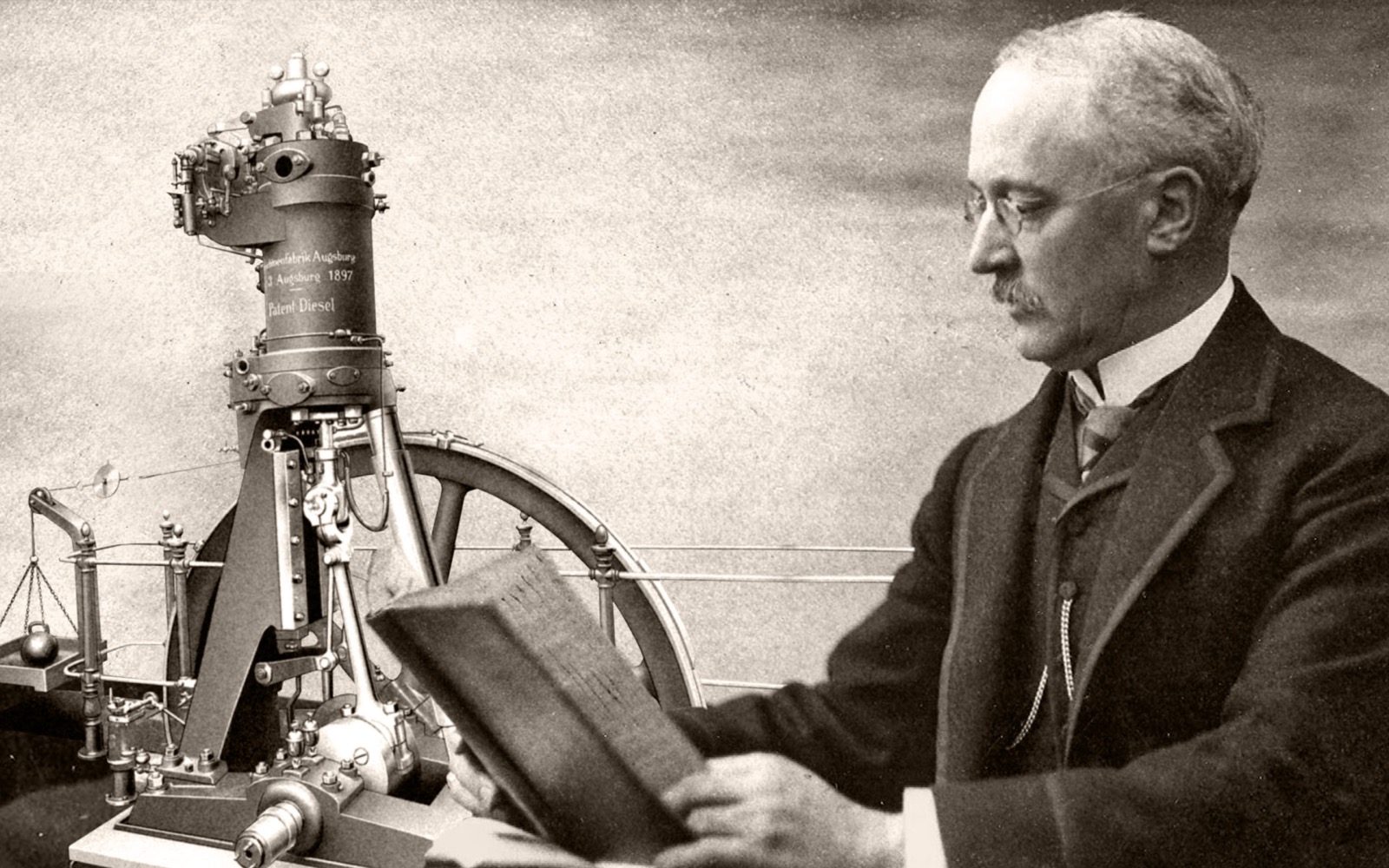
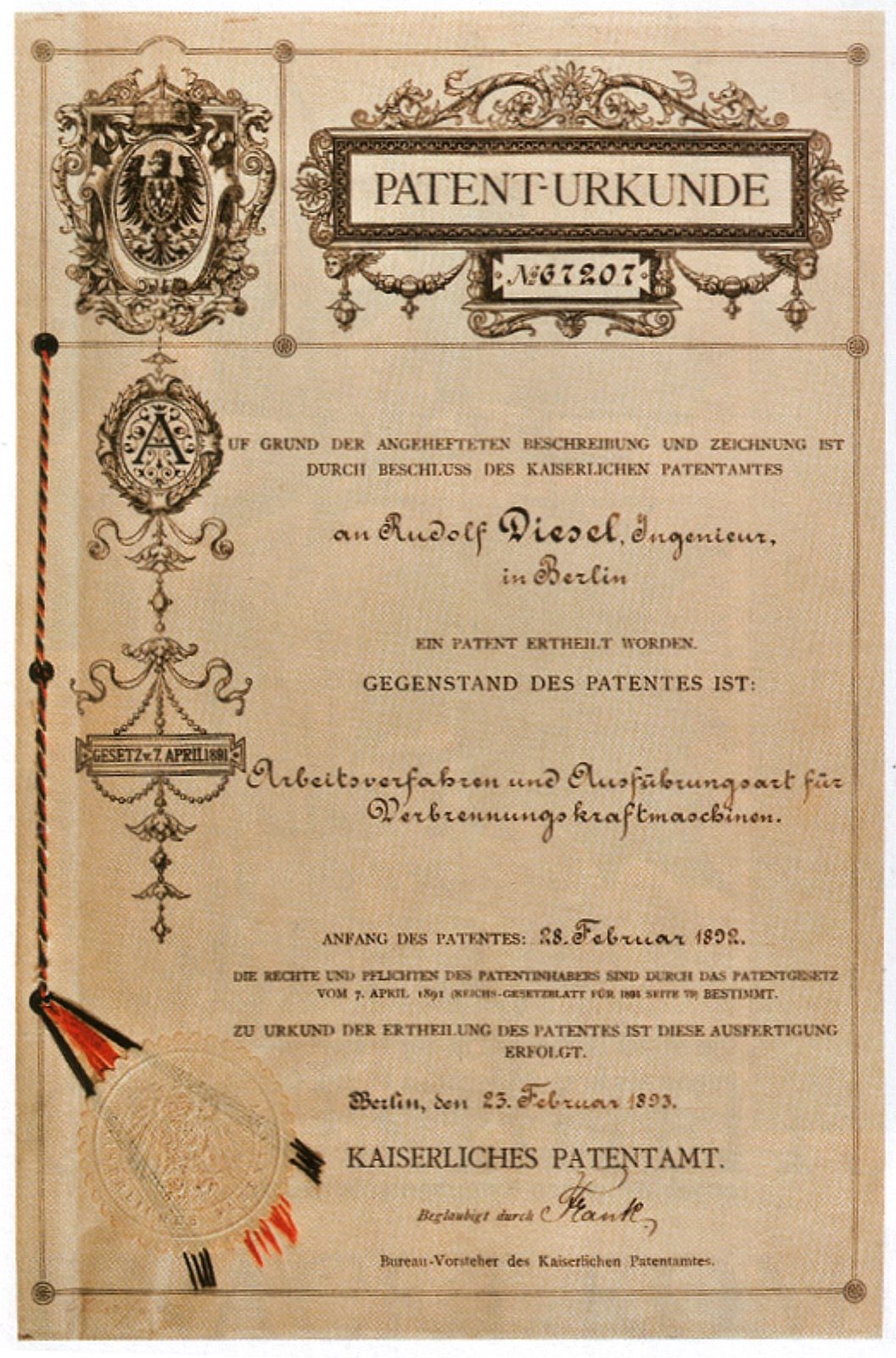
Rudolf Diesel, born in Paris in 1858 to Bavarian immigrant parents. / His patent for the underlying compression-ignition concept, filed on 28 February 1892.
An idea about waste, not an idea about engines
Diesel's actual motivation is often misunderstood. He wasn't trying to invent a “better engine” for its own sake — he was trying to solve a specific, quantifiable problem: nearly all of a steam engine's fuel energy escaped uselessly as heat. In 1893 he published his theory in a book titled The Theory and Construction of a Rational Heat Engine to Replace the Steam Engine and Contemporary Combustion Engines Known Hitherto. He calculated that his design could theoretically reach as much as 75% thermal efficiency — a genuinely radical claim for the era. He'd already patented the underlying concept a year earlier, on 28 February 1892.
The core idea was compression ignition: rather than igniting a fuel-air mixture with a spark, Diesel's engine compressed air alone to such high pressure that it grew hot enough to ignite fuel injected directly into it — no spark plug required at all. It made the engine mechanically simpler, and because it needed no separate combustion chamber the way a steam engine did, it could be lighter and more compact too.
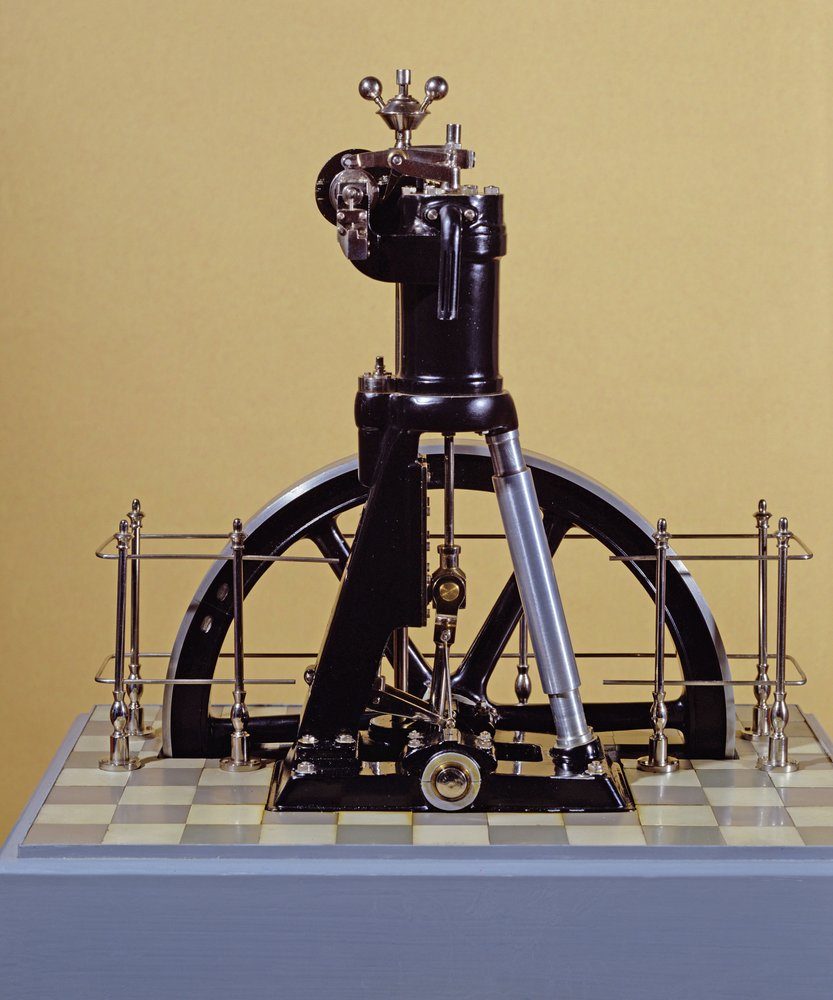
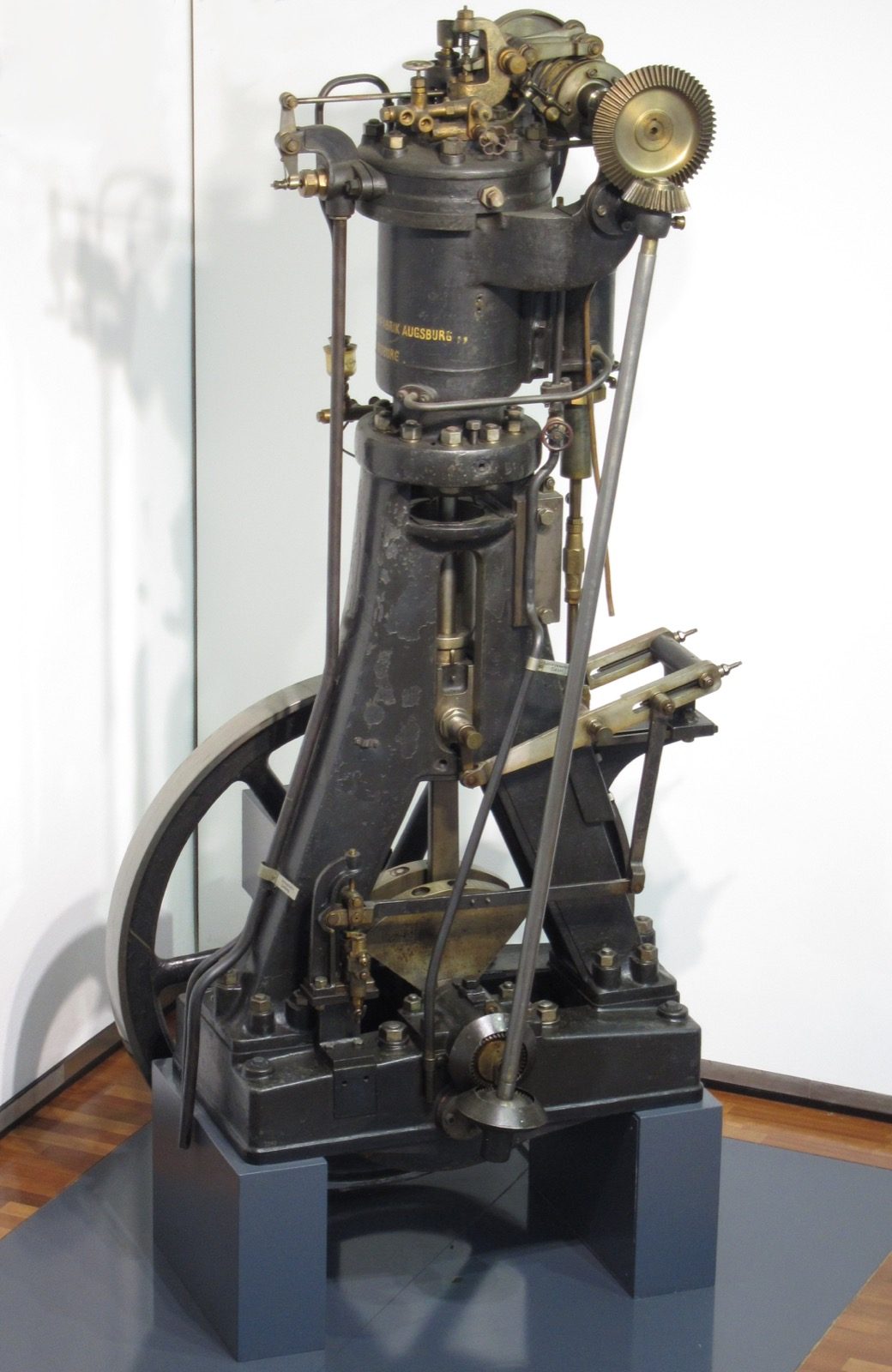
Working with the German engineering firm MAN, part of the Krupp industrial group, from 1893 to 1897, Diesel built his first genuinely successful prototype — and, tellingly, he designed it to run not on petroleum at all, but on peanut oil. The engine's first fully successful run happened in August 1897, and that very engine survives today, on display at the Deutsches Technikmuseum in Munich.
Diesel's first successful prototype, built with MAN — its first fully successful run came in August 1897. / A later prototype from the same MAN development programme, 1893-1897.
Peanut oil, castor oil, and a battleship running on soybeans
Diesel's choice of fuel wasn't incidental — it reflected a genuine, stated philosophy of energy independence. At the 1900 Paris Exhibition, at the request of the French government, a small Diesel engine ran publicly on Arachis (peanut) oil, working so smoothly that almost nobody in the crowd realised what fuel it was actually burning. Diesel himself wrote about the results with evident enthusiasm, noting that similar successful experiments had been carried out in St. Petersburg using castor oil, and that animal-derived oils had worked with excellent results too. His own conclusion, written more than a century before biofuels became a mainstream idea again, was strikingly prescient: an engine that could run on locally produced vegetable oil, he argued, could become “a really independent engine for the tropics” — freeing distant regions from having to import petroleum at all.
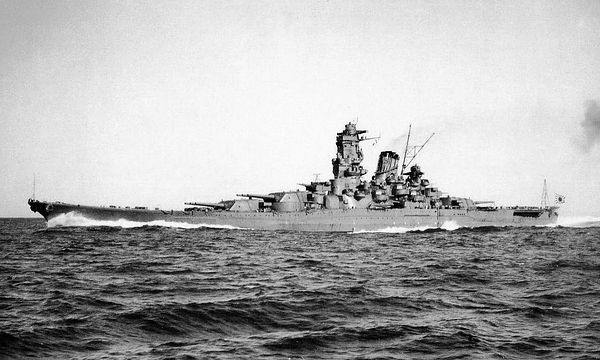
That vision briefly became a wartime necessity rather than a curiosity. During the Second World War, when petroleum supply chains were disrupted across entire theatres of war, several countries turned back to vegetable oils out of pure necessity — palm oil and peanut oil fuelled military vehicles in parts of Africa, and, in one of the more startling footnotes in naval history, Japan's battleship Yamato reportedly ran on edible refined soybean oil as bunker fuel. Once the war ended and cheap petroleum-derived diesel became widely available again, most of this vegetable-oil experimentation was simply abandoned — only to resurface decades later, during the 1970s oil crisis, and again today under an entirely different name: biodiesel.
The Japanese battleship Yamato — reportedly fuelled at one point by refined soybean oil, when conventional bunker fuel supplies ran short.
The everyday, petroleum-derived diesel fuel used in modern engines was, in the end, an adaptation of Diesel's original concept, not the concept itself. The engine came first, built around whatever combustible oil was locally available; the mineral, petroleum-refined fuel that eventually took over and gave the fuel its name was simply the cheapest, most consistent, most widely available option once the automobile and shipping industries scaled up demand for it.
How petroleum diesel is actually made
Given how much of Diesel's own story is about vegetable oil, it's worth being precise about what modern “diesel fuel” actually is, since it bears almost no resemblance to what came out of that first Augsburg prototype.
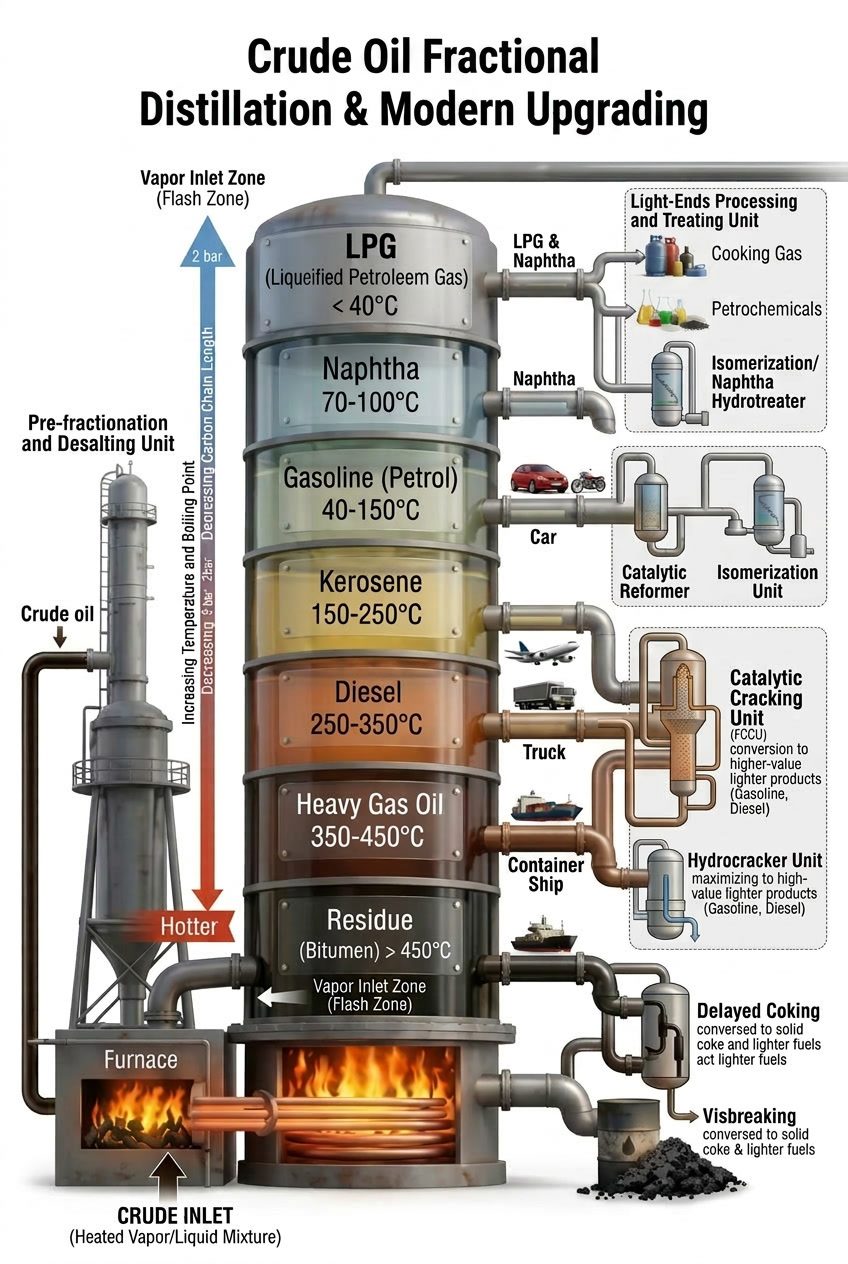
Petroleum diesel starts as crude oil, pumped from underground reservoirs and shipped to a refinery, where it undergoes fractional distillation — heated to high temperatures, vaporised, and separated inside a distillation column according to boiling point. Diesel sits in the “middle distillate” range of that spectrum, condensing out at roughly 200-350°C, heavier and slower to vaporise than the petrol drawn off higher up the tower, but lighter than the thick fuel oil and bitumen that settle out at the very bottom. From a single barrel of crude oil, only around 20-25% typically becomes diesel, with the remainder split across petrol, jet fuel, heating oil, and other products drawn from the same distillation run.
Crude oil fractional distillation — diesel condenses out of the “middle distillate” range, heavier than petrol but lighter than fuel oil and bitumen.
That raw, “straight-run” diesel isn't usable straight out of the tower. It still contains sulfur, nitrogen, and other impurities inherited from the crude oil itself, so refineries put it through hydrotreating — exposing the fuel to hydrogen under high heat and pressure in the presence of a catalyst, which strips out the sulfur and nitrogen compounds and leaves a cleaner, more stable fuel behind. Because straight-run distillation alone rarely produces enough diesel to meet demand, refineries also convert heavier, less valuable fractions of crude oil into additional diesel through cracking processes — breaking longer, heavier hydrocarbon chains down into the shorter chains diesel fuel actually needs, essentially manufacturing more diesel out of leftovers that would otherwise become low-value fuel oil or asphalt.
The end result is what's now called ultra-low sulfur diesel, or ULSD, containing no more than 15 parts per million of sulfur — a dramatic reduction from the diesel sold even a couple of decades ago, brought in specifically to allow modern emissions equipment like particulate filters and SCR systems to function properly without being poisoned by sulfur contamination.
It's a genuinely strange full-circle moment in this story: Rudolf Diesel built his engine to run on peanut oil, specifically envisioning a fuel any farmer or refinery could produce locally without needing to import anything. What eventually powered nearly every diesel engine on Earth instead became one of the most heavily industrialised, multi-stage refined products in the entire petroleum industry — precisely the kind of complex, centralised infrastructure Diesel's original vision was trying to make unnecessary.
Diesel vs gasoline: a timeline of two rival engines
The two great combustion engine families were developed only a few decades apart, by entirely different engineers solving different problems — and the timeline is worth laying out side by side.
1860 — Belgian-born engineer Étienne Lenoir builds one of the first commercially produced internal combustion engines, running on coal gas rather than liquid fuel. It's inefficient and never displaces the steam engine, but it establishes the basic concept.
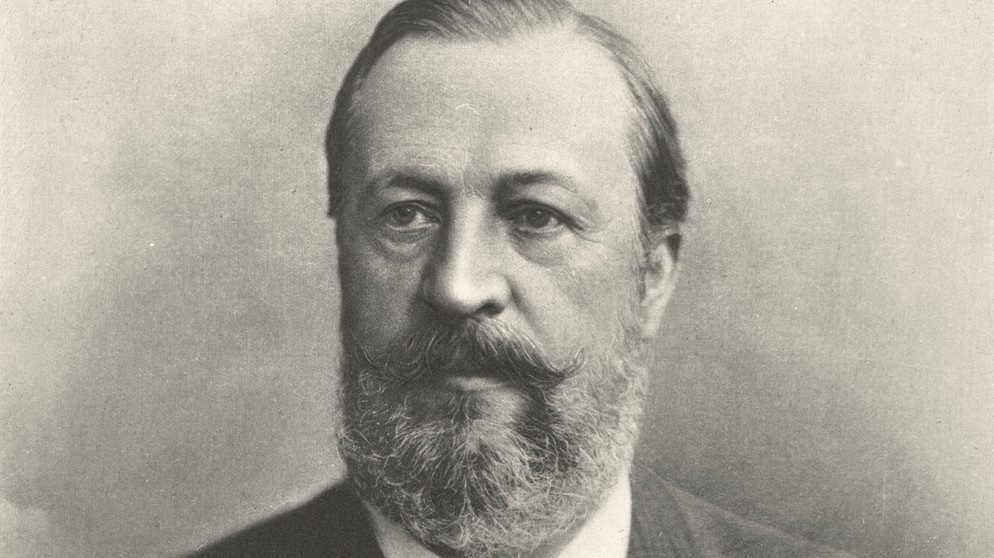
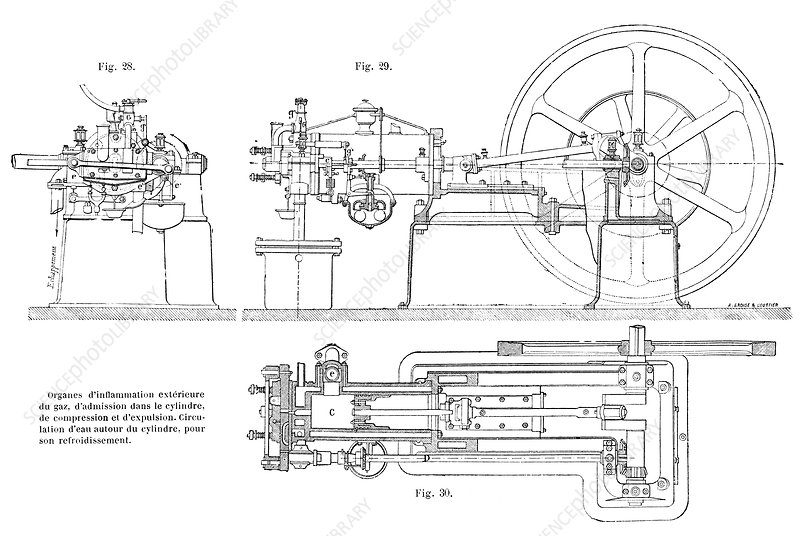
1876 — German engineer Nikolaus Otto builds the first practical four-stroke internal combustion engine, later known as the Otto cycle. More than 30,000 are built and sold within the following decade, though his 1877 patent is revoked in 1886 once a French engineer, Alphonse Beau de Rochas, is found to have described the same four-stroke principle back in 1861 or 1862, in an obscure, privately published pamphlet Otto had genuinely never seen.
Nikolaus Otto, who built the first practical four-stroke internal combustion engine in 1876.
An early Otto-cycle engine — more than 30,000 were built and sold within a decade of its 1876 debut.
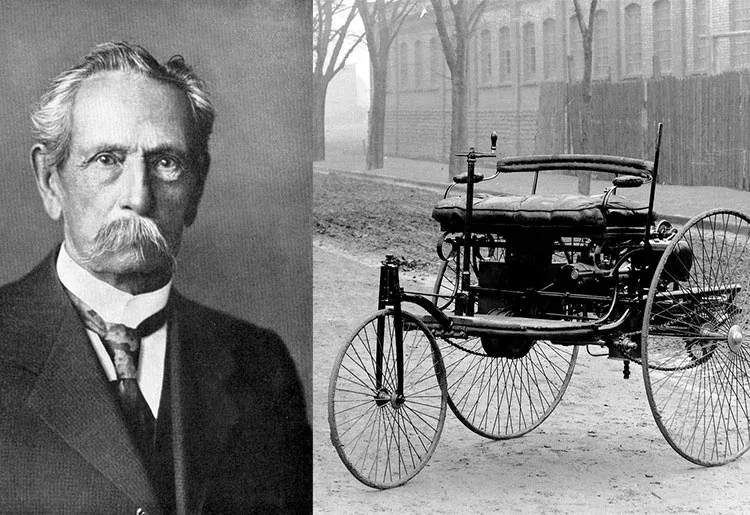
1885-1886 — Karl Benz builds the Motorwagen, widely regarded as the first practical automobile, powered by his own single-cylinder four-stroke gasoline engine producing just 0.75 horsepower. He files his patent on 29 January 1886 — the document now regarded as the birth certificate of the modern car.
Carl Benz and his Motorwagen, patented 29 January 1886 — the birth certificate of the modern car.
1893 — Rudolf Diesel patents the theoretical basis for compression ignition and begins prototype development with MAN.
1897 — Diesel's first genuinely successful engine runs, on peanut oil, in Augsburg.
1898 — Diesel exhibits his engine at the Munich Exhibition and is granted a formal patent. Within months he becomes a millionaire purely from licensing manufacturing rights.
1900 — Diesel's engine is publicly demonstrated at the Paris World's Fair, running on peanut oil at the request of the French government.
1903-1904 — The first diesel-powered ships (the Vandal and the Sarmat) are launched for river and canal use, followed almost immediately by the first diesel submarine, the French Aigrette, in 1904.
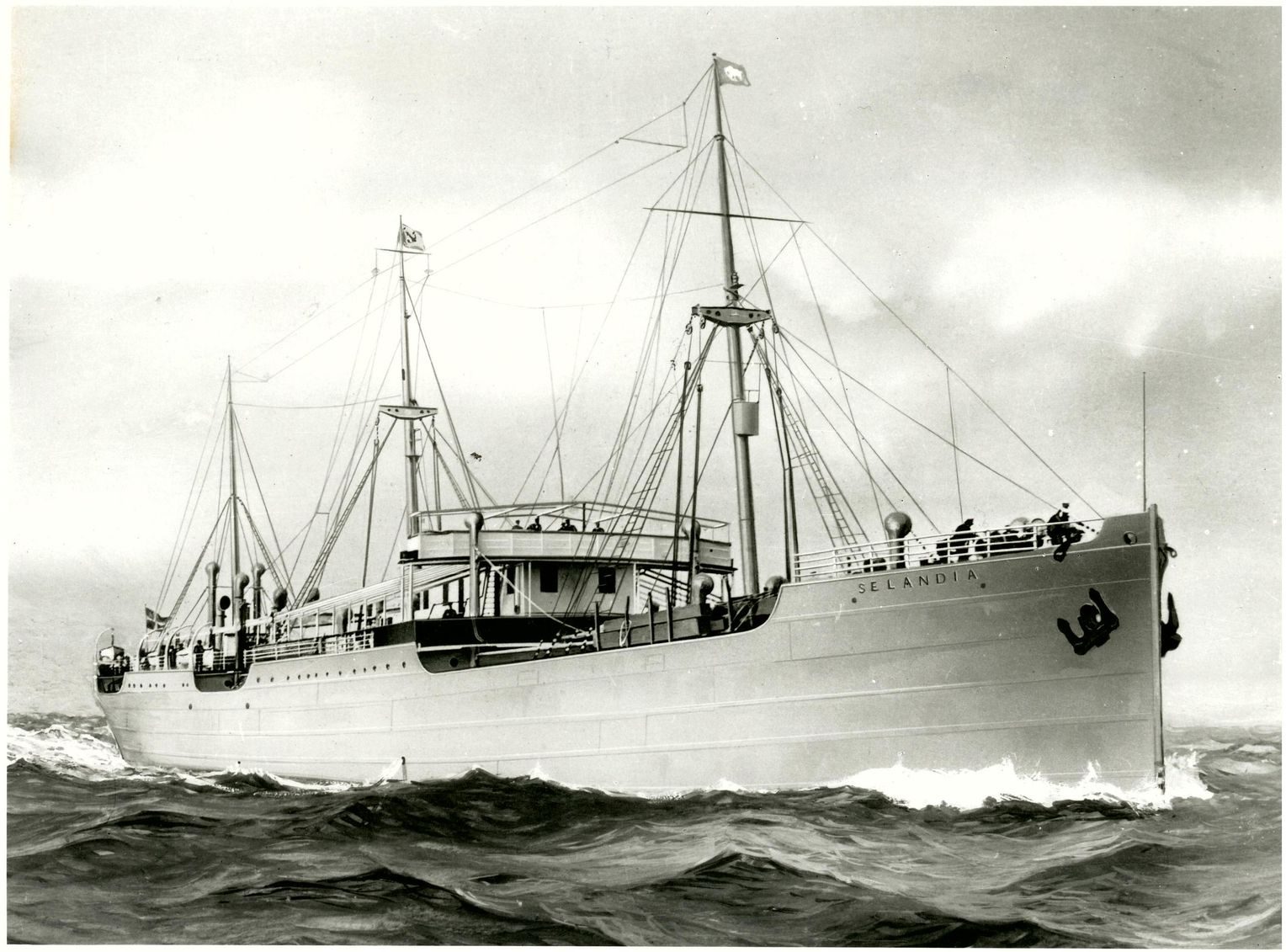
1912 — The MS Selandia becomes one of the first major ocean-going ships powered entirely by diesel engines, just as diesel locomotives begin appearing the following year.
The MS Selandia, 1912 — one of the first major ocean-going ships powered entirely by diesel engines.
1913 — Rudolf Diesel disappears from a ship crossing the English Channel and is never seen alive again.
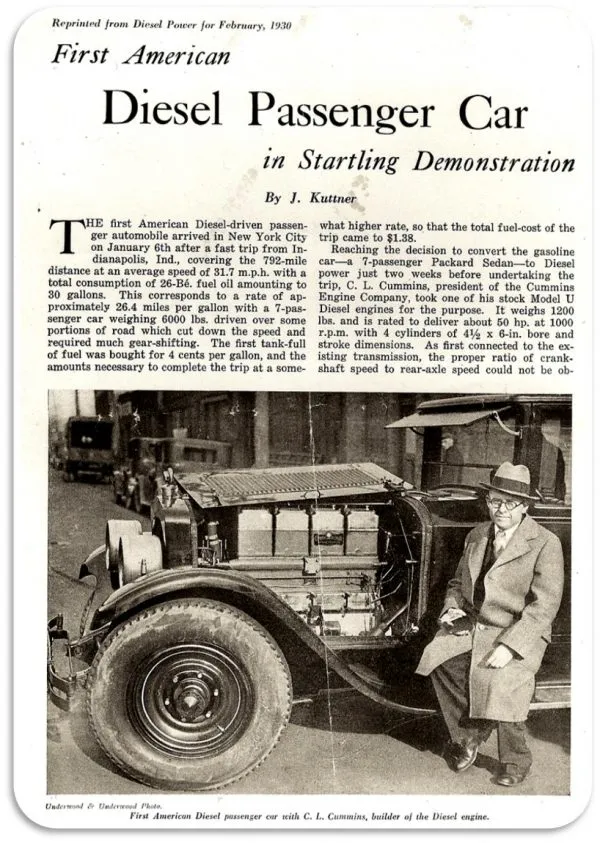
1919 — Clessie Cummins founds what becomes the Cummins Engine Company in Indiana, recognising the commercial potential of Diesel's invention early and turning it into one of the world's dominant diesel manufacturers.
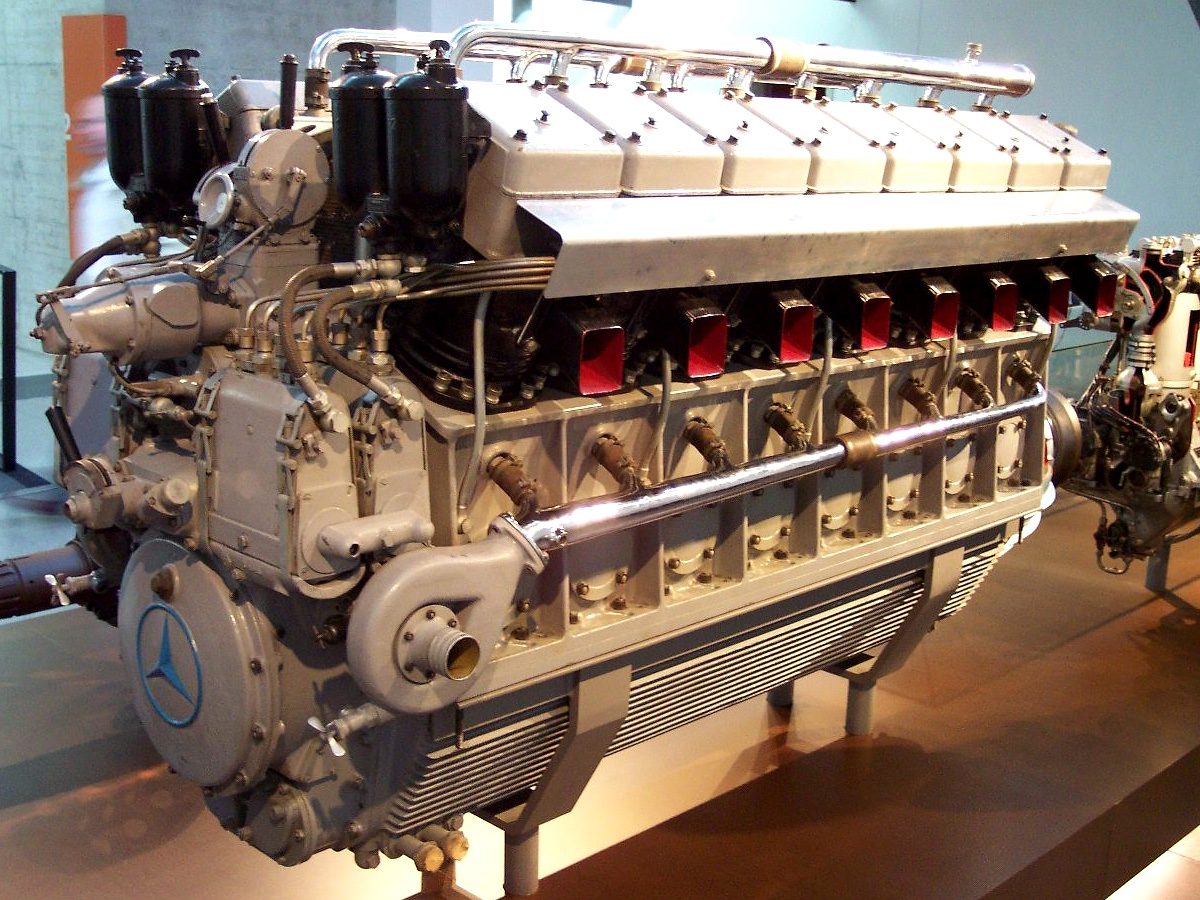
1929 — The Packard Motor Company builds one of America's first aircraft diesel engines. Daimler-Benz, meanwhile, was in the middle of developing its own diesel airship engines during this period, a lineage of development that eventually produced the four DB 602 diesel engines that powered the Hindenburg on its first flight in 1936.
One of the four Daimler-Benz DB 602 diesel engines that powered the Hindenburg on its first flight in 1936.
1933 — Citroën offers the 1,766cc 11UD diesel engine as a factory option on the Rosalie Familiale estate, making it, by most historians' reckoning, the world's first commercially available diesel passenger car — three full years before Mercedes' far more famous 260D.
1936 — Mercedes-Benz launches the 260D, the world's first diesel car built and sold at real scale.
1970s — The global oil crisis drives a surge in demand for diesel's superior fuel efficiency, and by the early 2010s diesel-powered cars account for roughly half of all new car registrations across the EU.
The fundamental difference, in plain terms
Both engines burn fuel to drive a piston. The difference is entirely in how that fuel gets ignited, and that single distinction cascades into almost everything else that separates the two.
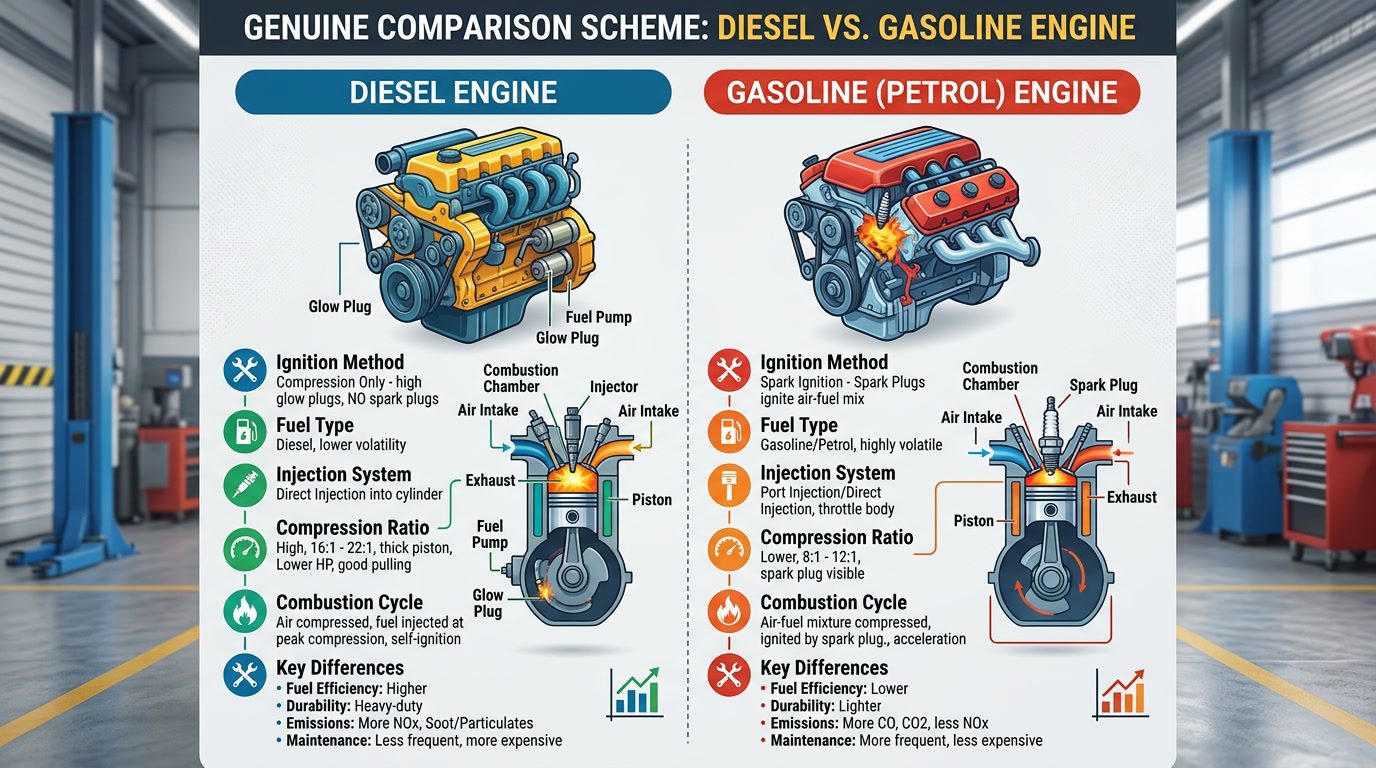
A gasoline engine compresses a mixture of fuel and air together, then ignites it deliberately with a spark plug at a precisely timed moment. A diesel engine compresses air alone, far more intensely, until it becomes hot enough on its own to ignite fuel the instant it's injected — no spark required at any point.
Diesel versus gasoline, in one diagram — the difference in how each engine ignites its fuel explains almost everything else that separates them.
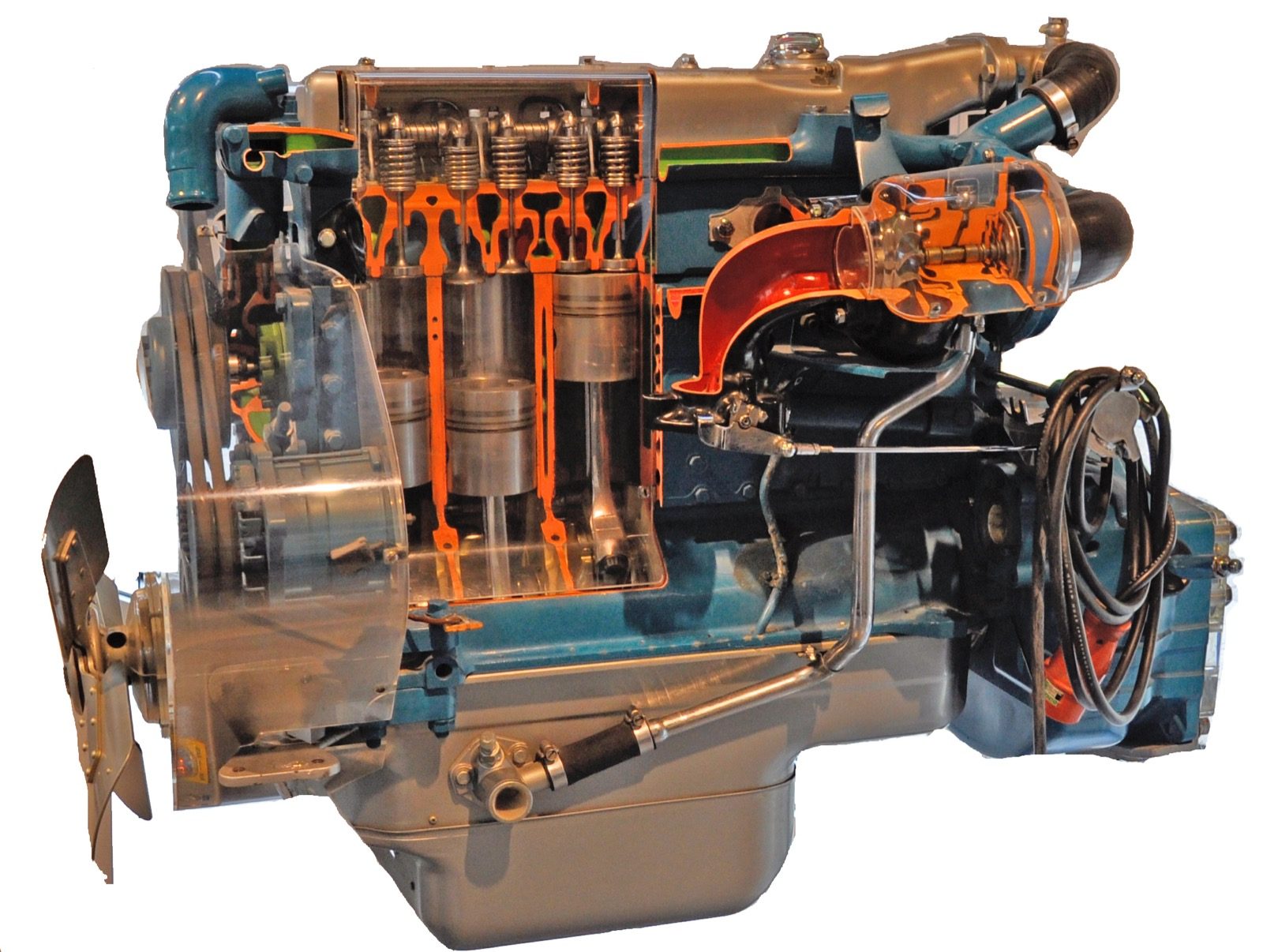
That single design choice explains diesel's core advantages: significantly higher thermal efficiency, since the diesel cycle wastes considerably less energy than a comparable petrol engine, and dramatically higher torque at low engine speeds, which is precisely why diesel became the default choice for anything that needs to pull or carry serious weight — trucks, tractors, ships, generators. It also explains diesel's core disadvantages: the far higher compression pressures needed mean diesel engines require heavier construction and thicker cylinder walls to survive, making them heavier, more expensive to build, and historically noisier and dirtier in their emissions than an equivalent petrol engine.
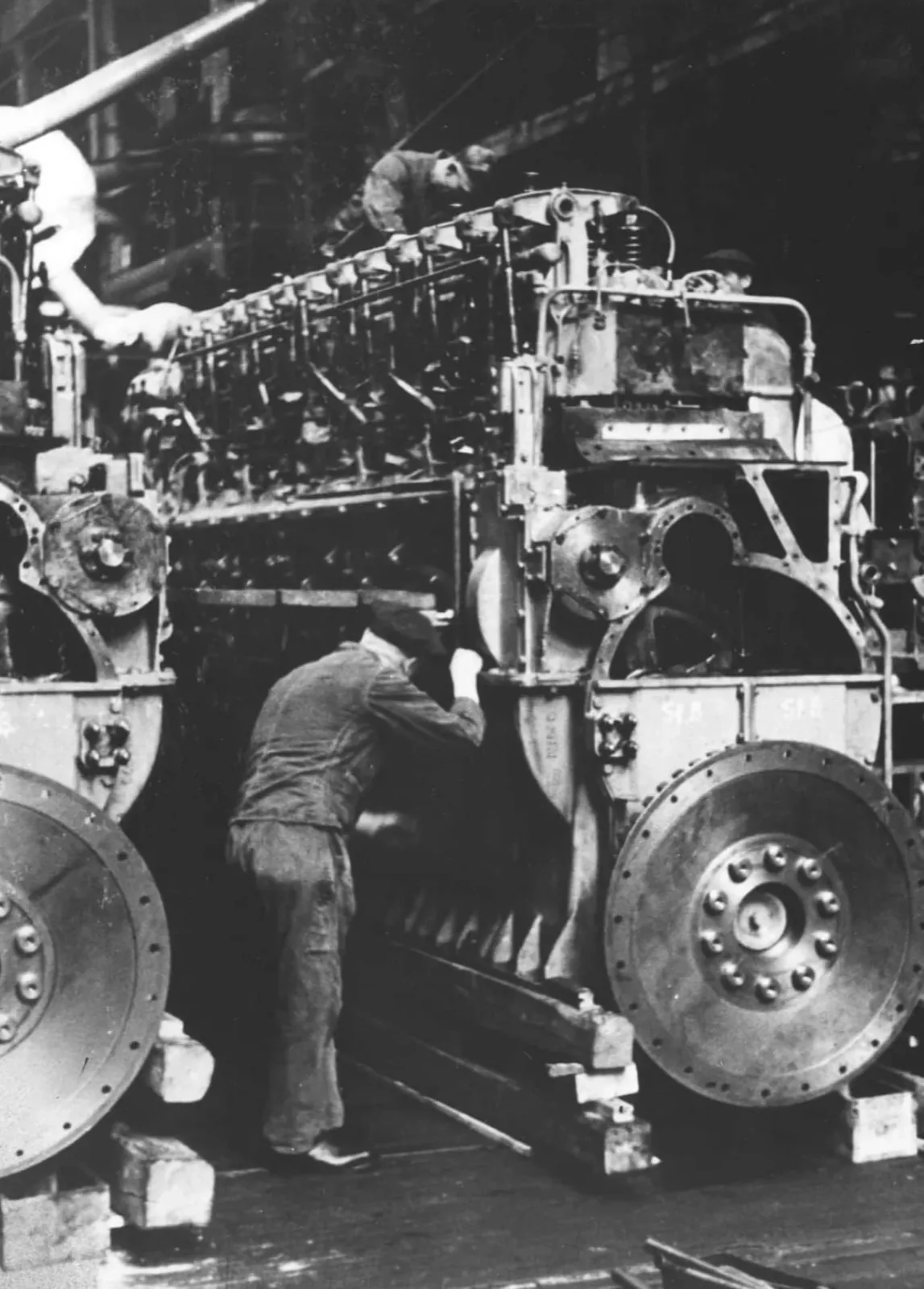
A classic mechanical diesel engine — the heavier construction and thicker cylinder walls needed to survive diesel's far higher compression pressures.
Petrol's advantage runs the other way — lighter construction, smoother and quieter running, and an engine that can rev far higher, making it the natural choice for cars prioritising speed and refinement over outright pulling power or fuel economy.
The engineering innovations that turned Diesel's idea into a modern engine
Diesel's original 1897 engine and a modern truck engine share a basic principle but almost nothing else in execution. The century between them is really a story of dozens of separate engineers, each solving one specific limitation, gradually building up the engine into something dramatically more powerful, cleaner, and more precise than Diesel could ever have built himself.
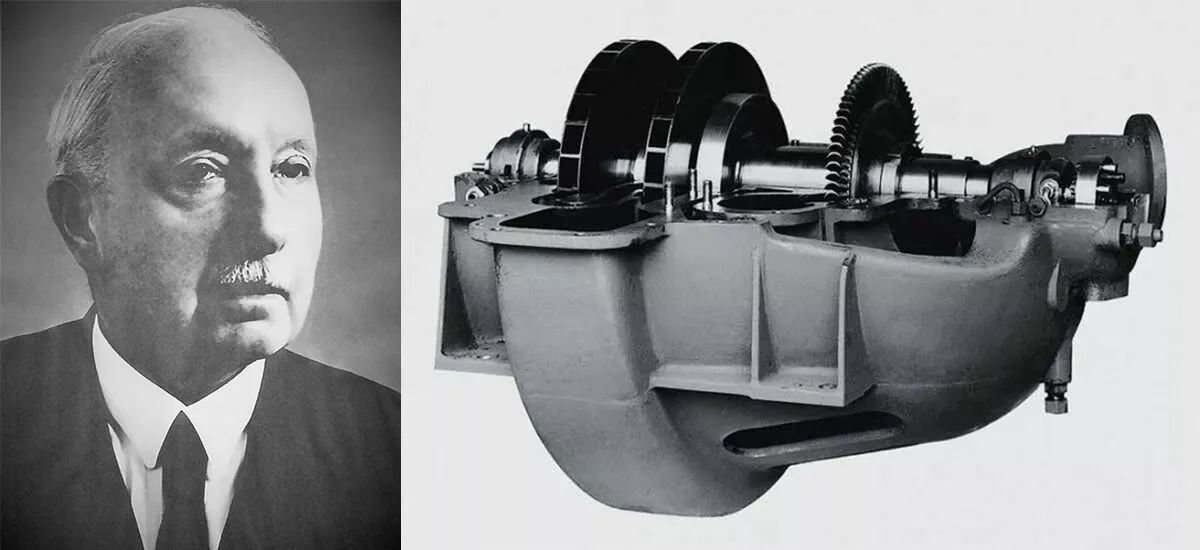
1905 — Swiss engineer Alfred Büchi, the son of an executive at industrial giant Sulzer, patents the turbocharger — a device using an engine's own exhaust gas, previously just wasted energy escaping out the back, to spin a turbine that force-feeds compressed air back into the cylinders. Büchi's own early demonstrations showed a 40% increase in power output, but the materials science of the era simply couldn't survive the extreme heat and rotational speeds his design demanded, and it would take until the 1920s for turbocharged marine diesels to become genuinely practical, and decades more before the technology reached ordinary road cars.
Alfred Büchi's 1905 turbocharger patent — it would take until the 1920s before the idea became genuinely practical at sea, and decades more before it reached road cars.
1911 — British engineer Frederick Lamplough patents an early unit injector design — a compact device combining a plunger pump and nozzle in a single assembly, eliminating the intermediary high-pressure tubing earlier systems relied on. It was a genuine step toward the precise, self-contained fuel delivery per cylinder that modern diesel engines still use, though commercial adoption wouldn't begin for another two decades.
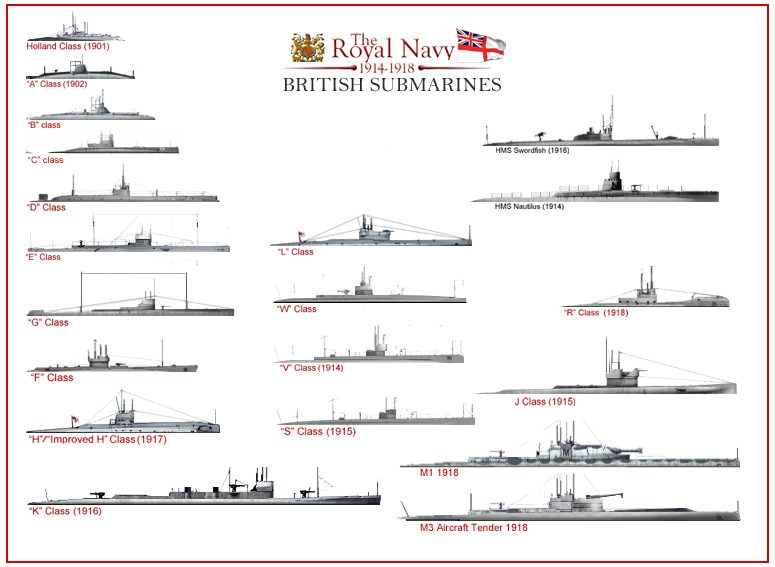
1916 — The British engineering firm Vickers becomes the first to use common rail fuel injection — where every injector draws from one shared, continuously pressurised fuel line rather than each cylinder having its own separate mechanical pump — fitting the system to submarine engines during the First World War, decades before the concept ever reached ordinary road cars.
British Vickers submarines, fitted with the first common rail fuel injection systems in 1916 — decades before the idea reached road cars.
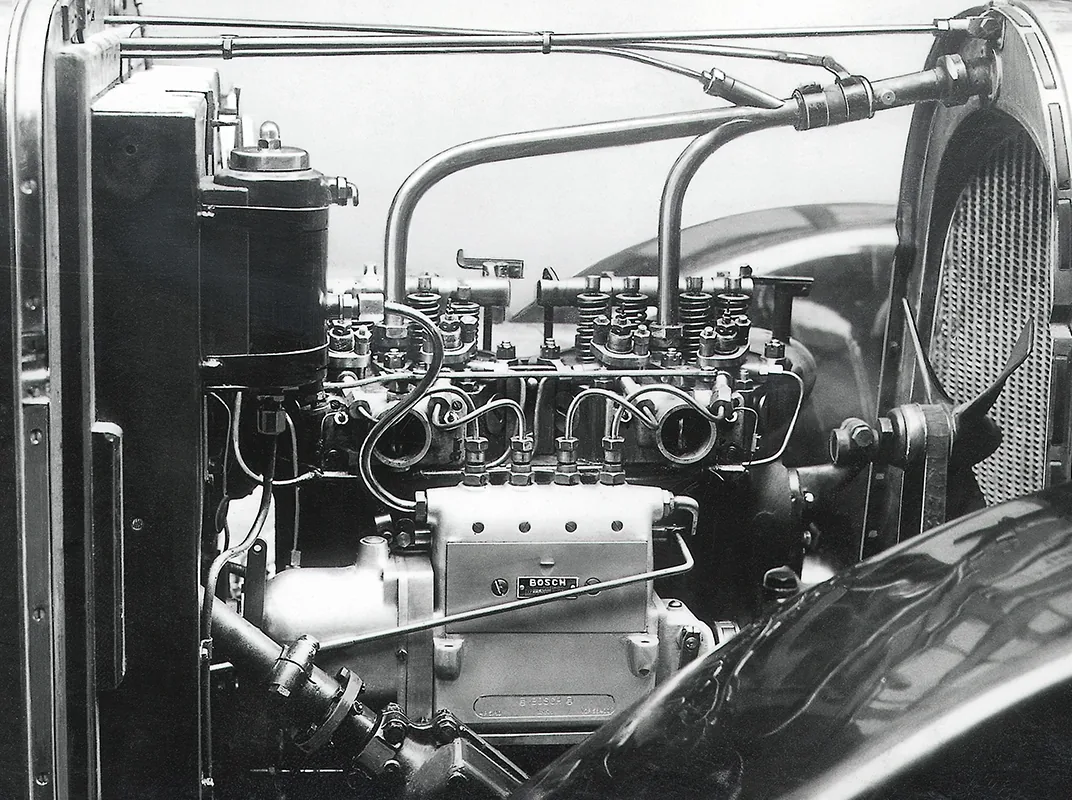
1927 — Robert Bosch, whose company would go on to become the dominant name in diesel fuel injection equipment for the rest of the century, significantly improves fuel pump design, making injection timing and delivery meaningfully more precise and reliable.
A Bosch fuel injection pump — Robert Bosch's 1927 improvements made injection timing and delivery meaningfully more precise.
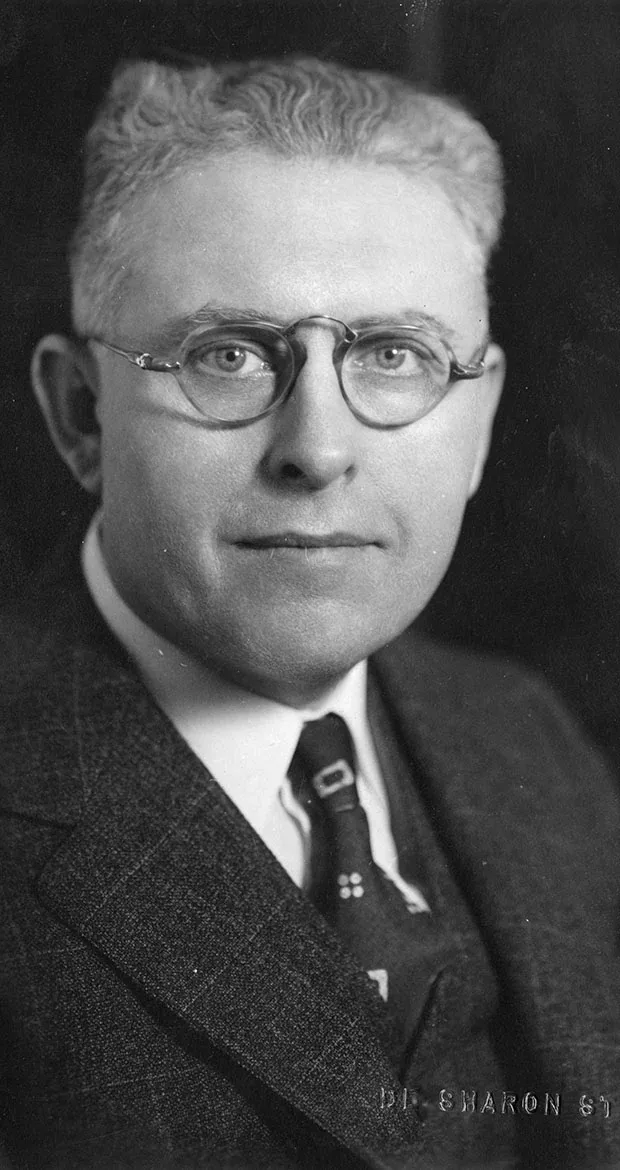
1930s — Clessie Cummins, the Indiana mechanic who founded what became the Cummins Engine Company, persuades Purity Stores, a California grocery chain controlled by his own business patron William Irwin, to convert its entire delivery truck fleet to diesel power. It's a genuinely pivotal moment for the industry: proof, delivered through an ordinary commercial fleet rather than a laboratory demonstration, that diesel wasn't just theoretically more efficient than gasoline for trucking — it was practically, provably better, in the hands of an unglamorous grocery delivery business.
Clessie Cummins, whose 1930s conversion of the Purity Stores delivery fleet proved diesel's commercial case for trucking. / Cummins also later developed the compression-release engine brake known as the “Jake Brake.”
Mid-1950s to 1965 — Clessie Cummins, by then retired from the company that still bore his name, develops and eventually patents a compression release engine brake — a system that dumps a cylinder's compressed air out through the exhaust valve rather than letting it push the piston back down, using the engine itself to slow a heavy vehicle on long descents without relying purely on the wheel brakes. Cummins' own company turned the idea down when he first offered it to them; it was Jacobs Vehicle Systems, a drill-chuck manufacturer, who eventually licensed and commercialised it. It became known as the “Jake Brake” and remains, to this day, the distinctive loud braking sound heard from trucks descending steep grades on highways worldwide.
1987 — Detroit Diesel introduces the Series 60 engine, the first diesel engine ever built with a complete electronic control system governing fuel injection — a genuine turning point that opened the door to the far more precise, computer-managed diesel engines that followed.
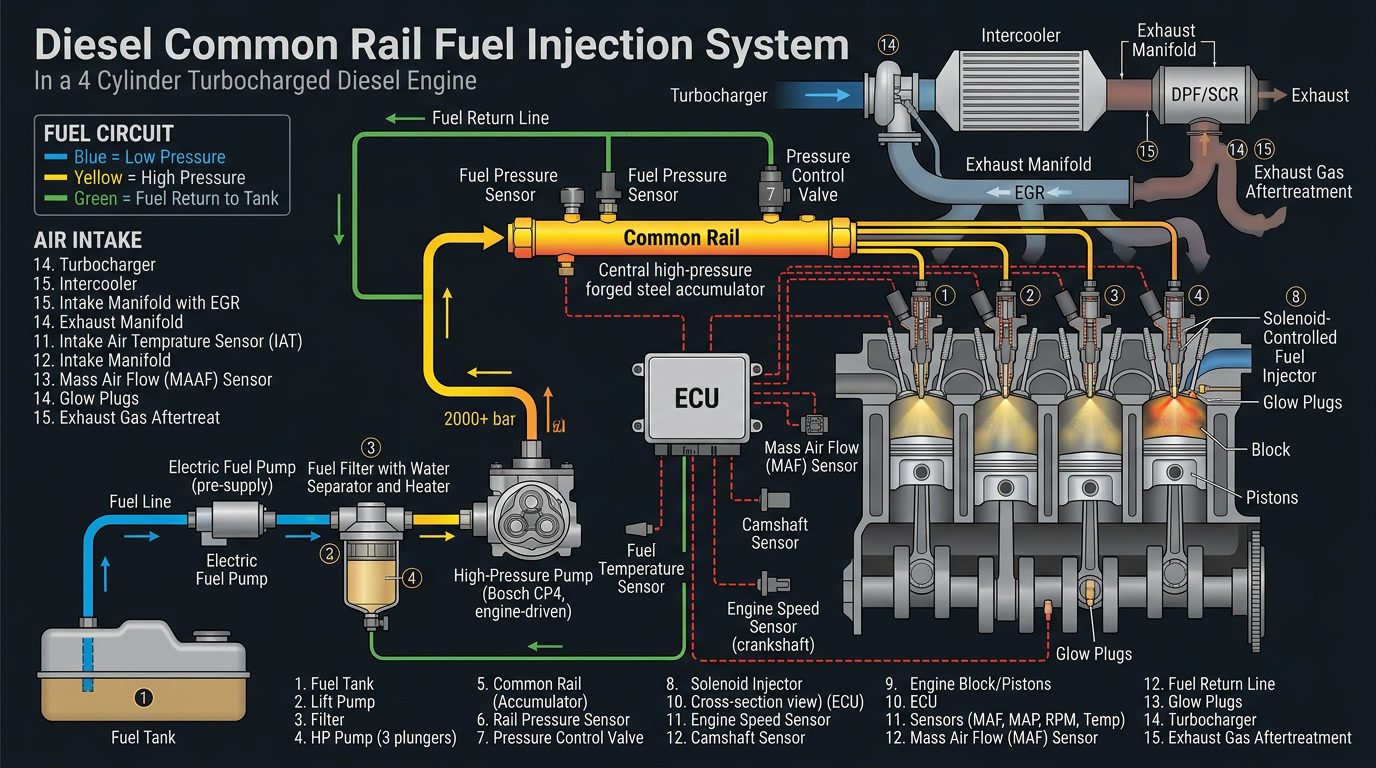
1987 — Fiat's own research division, Centro Ricerche Fiat, together with Magneti Marelli and Elasis, begins serious development of what becomes the modern common rail concept, based on a theory originally worked out by researchers at Zurich University: keep continually forcing diesel into a rigid tank and the rising internal pressure turns that tank into a hydraulic accumulator, or “rail” — a reservoir of already-pressurised fuel ready to be metered out to injectors independently of engine speed. This decoupling of fuel pressure from injection timing, controlled electronically rather than mechanically, is what separates modern common rail from Vickers' comparatively crude 1916 submarine version.
Common rail, represented — a shared, continually pressurised fuel reservoir metering diesel out to each injector independently of engine speed.
1990 — The resulting Unijet system, developed jointly by Fiat, Magneti Marelli, and Elasis, reaches the pre-production stage.
1993 — Caterpillar introduces the Hydraulically Actuated Electronically Controlled Unit Injector, known as HEUI, using engine oil pressure rather than a mechanical camshaft to drive fuel injection, giving engineers dramatically more flexibility over injection timing and pressure. In the same year, Fiat — financially unable to complete development and industrialisation of Unijet alone — sells the technology to Robert Bosch for roughly $14 million, retaining certain intellectual property rights while Bosch takes on refinement for mass production.
1994 — Bosch, having just acquired the Unijet system, introduces its own electronic unit injector, bringing computer-controlled precision to a wider range of diesel manufacturers beyond Detroit Diesel and Caterpillar alone.
1995 — Japanese supplier Denso produces the first common rail system to reach real-world commercial production anywhere, fitted to a truck sold in Japan — the first time the concept moved beyond prototypes and into a genuine commercial vehicle, though still not yet in a passenger car.
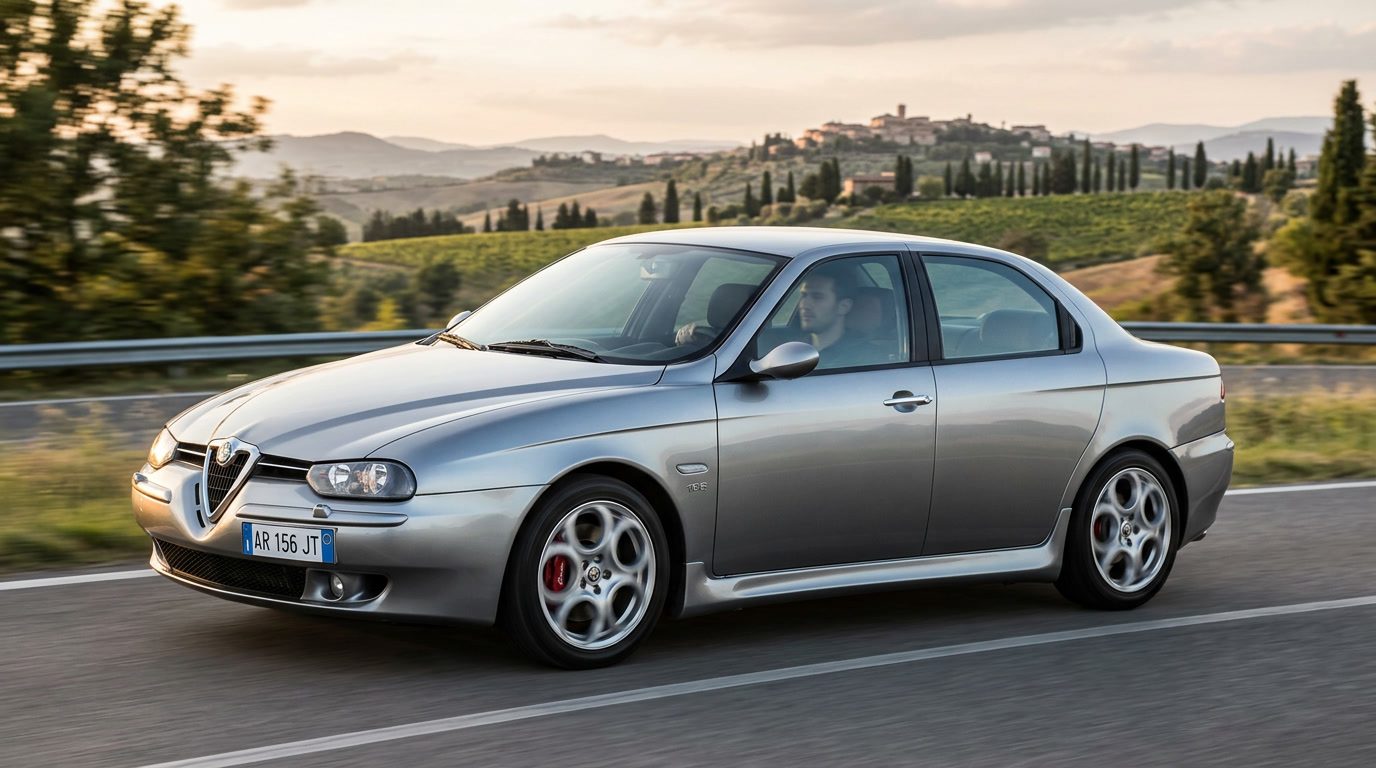
October 1997 — The Alfa Romeo 156 1.9 JTD becomes the world's first mass-production passenger car fitted with common rail diesel injection, running at pressures up to 1,350 bar and reportedly delivering around 12% better performance and 15% lower fuel consumption than earlier direct-injection diesels. Mercedes-Benz follows within weeks in the same model year with the C 220 CDI (W202), bringing the technology to a second major manufacturer almost simultaneously. Within a few years virtually every diesel car manufacturer in the world had adopted some version of the same basic system, each wrapped in its own brand name — Mercedes' CDI, Volkswagen's TDI, PSA's HDi, Fiat's own continuing JTD and later Multijet.
The Alfa Romeo 156 1.9 JTD, October 1997 — the world's first mass-production passenger car fitted with common rail diesel injection.
2000s — Tightening EPA emissions regulations in the United States force essentially every remaining diesel manufacturer still using older mechanical injection systems to adopt high-pressure common rail as standard, since the older technology simply couldn't deliver the precision needed to meet new pollution limits.
2003 — Fiat introduces a second-generation common rail system, branded Multijet, capable of up to five separate fuel injections per single combustion cycle rather than the original Unijet's simple pilot-plus-main injection — enabling quieter, more efficient combustion and significantly better cold-running performance.
2007 — Diesel particulate filters become standard equipment specifically to meet EPA emissions requirements, physically trapping soot particles in the exhaust stream rather than letting them escape into the atmosphere — the same DPF technology that, decades later, causes real headaches for drivers doing mostly short urban journeys, since the filter needs sustained highway-speed heat to properly clean itself.
2010 — Selective catalytic reduction, using a urea-based fluid (branded AdBlue in most markets) injected into the exhaust stream to chemically break down nitrogen oxide emissions, is introduced to meet the next tier of EPA requirements — the technology still fitted to virtually every modern diesel car and truck sold today.
By 2025 — Common rail pressures, which started at 1,350 bar in that original 1997 Alfa Romeo, have climbed past 2,500 bar in the latest fourth-generation systems, with newer designs increasingly built using materials and seals compatible with alternative and hydrogen fuels as manufacturers look toward decarbonisation.
Two world wars, two very different fuel strategies
Nowhere did the diesel-versus-gasoline divide matter more urgently than on the battlefields of the Second World War, where the choice of fuel and engine genuinely shaped the outcome of entire campaigns.
Ships and submarines went diesel almost universally. By the time war broke out, marine diesel technology had already proven itself over three decades of ocean-going service.
How U-boats actually ran: diesel on the surface, electric underwater
The common shorthand — “German U-boats ran on diesel” — is true but incomplete in a way that misses what actually made them work, and it's worth laying out properly.
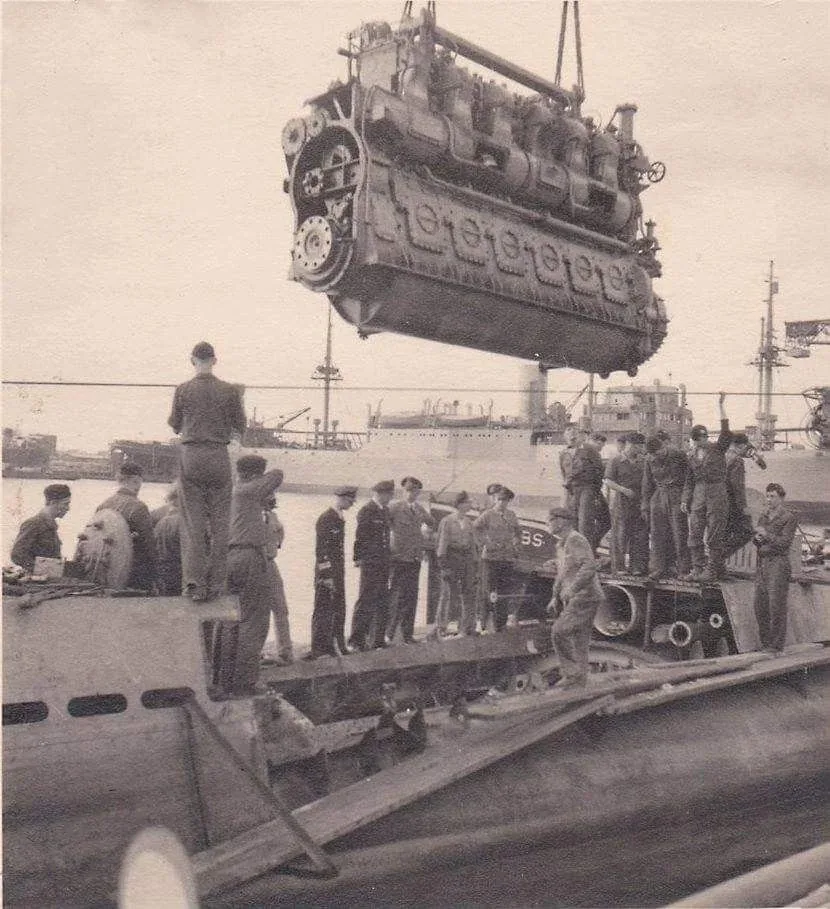
The basic system was diesel-electric, not diesel alone. On the surface, diesel engines drove the U-boat directly through a mechanical coupling, typically reaching 17-18 knots on a standard Type VIIC, while simultaneously charging large banks of lead-acid batteries stored low in the hull for stability. Submerged, the diesels had to shut down entirely — they need a continuous supply of air for combustion and would exhaust a submarine's entire breathable oxygen within minutes if run underwater without a way to draw in fresh air. So once submerged, the boat switched over completely to electric motors drawing on the batteries charged earlier on the surface. The power difference was dramatic: a Type IXC produced around 4,400 horsepower on the surface from its diesels but only about 1,000 horsepower submerged on electric power alone, and typical submerged speed dropped to just 5-8 knots, sustainable for only a matter of hours before the batteries needed recharging again.
A German U-boat's diesel engine — driving the boat directly on the surface while also charging its batteries for submerged running. / On the surface these diesels could push a Type VIIC to 17-18 knots; submerged, the boat ran on electric motors alone.
This is exactly why U-boats spent most of their time on the surface, not underwater. It wasn't a tactical choice so much as a hard technical limit — the battery-electric system simply couldn't sustain useful speed or range for long, so a U-boat on patrol behaved much more like a fast surface vessel that occasionally dived, rather than the fully submersible craft popular imagination often pictures. That routine need to surface and run diesels to recharge is precisely the vulnerability that Allied radar and aircraft learned to exploit devastatingly well as the war went on — a surfaced U-boat, even briefly, was a detectable, attackable target.
The snorkel changed that calculation, but only partially. The device itself predates the war and wasn't a German invention — Dutch naval officer Jan J. Wichers proposed the concept of a breathing tube for underwater diesel operation in 1933, and the Dutch navy began fitting them to its own submarines from 1936. Germany only acquired the technology after capturing Dutch vessels equipped with it during the 1940 invasion of the Netherlands. From roughly mid-war onward, Germany retrofitted the schnorchel to hundreds of U-boats, letting diesels run at periscope depth to recharge batteries without a full surface exposure — reducing, though never eliminating, the detection risk.
Germany also tried to escape the diesel-electric limitation entirely, and largely failed. Engineer Hellmuth Walter developed an air-independent propulsion system using concentrated hydrogen peroxide as an oxidant, allowing a turbine to run fully submerged without any external air at all. His experimental V-80 boat, built and tested in 1939-40, reached genuinely startling underwater speeds — accounts vary between roughly 14 knots achieved in early restricted trials and a theoretical 20-28 knots in open water, several times faster than any battery-electric U-boat could manage. Only a handful of experimental Type XVIIA boats using the system were ever built, and the concept never reached frontline service at any scale, chiefly because Germany never had the industrial capacity to produce enough hydrogen peroxide to fuel a real fleet with it, and once the peroxide ran out a Walter boat couldn't submerge again at all.
The late-war answer that did reach production kept the same basic diesel-electric principle, just scaled up dramatically. The Type XXI, built from 1943 to 1945 and nicknamed the Elektroboot, carried roughly triple the battery capacity of earlier designs alongside a snorkel and supercharged diesels, letting it cruise submerged at around 5 knots for up to 75 hours before needing to recharge — a genuine shift toward a boat designed to operate primarily submerged rather than as a surface vessel that dived occasionally. It arrived too late in the war to see meaningful combat use, but its design directly influenced postwar submarine engineering, including early Soviet and American diesel-electric boats, right up until nuclear propulsion made the entire diesel-electric compromise unnecessary from the 1950s onward.
Aircraft, by contrast, ran almost entirely on gasoline — and that decision became a genuine war-deciding factor. In the early stages of the war, German Luftwaffe fighters had a real performance edge over the RAF, and remarkably, the reason wasn't better aircraft design or better pilots — it was fuel. In spring 1940, RAF fighters ran on 87-octane fuel while the Luftwaffe's Bf-109s ran on higher-grade 100-octane, giving German aircraft a genuine speed and climb advantage in the skies over France and Belgium. Britain closed that gap dramatically once American refineries, using a new catalytic cracking process developed by Sun Oil, began shipping so-called BAM 100 fuel — 100/130 octane — to England from mid-1939 onward. By the Battle of Britain in the summer of 1940, RAF Spitfires and Hurricanes running on the new fuel gained up to 30% more horsepower on takeoff and climb, increasing top speed by 25-34 miles per hour at altitude. One contemporary historian went as far as calling it “an established fact that a difference of only 13 points in octane number made possible the defeat of the Luftwaffe by the RAF” — a genuinely striking claim, though it's worth treating as one historian's assessment rather than a settled consensus, since isolating fuel quality from the many other factors in the battle (radar, aircraft design, pilot training, numbers) is inherently difficult to prove with precision.
Germany, cut off from easy access to natural crude oil, relied heavily on synthetic gasoline manufactured from its abundant domestic coal supply using a hydrogenation process — by 1943, this synthetic fuel supplied over half of Germany's total wartime oil use and some 90% of the Luftwaffe's aviation fuel. It was a remarkable industrial achievement, but it could never quite match the higher-octane fuel America's much larger refining capacity was producing by the war's later years.
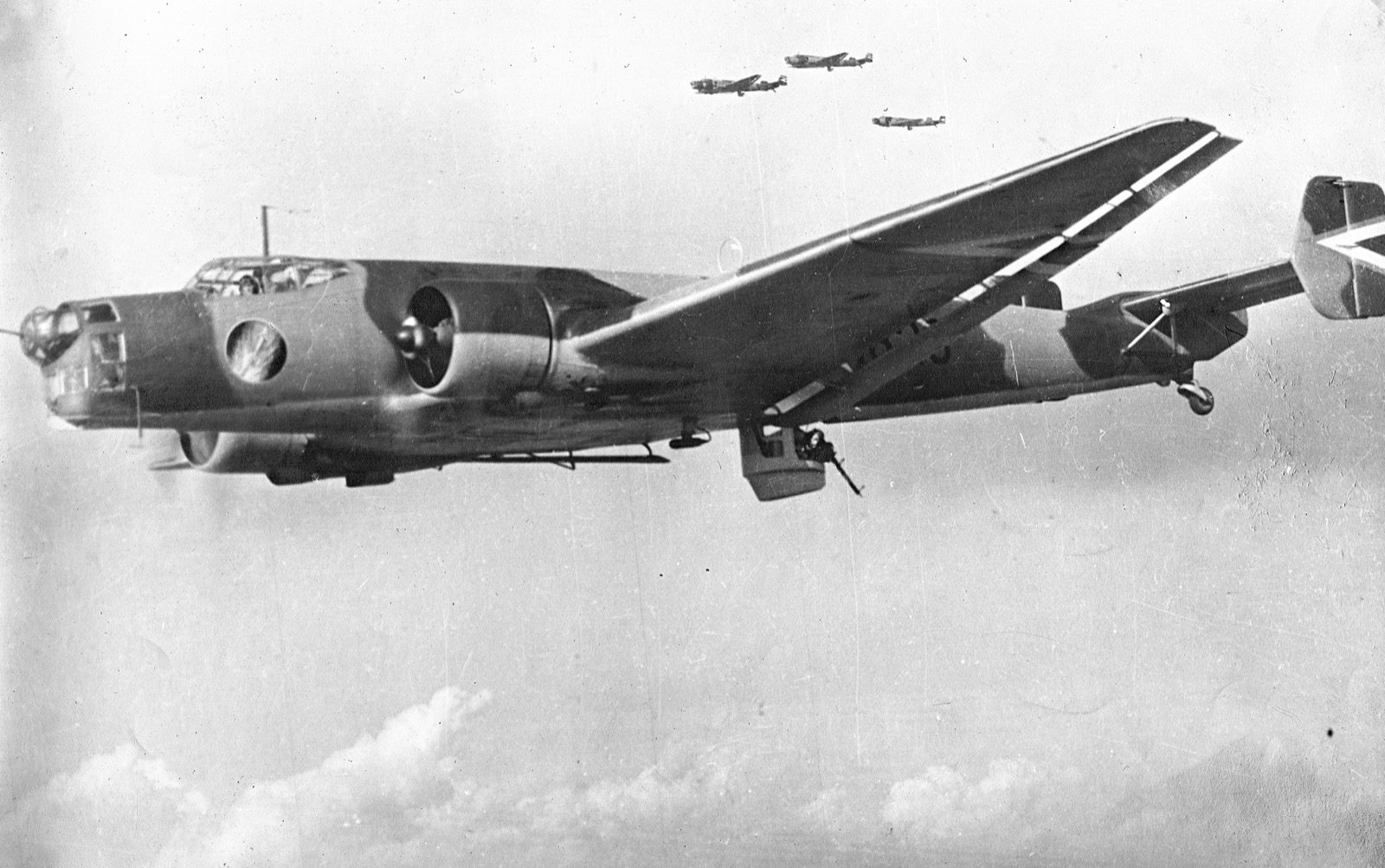
Why didn't anyone just build diesel-powered fighter planes? A handful of German diesel aircraft did exist — the Junkers Ju 86 and several flying boats among them — valued specifically because a diesel engine's greater range per unit of weight suited long-distance maritime patrol aircraft. But for fighters, weight and compactness mattered more than outright fuel range, and a gasoline engine of equivalent power was simply lighter and smaller than a diesel equivalent, which is why fighter aircraft on both sides overwhelmingly stuck with gasoline throughout the war.
The Junkers Ju 86 — one of a handful of German diesel-powered aircraft, valued for long-range maritime patrol rather than fighter duty.
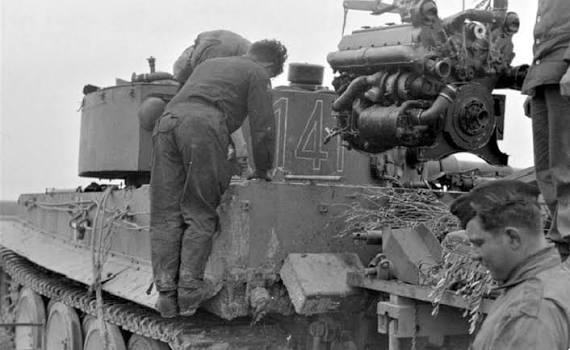
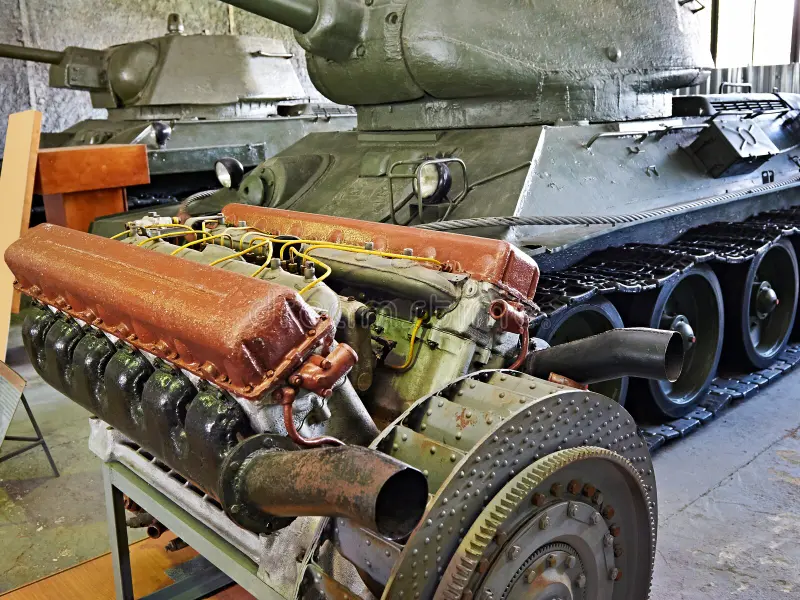
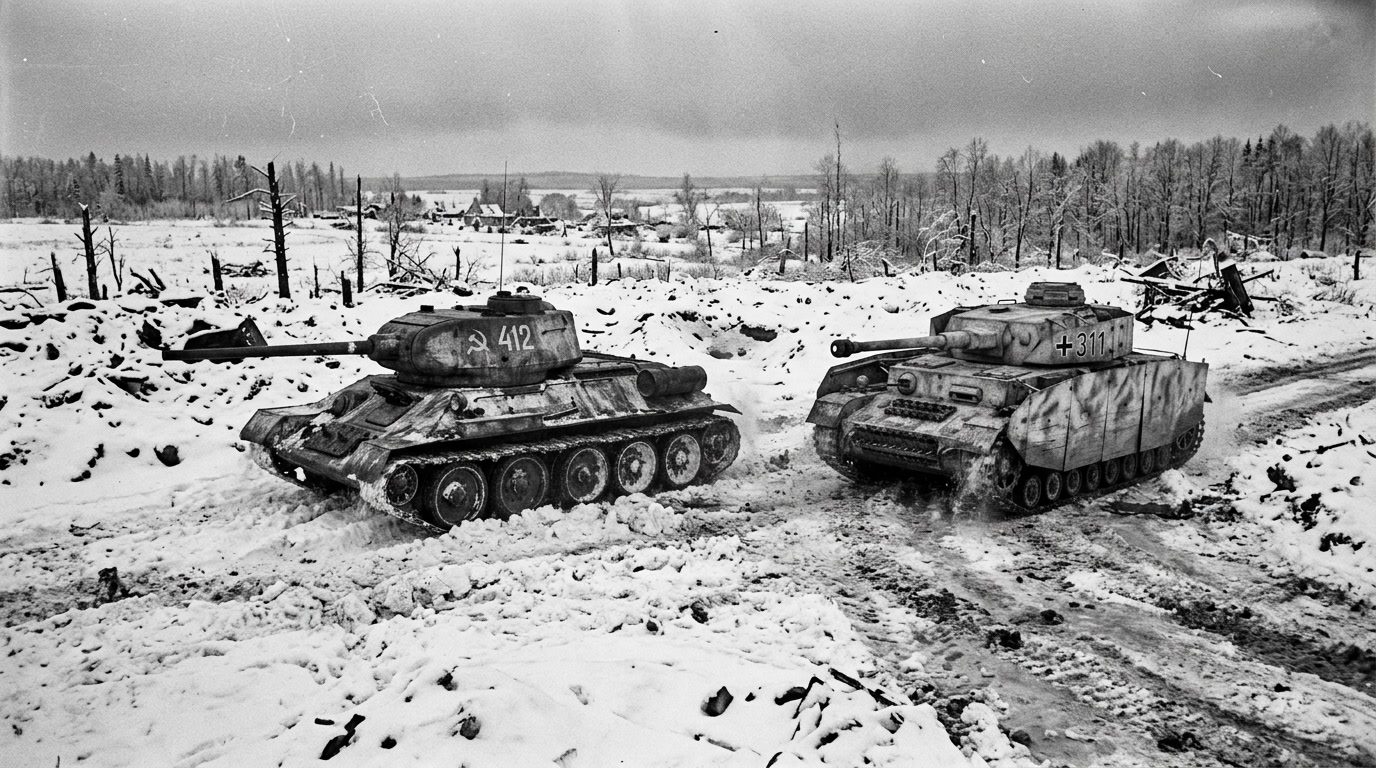
Germany's tanks tell perhaps the most consequential fuel story of the entire war — though the full picture is more nuanced than the popular version. German Panzers ran on gasoline, while the Soviet Union's legendary T-34 — arguably the finest all-around tank of the war — ran a V-12 diesel engine. When temperatures plunged during Operation Barbarossa, German gasoline-powered tanks reportedly grew so cold overnight that they could freeze solid to the ground, unable to move or fire until painstakingly thawed out, while diesel engines could be kept idling far longer without burning through nearly as much fuel, letting Soviet crews keep engines warm simply by leaving them running. The Soviets also blended kerosene into their diesel fuel in the coldest conditions — sometimes up to 70% kerosene — specifically to stop it gelling and clogging fuel lines.
A German Panzer engine — gasoline-powered, and reportedly prone to freezing solid overnight during Operation Barbarossa's coldest spells.
The Soviet T-34's V-12 diesel engine — it could be kept idling through the cold without burning through nearly as much fuel as a gasoline equivalent.
A T-34 and a Panzer IV in winter conditions — the fuel each ran on was a real factor in the Eastern Front's brutal winters, though not the only one.
That said, military historians increasingly caution against treating fuel type as the decisive factor here. The more fundamental German problem on the Eastern Front, by most serious accounts, wasn't really which fuel their tanks used at all — it was the catastrophic failure of German logistics to deliver enough fuel of any kind that far into Soviet territory, over supply lines stretched to breaking point across an unforgiving winter. The diesel-versus-gasoline freezing problem was real and well documented, but it compounded an already desperate supply situation rather than single-handedly causing German tanks' winter struggles.
The first company to put a diesel engine in a road car
Diesel engines had already conquered ships, submarines, and factories decades before anyone seriously tried putting one in a passenger car — the sheer weight and bulk needed to survive diesel's punishing compression pressures made it a poor fit for anything designed to carry people rather than freight.
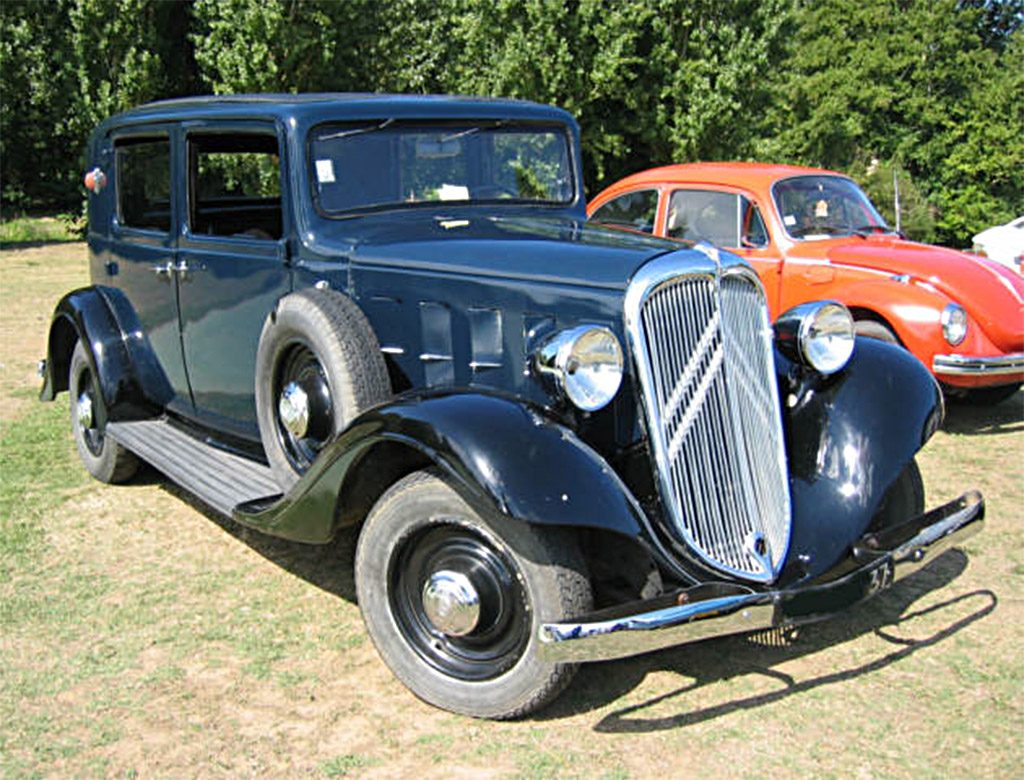
The first company to genuinely crack the problem was the French automaker Citroën, which from the 1933 model year offered a 1,766cc diesel engine — the 11UD — as a genuine factory option on the Familiale estate version of its Rosalie model, making it, by most historians' reckoning, the world's first commercially available diesel passenger car. It sold in only modest numbers and never became a defining part of the Rosalie's identity, but it predates Mercedes' far more famous 260D by three full years.
The Citroën Rosalie — its 1933 11UD diesel option makes it, by most historians' reckoning, the world's first commercially available diesel passenger car.
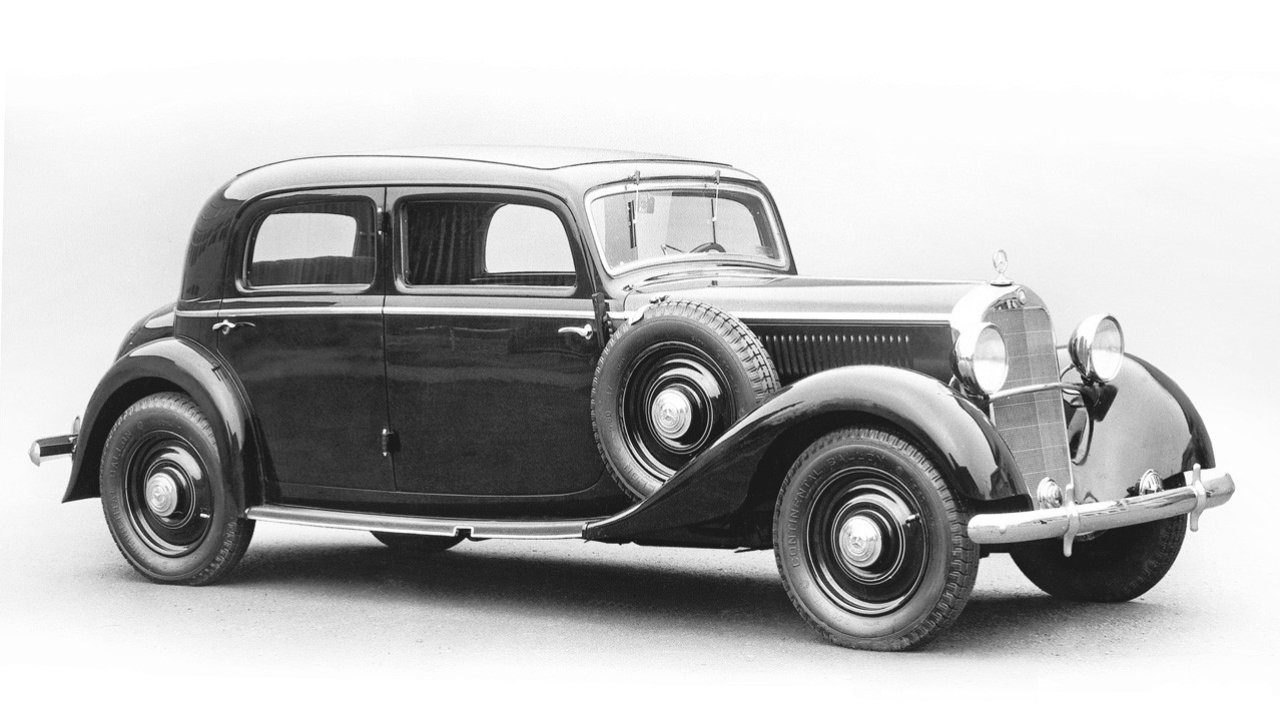
The company that actually took diesel to market at real scale was Mercedes-Benz, following the 1926 merger that created Daimler-Benz AG, which had already been developing six-cylinder diesel engines for heavy trucks. Nearly a decade of further testing led to the 1936 Mercedes-Benz 260D — the world's first diesel passenger car built and sold at genuine production scale. Unveiled at the International Motorcycle and Automobile Exhibition in Berlin in February 1936, its 2.6-litre four-cylinder engine produced a modest 45 horsepower, but its real selling point was economy: it consumed roughly 9 litres of diesel per 100km against the petrol-powered equivalent Mercedes model's 13 litres, and diesel fuel itself cost less than half the price of petrol for licensed drivers at the time. Between 1936 and 1940, Mercedes built almost 2,000 examples, and the 260D became a favourite among taxi operators worldwide specifically because of its exceptional range and running costs — some were reportedly still working the streets as taxis well into the 1950s.
The Mercedes-Benz 260D, 1936 — the world's first diesel passenger car built and sold at genuine production scale.
The first major automotive diesel innovations, in order
1936 — Mercedes-Benz 260D: the first genuinely mass-produced diesel passenger car.
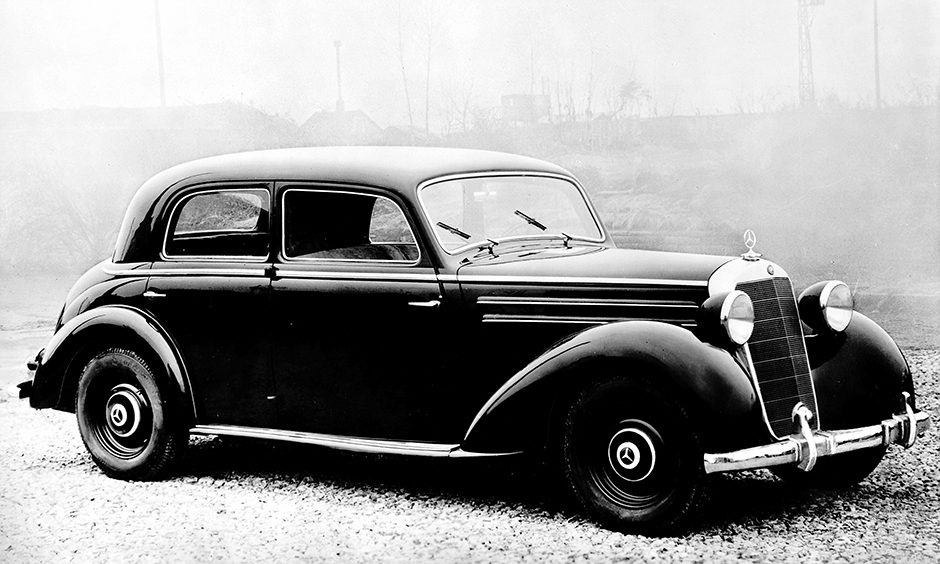
1949 — Mercedes-Benz brings diesel power to the American market with the 170D.
The Mercedes-Benz 170D, 1949 — the car that brought diesel power to the American market.
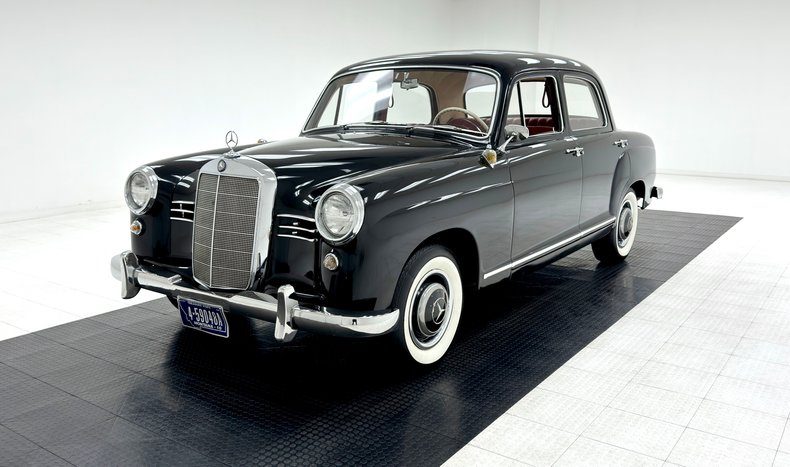
1954 — The 180D introduces Mercedes's groundbreaking unibody “Ponton” design to a diesel car.
The Mercedes-Benz 180D, 1954 — the first diesel car with Mercedes's groundbreaking unibody “Ponton” design.
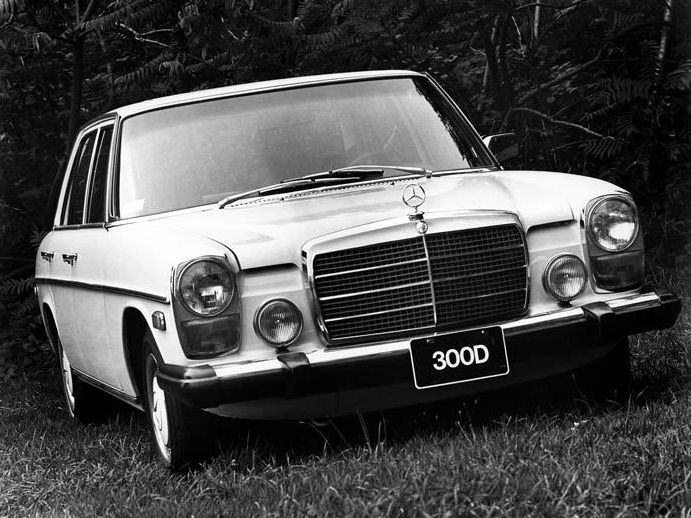
1975 — Mercedes introduces the world's first five-cylinder diesel engine in the 300D, launched directly in response to the 1973 oil crisis and the sudden global scramble for better fuel economy, followed in 1977 by the four-cylinder 240D.
The Mercedes-Benz 300D, 1975 — the world's first five-cylinder diesel engine, launched in direct response to the 1973 oil crisis.
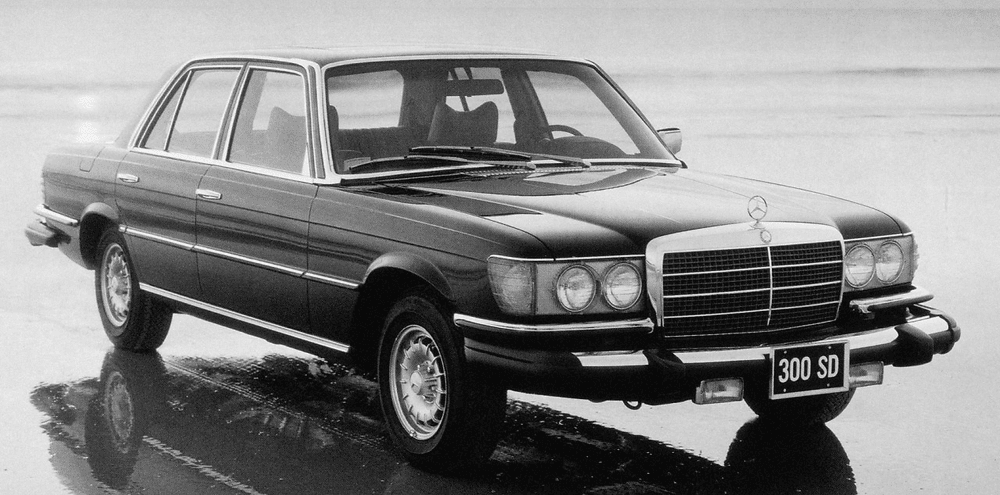
1978 — Mercedes launches two groundbreaking US-specific diesels in the same year: the world's first diesel-powered coupé, the 300CD, and the first-ever diesel S-Class, the 300SD — which also introduces turbocharging to a diesel passenger car for the first time anywhere, developed in close cooperation with American turbo specialists Garrett.
The Mercedes-Benz 300SD, 1978 — the first-ever diesel S-Class, and the first turbocharged diesel passenger car anywhere.
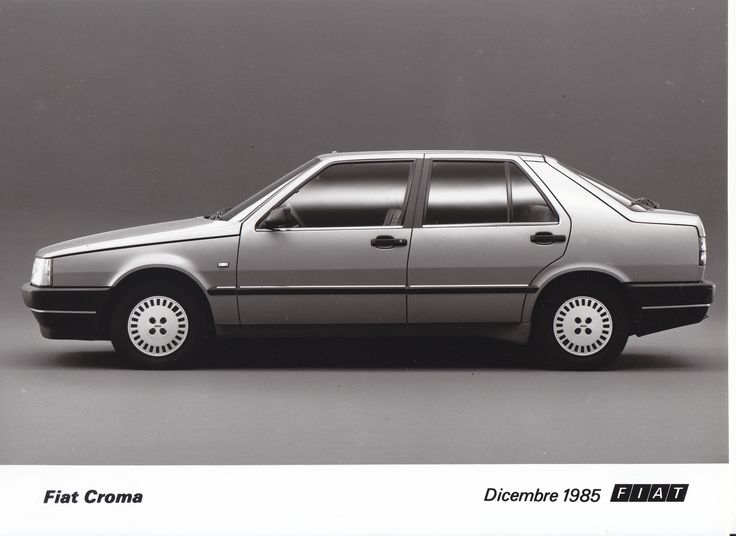
1986 — Fiat launches the Croma TDI, the first direct-injection passenger car diesel, laying the groundwork for the common rail breakthrough still over a decade away.
The Fiat Croma TDI, 1986 — the first direct-injection passenger car diesel, laying the groundwork for common rail a decade later.
1997 — The Alfa Romeo 156 1.9 JTD becomes the world's first mass-production passenger car with common rail diesel injection, followed within weeks by the Mercedes-Benz C 220 CDI.
2008 — Audi launches the Q7 V12 TDI, a road-legal SUV with a genuine Le Mans-derived twin-turbo diesel V12, sold in extremely limited numbers.
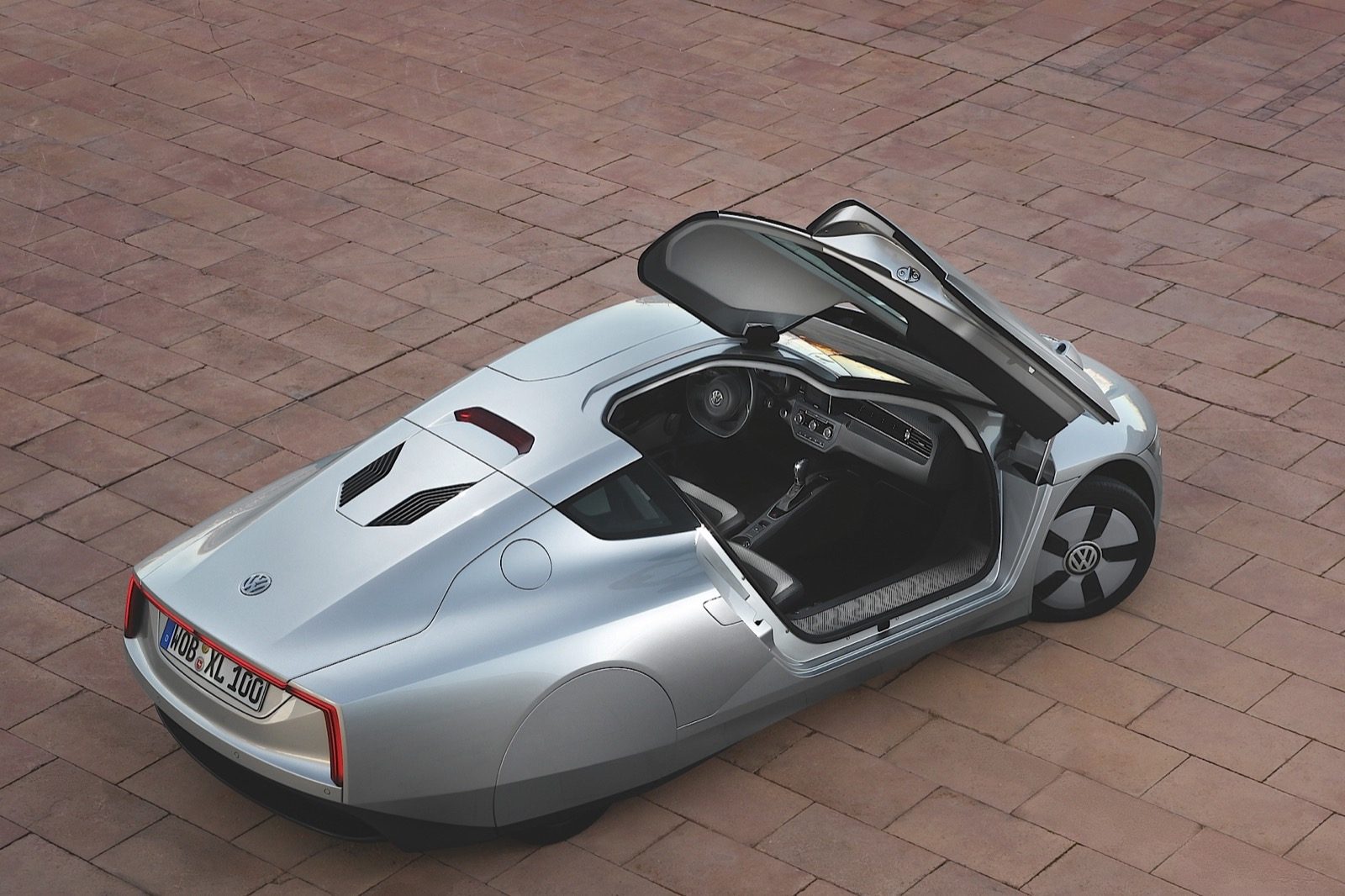
2013 — Volkswagen's XL1 becomes the most fuel-efficient production car ever built, using a two-cylinder diesel-electric hybrid powertrain.
2016-2017 — Audi and Bentley launch, respectively, the SQ7 TDI and Bentayga Diesel, sharing a 4.0-litre triple-charged V8 that delivers a record-setting 664 lb-ft of torque from just 1,000rpm using a 48-volt electric supercharger stacked ahead of two conventional turbochargers.
The most efficient, and the most powerful, diesel cars ever built
The most fuel-efficient production car in automotive history is a diesel — the Volkswagen XL1, a two-seat plug-in hybrid launched in 2013 that paired a tiny 800cc two-cylinder diesel engine with a 27-horsepower electric motor. Officially rated at 261mpg on the European combined cycle, with some reviewers recording figures as high as 313mpg in ideal conditions, the XL1 could travel over 500 miles on just 2.6 gallons of fuel. Its record-setting economy came from an obsessive, almost extreme approach to weight and drag — a carbon-fibre monocoque bringing total weight down to just 1,753 pounds, a drag coefficient of 0.186 (rivalling dedicated electric concept cars), butterfly doors, camera-based wing mirrors instead of glass ones, and asymmetrically offset seating to keep the cabin as narrow as possible. Only 250 were ever built, each one effectively hand-assembled at Volkswagen's Osnabrück plant, and the project was quietly wound down not long after the 2015 Dieselgate scandal made further diesel R&D politically toxic for the brand.
The Volkswagen XL1 — the most fuel-efficient production car ever built, officially rated at 261mpg.
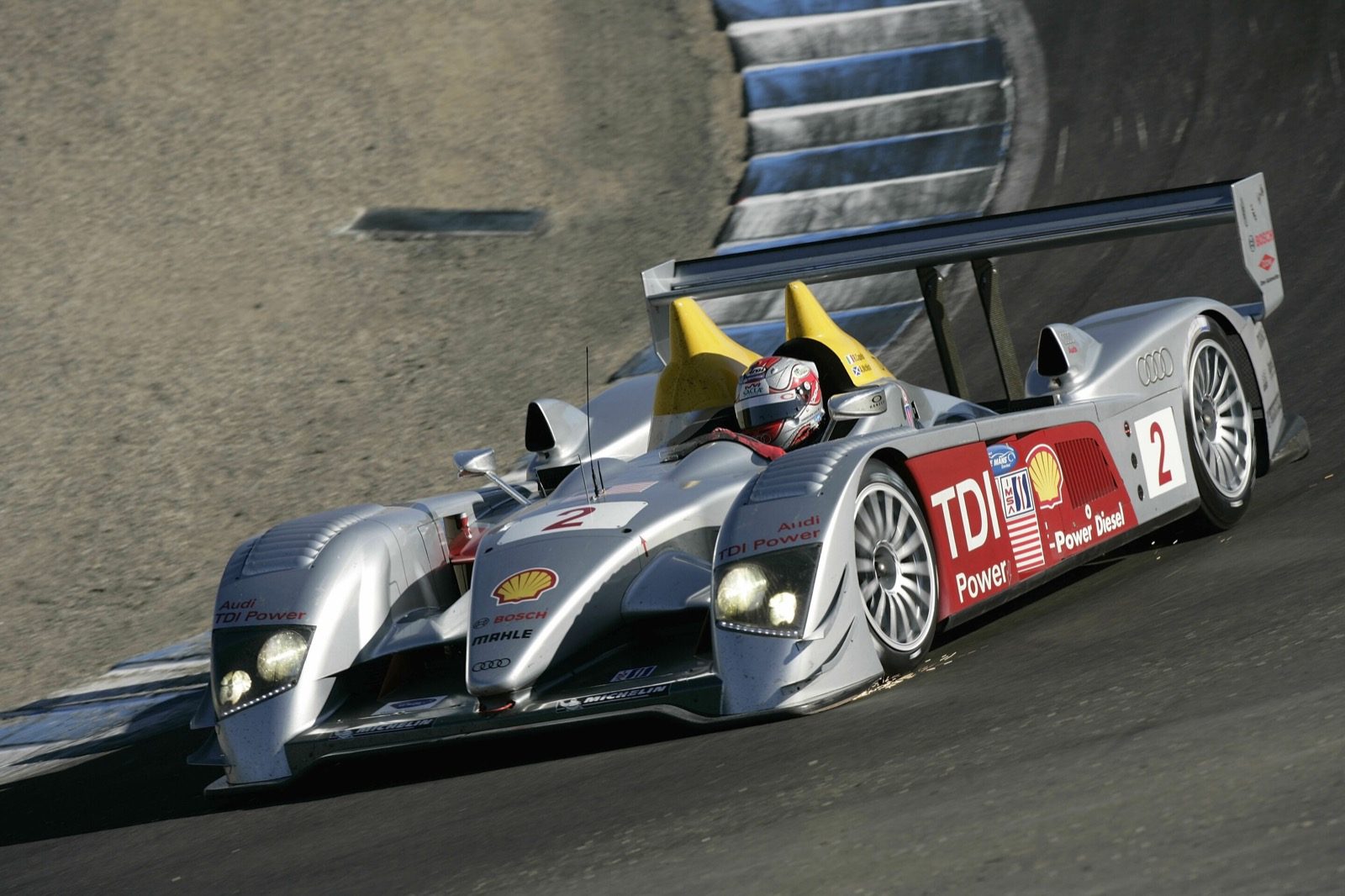
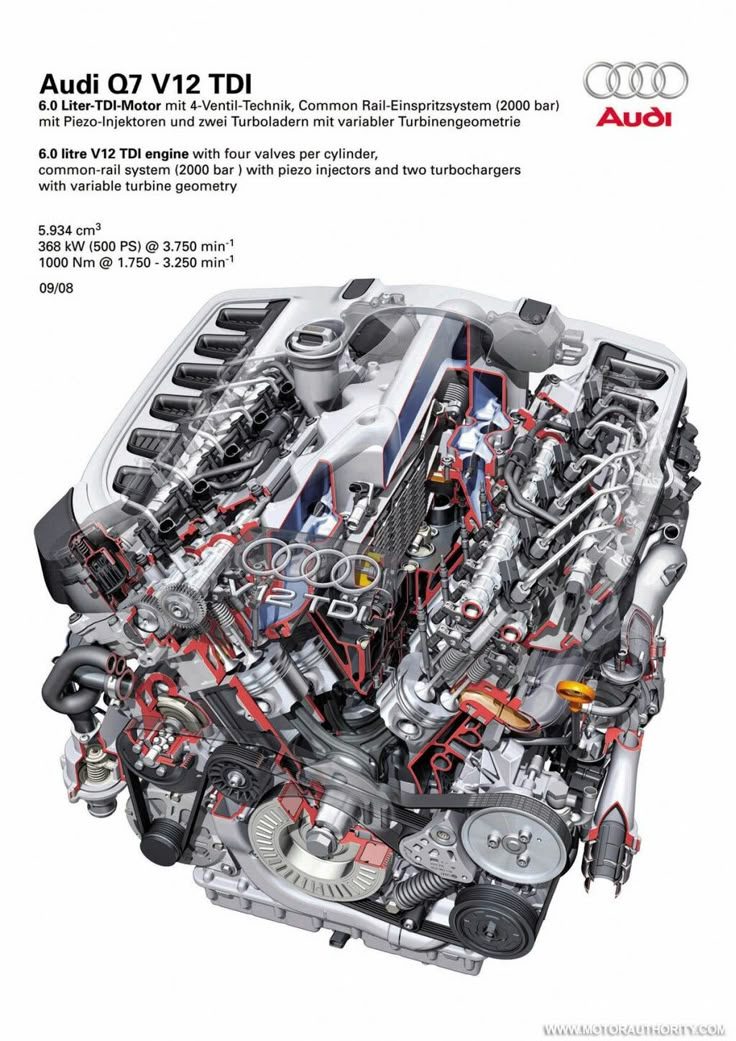
The most powerful production diesel car engine ever built, measured by pure horsepower, is the Audi Q7 V12 TDI, produced only between 2008 and 2012. Its twin-turbocharged 6.0-litre V12 developed 500 horsepower and 737 lb-ft of torque, and remains, to this day, the only diesel V12 engine ever fitted to a production passenger car. It was built directly off the back of Audi's diesel-powered R10 TDI, which had been winning Le Mans outright at the time, and only around 50 examples were ever produced — making it one of the rarest engines ever offered in a road car of any fuel type, alongside genuine exotica like the McLaren F1's V12.
The Audi R10 TDI — the Le Mans-winning race car whose diesel V12 technology went on to power the road-going Q7 V12 TDI.
The Audi Q7 V12 TDI's engine — the only diesel V12 ever fitted to a production passenger car. / The Audi Q7 V12 TDI, 2008-2012 — only around 50 examples were ever produced.
By torque, the record belongs to a different pairing entirely — the Audi SQ7/SQ8 TDI and the Bentley Bentayga Diesel, both sharing a 4.0-litre triple-charged V8 that delivers 664 lb-ft from just 1,000rpm, using two conventional turbochargers plus a genuinely novel third component: a 48-volt electrically driven supercharger that spins up instantly, long before exhaust gas is available to drive a conventional turbo, effectively eliminating the lag diesel engines have always struggled with at low revs. In the Bentley application it develops the exact same peak torque as the brand's own 6.0-litre W12 petrol engine — an extraordinary result from an engine roughly a third smaller.
Where diesel actually ended up powering the world
Diesel's engine found its calling almost everywhere except where he might first have expected. Its earliest use, in the years right after 1897, was as a stationary replacement for factory steam engines — exactly the role Diesel had originally designed it for. But it was at sea and underground that the engine truly proved itself.
By the end of the First World War, double-acting piston two-stroke marine diesel engines producing up to 12,200 horsepower had been built for naval use, and Germany's submarine fleet relied on diesel power throughout that conflict too — a strategic advantage serious enough that some historians have speculated Diesel's mysterious 1913 disappearance may have been connected to fears over what he might reveal to British naval intelligence about submarine propulsion, though this, like every other theory about his death, remains unproven.
Diesel-electric locomotives, in which the diesel engine drives a generator that powers separate electric traction motors rather than turning the wheels directly, eventually replaced steam on almost every non-electrified railway on Earth. Trucking adopted diesel more gradually — but once it did, in the mid-20th century, it became the undisputed backbone of global freight transport, prized for exactly the low-end torque and fuel efficiency that make hauling heavy loads over long distances economically viable. Agriculture, construction, mining, and backup power generation for hospitals and remote facilities all followed the same logic.
The records: biggest, most powerful, and most economical
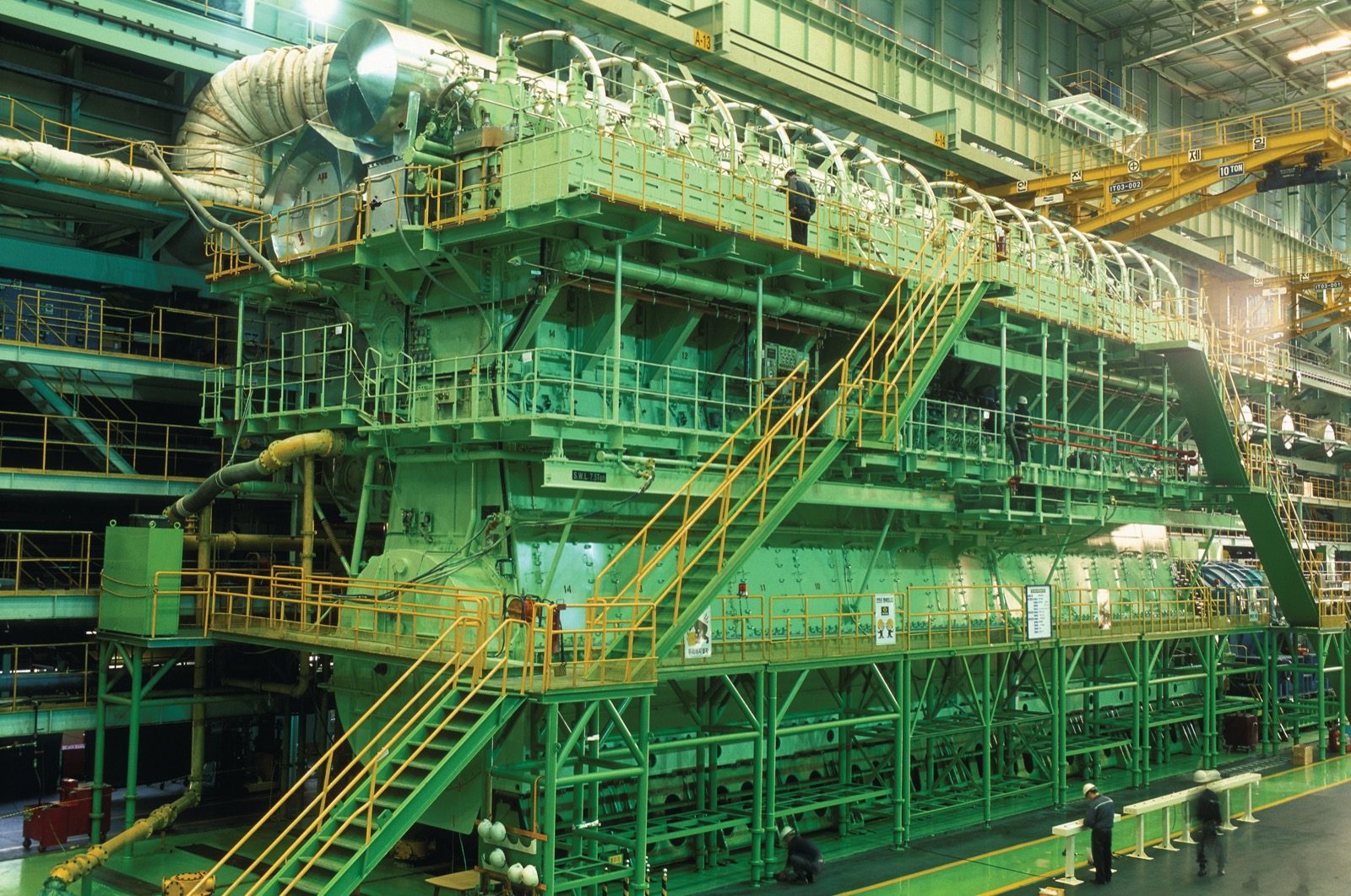
The largest and most powerful diesel engine ever built is commonly cited as the Wärtsilä RT-flex96C, a Finnish-designed, two-stroke marine engine with 14 cylinders that produces roughly 109,000 horsepower — enough to power the Emma Mærsk, a container ship capable of carrying 11,000 shipping containers at 31 knots, considerably faster than most comparable vessels manage at 20 knots. Each cylinder consumes 6.5 ounces of fuel per single combustion cycle, and the engine is widely reported to be highly efficient and among the cleanest of its kind for its size, thanks to common-rail fuel injection and selective catalytic reduction systems said to cut nitrogen oxide emissions by up to 95%. It's worth noting this specific figure circulates widely across general-interest sources rather than being something independently confirmed here against a dedicated marine engineering authority — but the RT-flex96C's status as the largest reciprocating engine of any kind currently in production is not seriously disputed.
The Wärtsilä RT-flex96C — the largest reciprocating engine of any kind currently in production, producing roughly 109,000 horsepower.
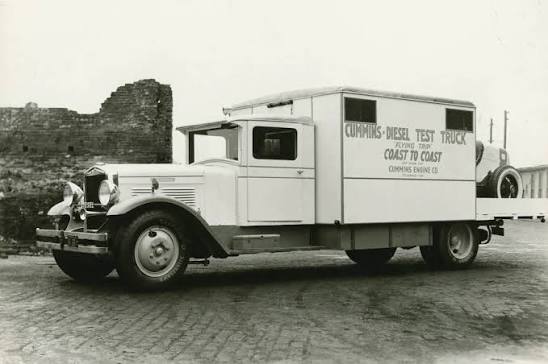
The most economically dramatic early proof of diesel's efficiency came in 1932, when Clessie Cummins installed one of his engines in a Mack bus and drove it across the United States — 5,181 kilometres in 78 hours and 10 minutes, faster than any train covering the same route at the time, for a total fuel cost of just $21.80. The following year, an Indiana truck completed the New York-to-Los Angeles run powered exclusively by a Cummins diesel engine, decades before America's interstate highway system even existed.
The Cummins-powered Mack bus that crossed the United States in 1932 — 5,181 kilometres for a total fuel cost of just $21.80.
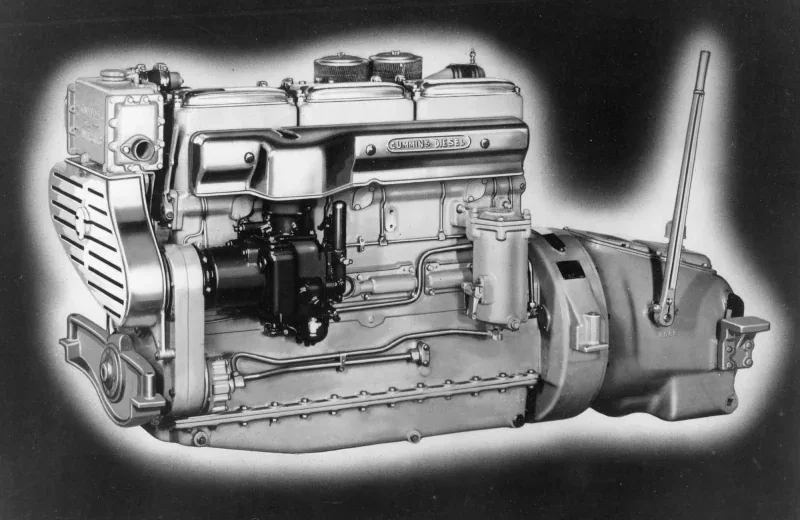
A Cummins diesel engine — the company Clessie Cummins founded in 1919 became one of the world's dominant diesel manufacturers.
The smallest diesel engines in common use today sit at the opposite extreme entirely — compact single-cylinder units producing as little as 10 to 12 horsepower, widely used to power small agricultural equipment; in parts of rural China, locally built 12-horsepower single-cylinder diesel engines, mounted on simple wheelbarrow-like frames, have genuinely revolutionised farming by replacing draft animals outright.
Where diesel stands today
Diesel's engine still powers the overwhelming majority of the world's shipping, freight trucking, heavy construction equipment, and railway locomotives that haven't yet been electrified — precisely the applications where its torque and efficiency advantages remain hardest to replace. Its role in ordinary passenger cars, however, has contracted sharply over the past decade, driven by tightening emissions regulations and the fallout from various manufacturer emissions scandals, particularly across Europe and North America, where diesel passenger cars were once genuinely mainstream. Even the high-performance diesel niche has narrowed: Audi replaced its 4.0 V8 TDI with a petrol V8 in both the SQ7 and SQ8, a change one outlet bluntly described as “the death of the Volkswagen Group's V8 diesel engine.”
More than 125 years after that first successful run on peanut oil in Augsburg, the fundamental principle Rudolf Diesel patented — igniting fuel purely through the heat of compressed air, no spark required — remains essentially unchanged in every diesel engine built today, from the smallest single-cylinder farm generator to the largest engines driving container ships across the Pacific.
A death nobody has ever fully explained
Diesel's own story ends far less tidily than his engine's. Despite his invention's runaway commercial success, his personal finances collapsed — widely attributed to poor stock market speculation and bad property investments — and as other companies took his expiring patents and developed the engine further, often without him, Diesel grew increasingly sidelined and struggled to work constructively with the engineers now shaping his own invention's future. He suffered what's described as a nervous breakdown under the combined pressure of his finances and mounting public criticism of his role in his own creation.
On the evening of 29 September 1913, Diesel boarded the steamship SS Dresden in Antwerp, bound for a business meeting in London. He had dinner on board, retired to his cabin around 10pm, and left instructions to be woken the next morning. He was never seen alive again. Ten days later, a sailor aboard a different North Sea steamer spotted a body floating in the water; it was identified as Diesel's.
His death was officially ruled a suicide, consistent with the financial pressure he was under. But the theory has never entirely settled the matter — persistent alternative theories point to coal industrialists, threatened by an engine that made their fuel of choice increasingly obsolete, or to oil cartels, or even to foreign agents anxious to stop Diesel sharing submarine propulsion secrets with British naval intelligence. None of these theories has ever been substantiated. Strangest of all, in March 1914, several months after his body had already been recovered and identified, a Munich newspaper and the New York Times both ran reports suggesting Diesel might actually still be alive, quietly living in Canada — a rumour that went nowhere, and that nobody has ever definitively laid to rest.
The bottom line
Rudolf Diesel set out to stop the world from wasting fuel, and by almost any measure imaginable, he succeeded far beyond what he could have predicted from a peanut-oil-powered prototype in a German workshop in 1897. His engine now moves the vast majority of the world's freight, powers ships the size of small towns, helped Soviet tanks keep running through a winter that badly hampered German equipment, and still runs on the exact same principle he patented — compression, not spark — more than a century after he vanished from the deck of a ship in the English Channel, in circumstances nobody has ever fully explained. Every refinement since, from Büchi's 1905 turbocharger to the Alfa Romeo 156's 1997 common rail breakthrough to the AdBlue system quietly doing its job in a modern car's exhaust, has been in service of the same basic idea he started with: waste less, do more.
Whatever's under your bonnet today — diesel, petrol, or something else entirely — autOracle can help you understand exactly what it needs and what to check before your next MOT.
Know your engine before you buy it.
Diesel, petrol, or something else entirely, autOracle reads your car's diagnostics and explains exactly what's going on under the bonnet.
Join autOracle waitlistSources
- demotor.net, “Inventor of the diesel engine: Rudolf Diesel” — demotor.net
- Study.com, “Rudolf Diesel | Biography, Invention & Death” — study.com
- HISTORY.com, “Inventor Rudolf Diesel mysteriously vanishes” — history.com
- Lemelson-MIT, “Rudolf Diesel” — lemelson.mit.edu
- DieselNet, “Early History of the Diesel Engine,” “What is Diesel Fuel” — dieselnet.com
- This Day In Automotive History, “Inventor of the Diesel engine mysteriously disappears from ship” — automotivehistory.org
- ScienceDirect Topics, “Rudolf Diesel — an overview” — sciencedirect.com
- Wikipedia, “Rudolf Diesel,” “Diesel engine,” “Carl Benz,” “Benz Patent-Motorwagen,” “Alfred Büchi,” “Clessie Cummins,” “Diesel fuel,” “Common rail,” “Fiat JTD engine,” “Frederick Lamplough,” “Unit injector,” “Daimler-Benz DB 602,” “Aircraft diesel engine” — en.wikipedia.org
- AOCS, “Historical Perspectives on Vegetable Oil-Based Diesel Fuels” — aocs.org
- ScienceDirect, “History of Vegetable Oil-Based Diesel Fuels” — sciencedirect.com
- Life Cycle Renewables, “From Plants to Power: The History of Vegetable Oil as Fuel” — lifecyclerenewables.com
- Cummins Inc., “History of diesel engines” and “Clessie in retirement” — cummins.com
- ZME Science, “This is what 109,000 horsepower looks like” — zmescience.com
- Highway and Heavy Parts, “The History of the Diesel Engine: How Rudolf Diesel Changed the World” — highwayandheavyparts.com
- Mitsubishi Heavy Industries / VST Diesel Engines, “History of Diesel Engines: Powering the Industrial Revolution” — mhi.com
- Mansfield Service Partners, “A Brief History of Marine Diesel Applications - Part 1” — msp.energy
- EBSCO Research Starters, “Diesel Engine | History,” “Otto's Practical Internal Combustion Engine” — ebsco.com
- Britannica Kids, “diesel engine”; Britannica, “Nikolaus Otto” — britannica.com
- Dieselduck, “The Diesel engine and its development: A historical timeline,” “History of Fuel Injection” — dieselduck.info
- Shortform, “The History of the Diesel Engine: From Idea to Impact” — shortform.com
- Heacock Classic, “1886 Benz Patent Motorwagen – Birth of the Motorcar” — heacockclassic.com
- New World Encyclopedia, “Karl Benz” — newworldencyclopedia.org
- Mercedes-Benz Group, “Benz Patent Motor Car” — group.mercedes-benz.com
- Quora, “T34s run on diesel. How the heck did the Soviets stop their fuel freezing?” — quora.com
- Warfare History Network, “The Red Army's T-34 Tank” and “The T-34 Tank: The Story of Soviet Russia's Rugged Armored Vehicle” — warfarehistorynetwork.com
- Axis History Forum, “How did german equipment do in the russian winter?” — forum.axishistory.com
- Armchair General, “How Did Soviets Keep T-34 Diesels From Freezing?” — forums.armchairgeneral.com
- War History Online, “Why the German Army Refused to Use the ‘Superior’ Captured T-34” — warhistoryonline.com
- MilitaryHistoryNow.com, “High-Octane Victory” — militaryhistorynow.com
- WW2Aircraft.net Forums, “Why Luftwaffe and Kreigsmarine diesels but petrol Wehrmacht?” and “Why was Luftwaffe fuel Octane so low?” — ww2aircraft.net
- Legion Magazine, “Gassed up: The juice that fuelled victory in the Battle of Britain” — legionmagazine.com
- SOFREP, “How High-Octane Gasoline Saved Untold Allied Pilots” — sofrep.com
- Thunder Said Energy, “Oil and War: ten conclusions from WWII?” — thundersaidenergy.com
- Autodana.eu, “1936. Mercedes-Benz 260D” — autodana.eu
- SlashGear, “6 Of The Most Powerful Mercedes Diesel Engines Ever Built” and “How Is Diesel Fuel Made?” — slashgear.com
- eMercedesBenz, “Mercedes-Benz History: Diesel Passenger Car Premiered 75 Years Ago” — emercedesbenz.com
- Mercedes-Benz Media, “Leading the way with diesel” — media.mbusa.com
- Mercedes-Benz Group, “OM 656 - Most powerful diesel car in Mercedes-Benz history” — group.mercedes-benz.com
- HotCars, “Mercedes Built The World's First Turbo Diesel Passenger Car” — hotcars.com
- Curbside Classic, “Vintage R&T Review: 1978 Mercedes 300SD” and “CC Capsule: 1978 Mercedes-Benz 300 SD Turbodiesel” — curbsideclassic.com
- DieselArmy, “Nothing Is More 1980s Than A Diesel Mercedes-Benz” — dieselarmy.com
- conceptcarz, “1979 Mercedes-Benz 300 SD” — conceptcarz.com
- Jalopnik, “This Was The First Car Ever Powered By A Diesel Engine” and “This Is How Diesel Fuel Is Made” — jalopnik.com
- JOE.ie, “Mercedes-Benz 260 D” — joe.ie
- VW of Akron, “Volkswagen's Most Efficient Car Ever!” — vwofakron.com
- Volkswagen Newsroom, “The Volkswagen XL1 hits the streets of New York” — media.vw.com
- CarBuzz, “The Volkswagen Coupe That Achieved 313 MPG” — carbuzz.com
- Car Talk, “Driving VW's Astonishing 200 MPG XL1” — cartalk.com
- Wikipedia, “Volkswagen 1-litre car” — en.wikipedia.org
- TurboCarParts.co.uk, “History of the turbocharger (turbine)” — turbocarparts.co.uk
- Getradingeg, “The History of Turbocharging: From 1905 to Today” — getradingeg.com
- FastestLaps.com, “Alfred Buchi Inventor of the ‘Exhaust-Driven’ Turbo” — fastestlaps.com
- Accelleron, “100 Years of Industrial Turbocharging” — accelleron.com
- Engineer Fix, “Who Invented the Turbocharger? The Story of Alfred Büchi” — engineerfix.com
- ABB, “Staying power” — new.abb.com
- Techhistorian, “Who Invented the Turbocharger?” — techhistorian.com
- IMarEST, “The innovations behind the turbocharged diesel engine” — imarest.org
- Industrial Engines UK, “How Industrial Engines Help Maximise Engine Efficiency” — industrialenginesuk.com
- Automotive Hall of Fame, “Clessie L. Cummins” — automotivehalloffame.org
- The Truth About Cars, “Clessie Cummins Made Diesels the King of the Road” — thetruthaboutcars.com
- Bostech, “The History of Diesel Engines: Everything You Need to Know” — bostechauto.com
- FundingUniverse, “History of Cummins Engine Company, Inc.” — fundinguniverse.com
- Motor Sport Magazine, “Road test: Audi SQ7 & Bentley Bentayga Diesel” — motorsportmagazine.com
- autoevolution, “Audi SQ7 vs. Bentley Bentayga Diesel Acceleration” — autoevolution.com
- Top Gear, “Bentley Bentayga Diesel review” — topgear.com
- HotCars, “The Highest Torque Ever In A Diesel Car” — hotcars.com
- Yahoo/autos, “4 Diesel Engines More Powerful Than The 6.7 Cummins” — autos.yahoo.com
- Exotic Car List, “Bentley Bentayga Diesel Is World's Fastest Diesel SUV” — exoticcarlist.com
- Carscoops, “Bentley Bentayga To Get Audi SQ7's Trick Diesel Engine” — carscoops.com
- Motor1, “2017 Bentley Bentayga Diesel First Drive” — motor1.com
- Auto Express, “New Bentley Bentayga Diesel 2017 review” — autoexpress.co.uk
- ChemAnalyst, “How Diesel is Made: A Step-by-Step Guide to Its Refining Process” — chemanalyst.com
- Northwest Dieselworks, “How Diesel is Made” — nwdieselworks.com
- oftrb.com, “How Is Diesel Fuel Made from Crude Oil?” — oftrb.com
- Kendrick Oil, “How Is Diesel Fuel Made From Crude Oil?” — kendrickoil.com
- Diesel World, “Diesel Power Takes Flight” and “Flying Diesels” — dieselworldmag.com
- Old Machine Press, “Daimler-Benz DB 602 (LOF-6) V-16 Diesel Airship Engine” — oldmachinepress.com
- Dieselmatic, “From Packard to Technify: The Ups & Downs Of Diesel Engines in Aviation” — dieselmatic.com
- This Day in Aviation, “Daimler-Benz DB 602” — thisdayinaviation.com