
Jul 23, 2026History
Back to blogHistory
Electric Cars Aren't the Future. They're the Past We Forgot.
The autOracle Team
Jul 13, 2026
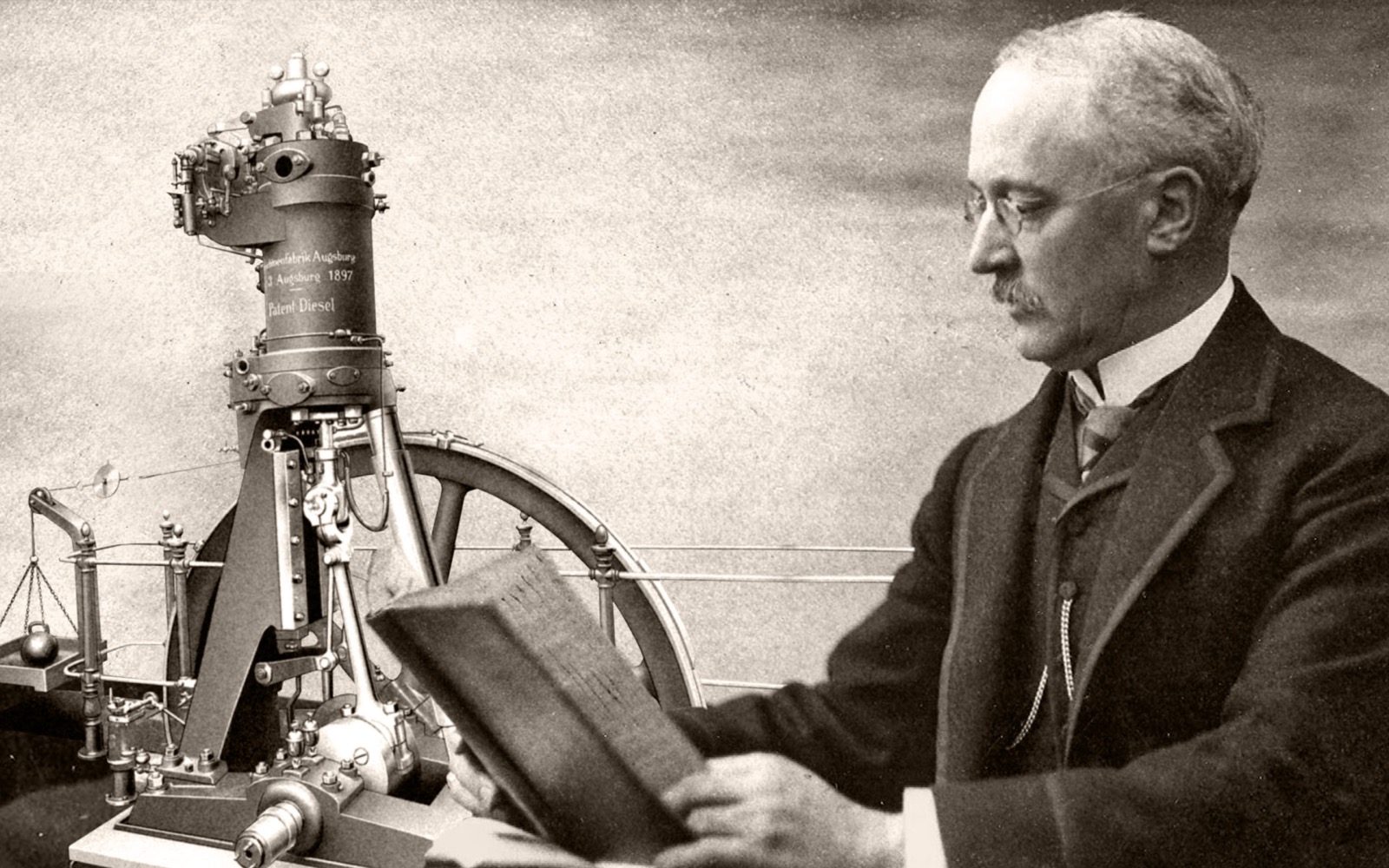
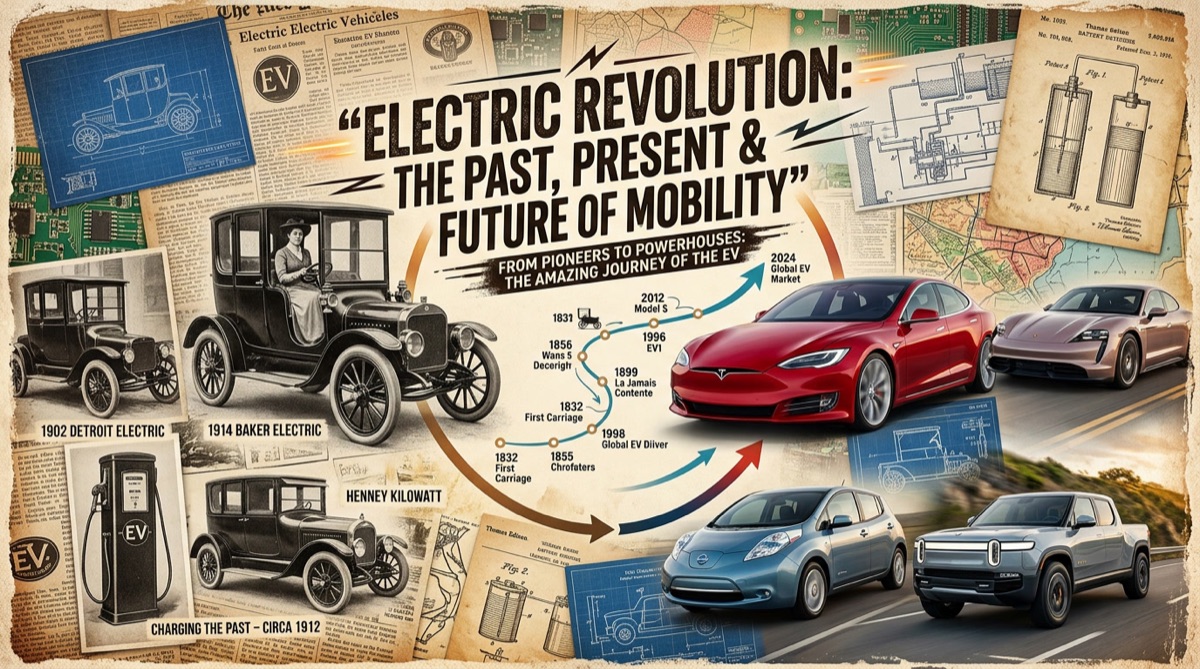
Here's a fact that surprises almost everyone: electric cars are older than gasoline cars. Decades older. Long before Karl Benz filed his 1886 patent, before Rudolf Diesel dreamed up compression ignition, electric vehicles were already on the road, holding land speed records, and outselling everything else in America. The story of the EV isn't really a story about the future. It's a story about something brilliant that got buried for eighty years — and the strange, occasionally ugly circumstances of both its burial and its resurrection.
A Hungarian priest, decades before anyone else
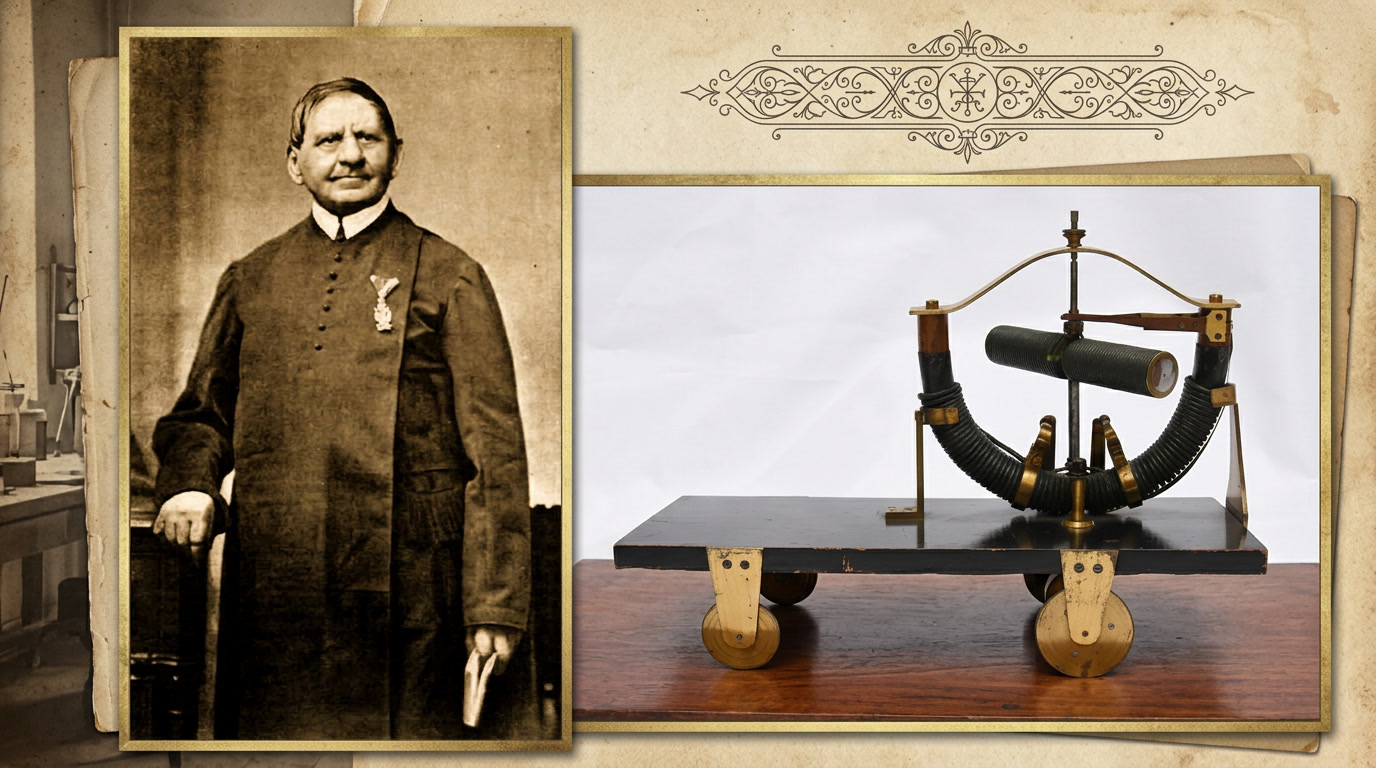
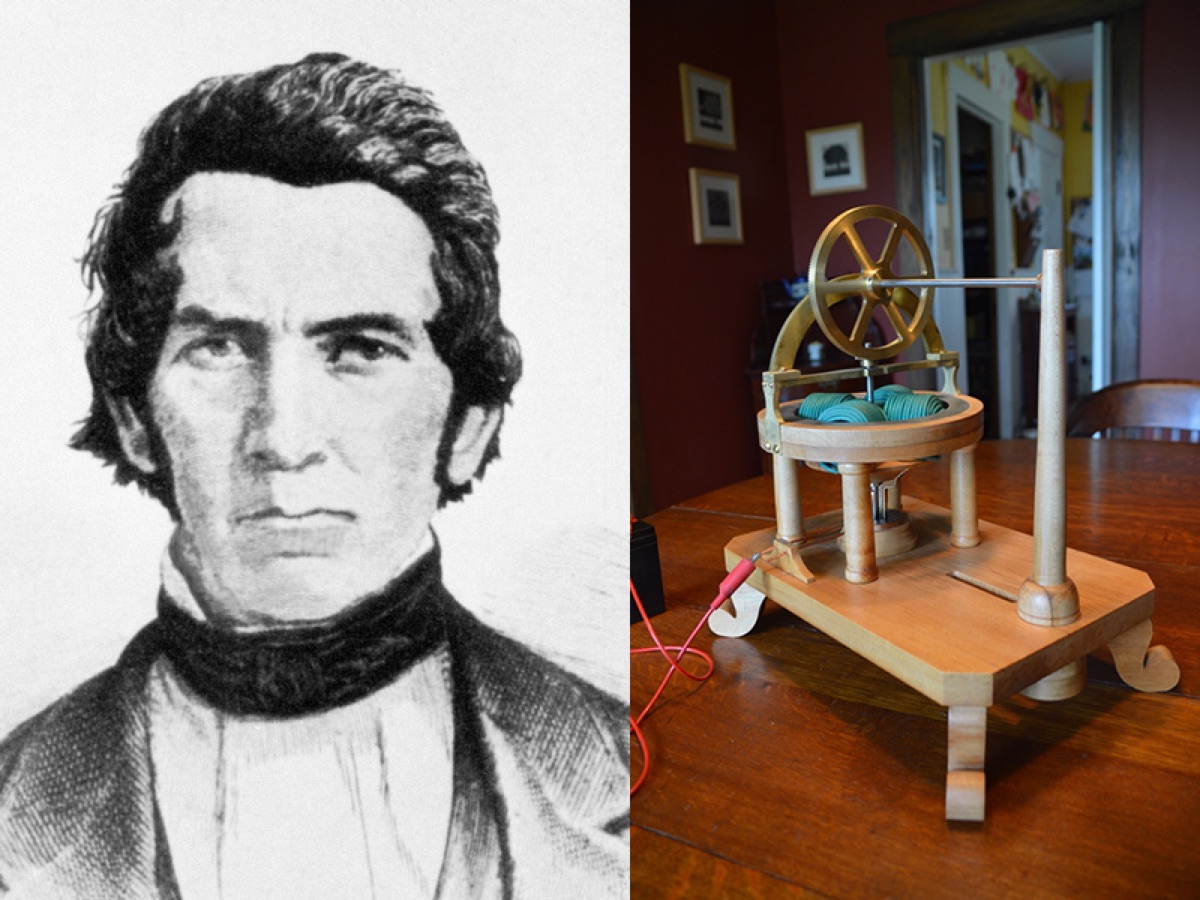
The earliest ancestor of every EV on the road today traces back to 1827, when Hungarian priest and physicist Ányos Jedlik built one of the first working electric motors. The following year, he mounted it on a small wheeled model — arguably the first self-propelled electric vehicle in history, decades before anyone had built a working car of any kind. The prototype and Jedlik's original motor both still survive, on display at the University of Technology and Economics in Budapest.
Ányos Jedlik and his 1828 model — arguably the first self-propelled electric vehicle ever built.
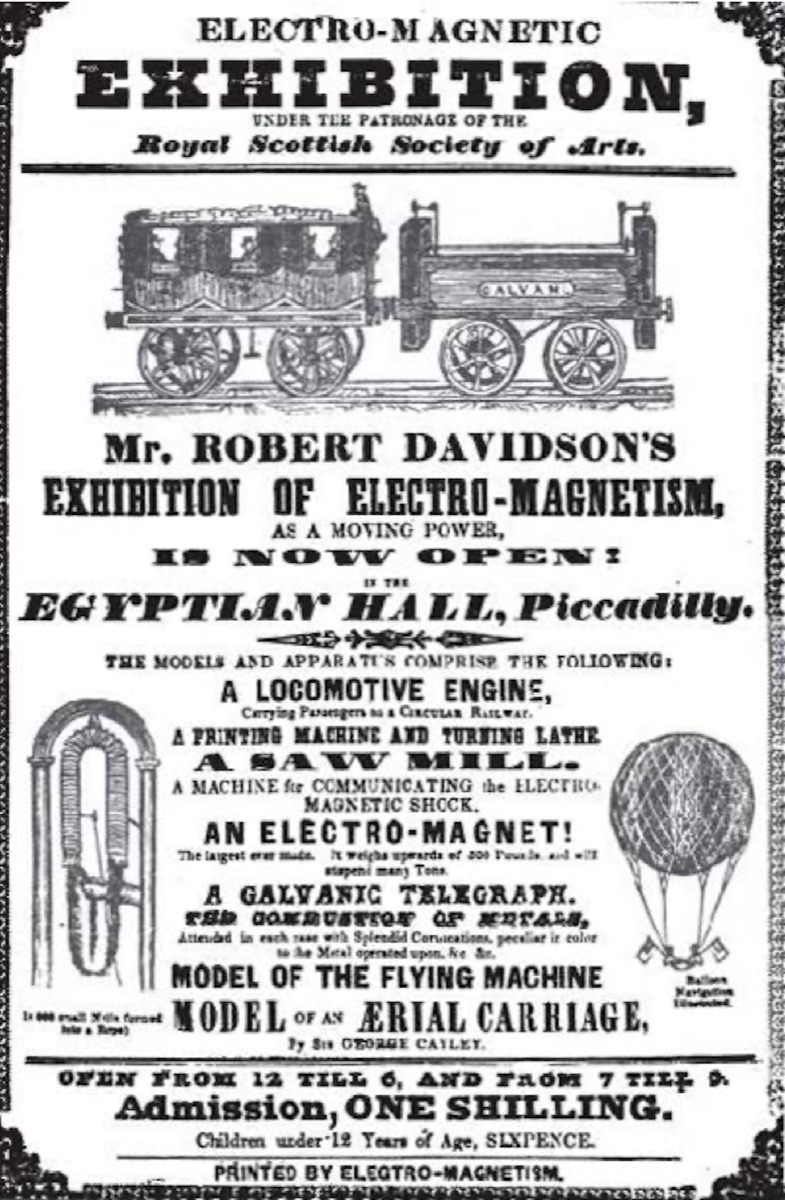
Jedlik wasn't alone for long. Between 1832 and 1839, Scottish inventor Robert Anderson built a crude electric carriage. In 1834, Vermont blacksmith Thomas Davenport built his own small electric vehicle running on a short circular track. And in 1837, Scottish chemist Robert Davidson built what's considered the first electric locomotive, powered by galvanic cells, later exhibiting a larger version named Galvani at the Royal Scottish Society of Arts. None of these machines were remotely practical — Davidson's locomotive needed fresh batteries after every single run, and railway workers reportedly destroyed one of his machines out of fear it would cost them their jobs — but the basic principle was already proven, half a century before the internal combustion engine existed at all.
Thomas Davenport's 1834 electric vehicle, running on a short circular track in Vermont.
Robert Davidson's Galvani — the first electric locomotive, powered by galvanic cells that needed replacing after every run.
The battery breakthrough that made a real car possible
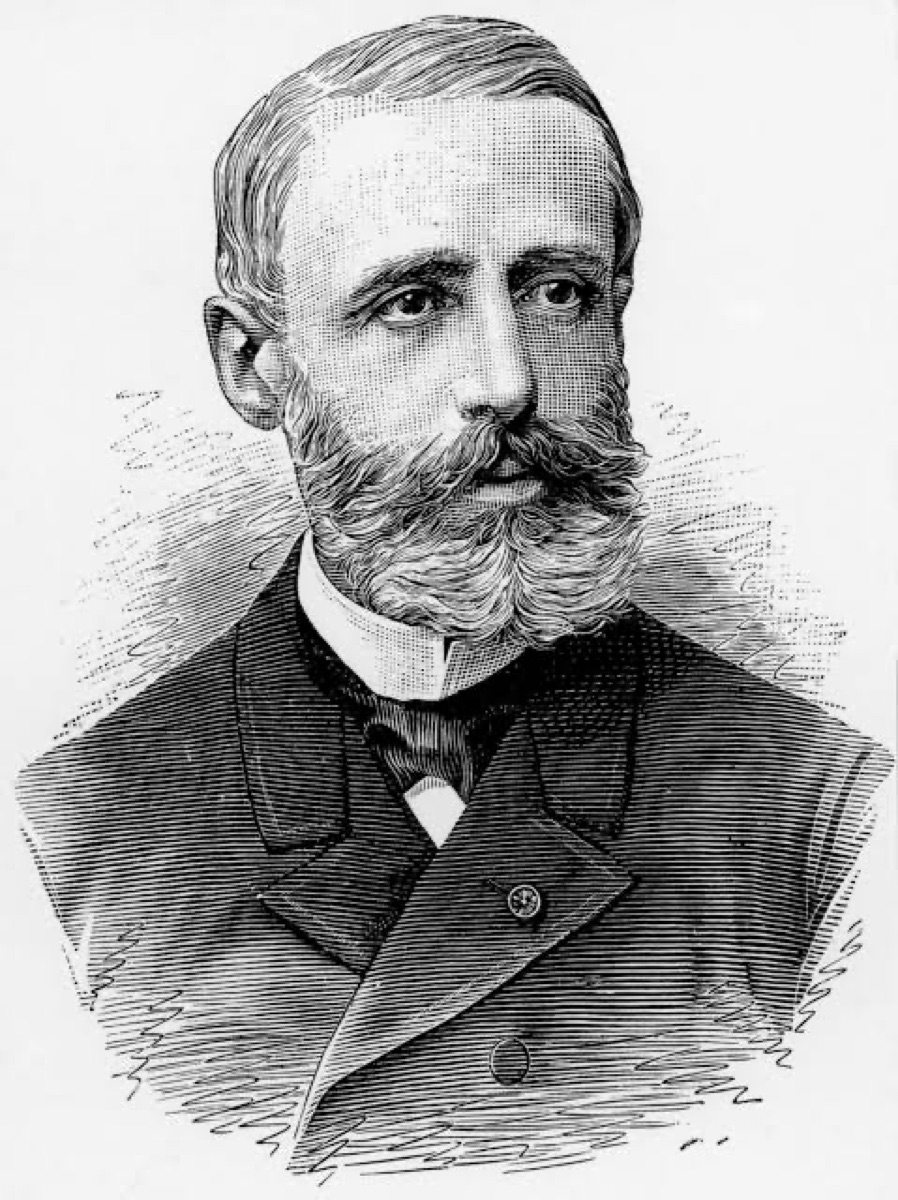
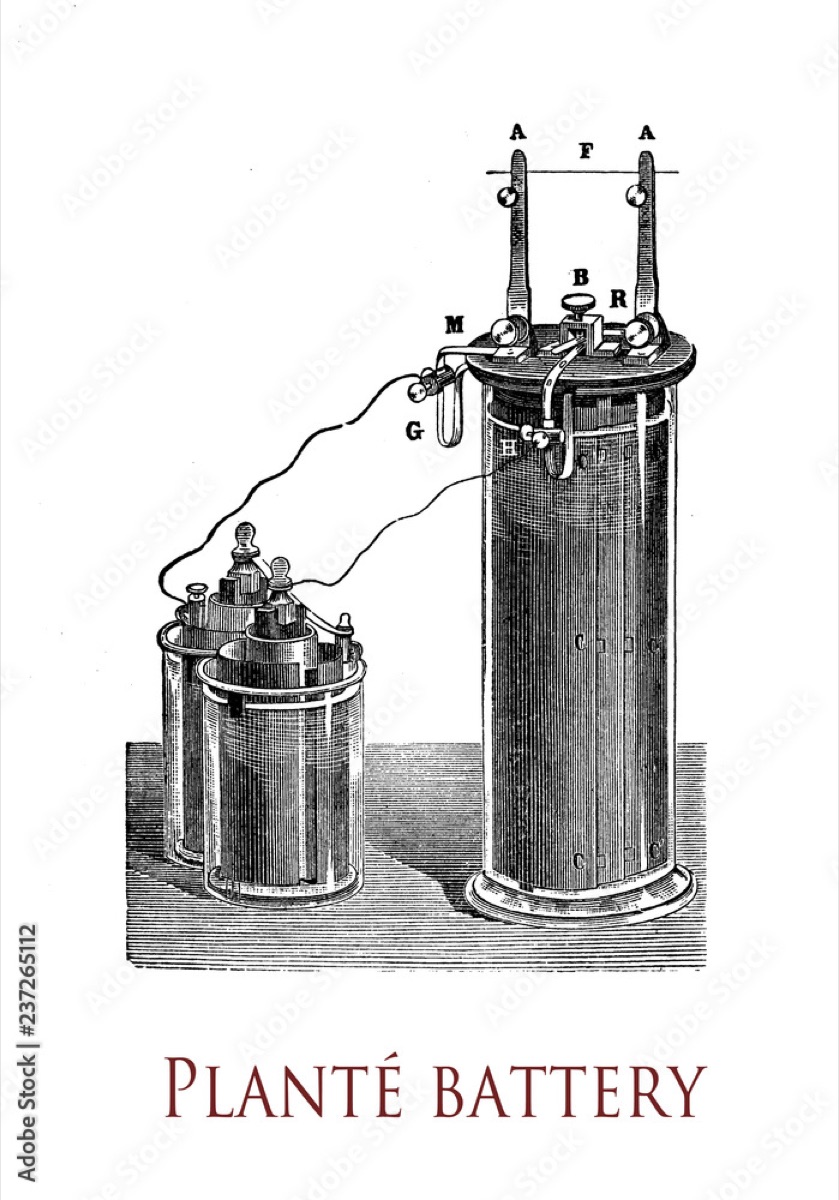
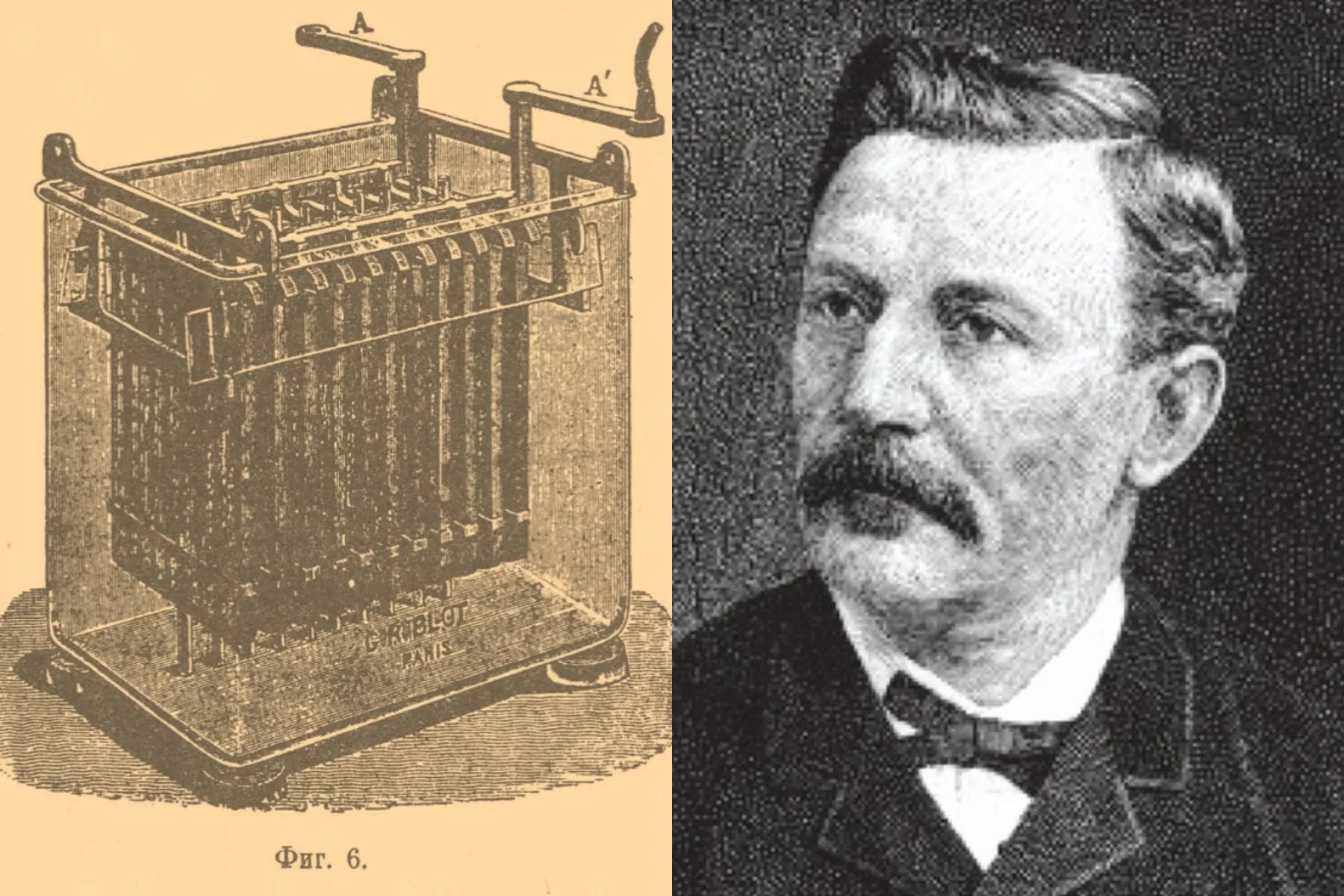
Early electric vehicles all shared the same crippling flaw: their batteries couldn't be recharged. Once depleted, that was the end of the journey. The breakthrough came in 1859, when French inventor Gaston Planté developed the rechargeable lead-acid battery — the same basic chemistry, remarkably, still used in ordinary car starter batteries today, well over 160 years later. Camille Faure refined the design further in the following decades, making it practical to actually manufacture at scale.
Gaston Planté / His 1859 rechargeable lead-acid cell
Camille Faure's refined battery design turned Planté's invention into something manufacturers could actually build at scale.
The forgotten Parisian watchmaker who built the first real one
If there's a single most under-credited figure in this entire story, it's Gustave Trouvé — a French electrical engineer and watchmaker by trade, working out of a small Paris workshop, whose name has largely faded from popular memory despite building something genuinely first.
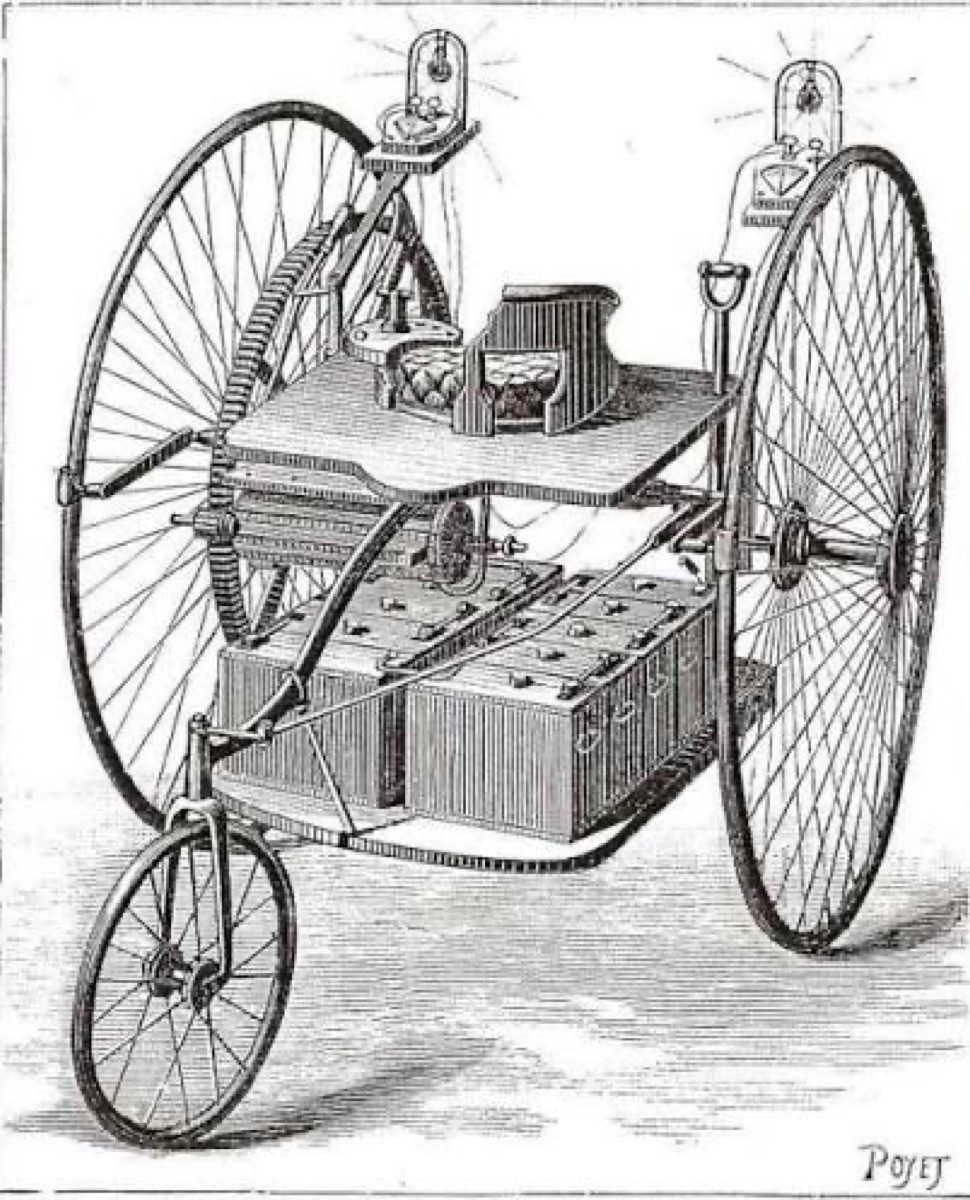
In 1880, Trouvé took a small electric motor originally developed by Siemens — itself based on a design purchased from Johann Kravogl in 1867 — improved its efficiency, and paired it with Planté's newly available rechargeable battery. He fitted the whole assembly to an ordinary English-made James Starley tricycle. On 19 April 1881, on the Rue Valois in central Paris, an assistant rode Trouvé's creation successfully in front of a watching crowd — the first practical electric road vehicle ever publicly demonstrated, a full three years before Thomas Parker's more commonly cited 1884 car. It reached a genuinely respectable top speed of around 12 km/h (roughly 7.5 mph) — several times faster than Parker's later 2 mph commute.
Trouvé's tricycle, Rue Valois, Paris, 19 April 1881 — the first practical electric road vehicle ever publicly demonstrated.
Trouvé never got to claim the credit history arguably owes him. He was unable to patent the vehicle, since a steam-powered tricycle using a similar concept had already been patented by another inventor. Characteristically restless, he simply moved on — within weeks he'd unbolted the same battery and motor from the tricycle and fitted it to a small boat instead, inventing, almost as an afterthought, the world's first outboard motor, which he demonstrated on the Seine that same year and for which he was awarded the Légion d'Honneur. Across his career Trouvé patented some 300 other inventions, including one of the earliest medical endoscopes.
His subsequent obscurity is a genuinely poignant footnote. Trouvé died in 1902, a lifelong bachelor with no children to preserve his legacy; when the lease on his Paris grave eventually expired, the city quietly reburied him in a communal plot. In 1980, a fire at the Descartes town hall destroyed much of what remained of his personal archive. Only in recent years has his role been properly recognised — a commemorative plaque was unveiled at his birthplace in Descartes in 2012, a second placed at his old Paris workshop in 2016, and in 2021 a British engineer built and rode a faithful replica of his tricycle down the same Rue Valois, 140 years after the original.
The eccentric who electrified an entire English seaside town
If Trouvé is the most under-credited figure in this story, Magnus Volk is easily the most delightfully eccentric — a man the New York Times once reported was so uncannily skilled with electricity that his inventions were denounced by suspicious locals as “the work of the devil.”
Born in Brighton in 1851, the son of a German immigrant clockmaker, Volk took over the family clockmaking business at just 14 when his father died, and simply never stopped inventing from that point on. By 1879 he'd built Brighton's first private telephone link; by 1880 he'd wired his own house for electric light, at a time when almost nobody in Britain had any electricity at home at all; by 1883 he'd electrified the Royal Pavilion — one of the largest such installations in the entire country at the time, requiring insulation robust enough to survive sitting alongside the estate's existing gas fittings, which were deliberately kept in place as a backup.
That same year, 1883, Volk opened Volk's Electric Railway along Brighton's seafront — still running today, and recognised as the oldest continuously operating electric railway anywhere in the world. Not content with one seafront railway, in 1896 he built something genuinely stranger still: the Brighton and Rottingdean Seashore Electric Railway, nicknamed the “Daddy Long-Legs,” an electric train that ran on stilts directly through the surf itself, mounted on tall legs to keep its carriage above the waves, complete with a lifeboat, life rings, and an actual sea captain at the helm — essentially a train, a boat, and a pier fused into one bizarre vehicle, built specifically because the coastal terrain was too rugged for a conventional rail line. It didn't last especially long, but nothing else quite like it has ever been built again.
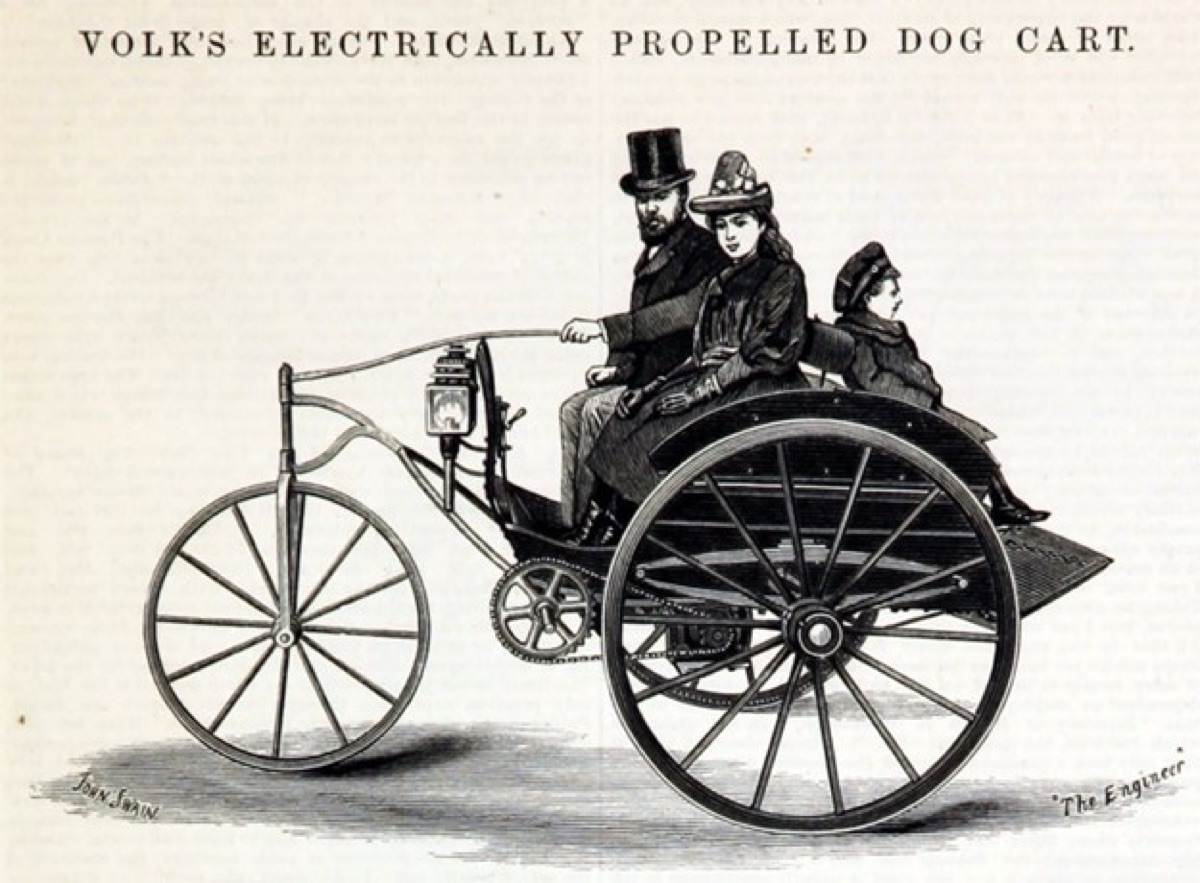
Volk's automotive contribution came in 1887, when — while in the middle of a genuine bankruptcy, having been forced to sell his own house — he built a three-wheeled electric car, powered by an Immisch motor, that he demonstrated around Brighton as an “electric dog-cart.” It ran on six batteries tucked under the seats, good for around six hours of driving and a top speed of roughly 14 km/h. The car caught the attention of a rather significant customer: in 1888, Volk built a four-wheeled version specifically to the order of Sultan Abdul Hamid of the Ottoman Empire, delivering what's widely considered the first ever export order for a motorcar. The Sultan was evidently pleased — he personally presented Volk with the Ottoman Order of Osmani during a visit to Constantinople, and bought one of Volk's electric boats the following year for good measure.
Magnus Volk's 1887 “electric dog-cart” — built while its inventor was going through bankruptcy, and later exported to the Sultan of the Ottoman Empire.
Volk died in 1937, the same year Marina Station on his original electric railway was completed. His name is barely known outside Britain today, but his railway is still carrying passengers along the Brighton seafront well over 140 years after it first opened — arguably making him the only figure in this entire story whose original invention is still in daily commercial operation.
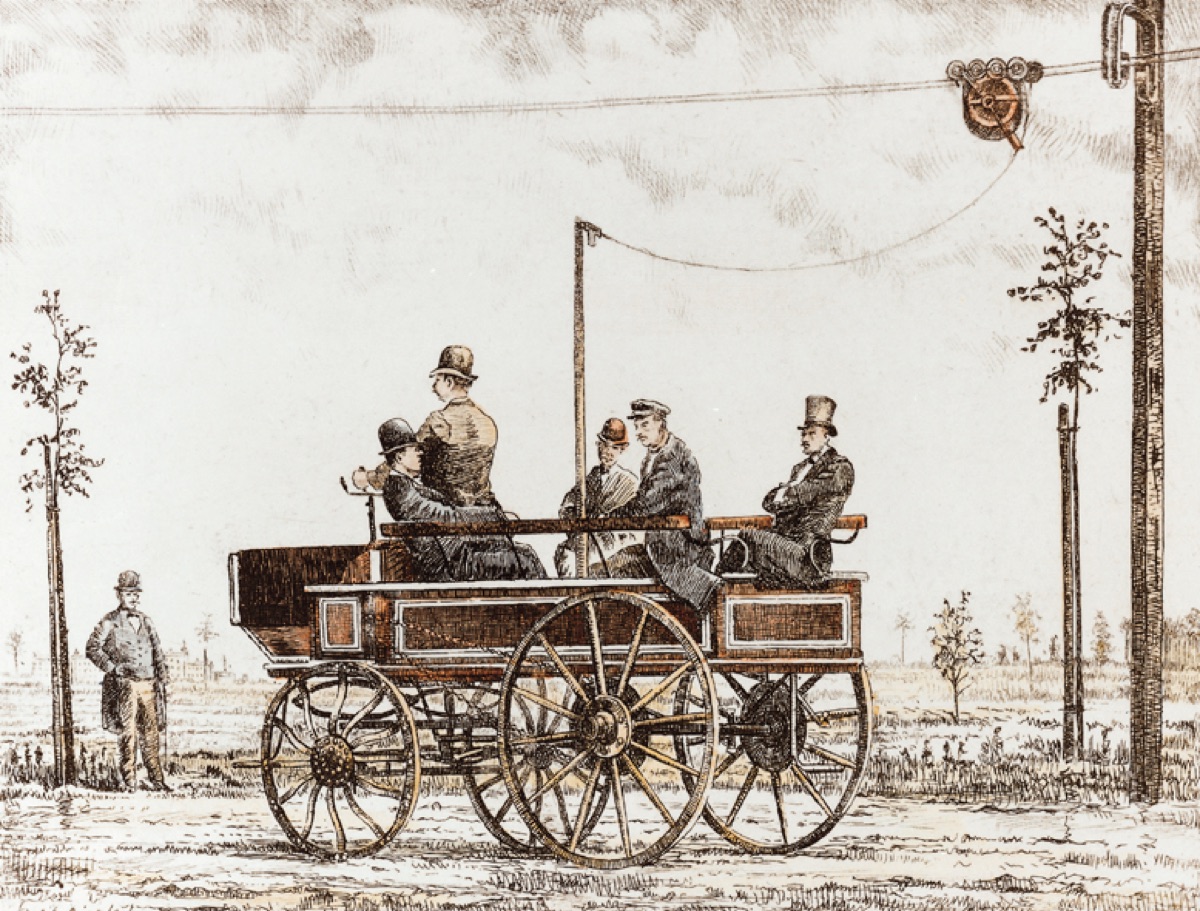
Electric traction was already spreading beyond the car itself — this Siemens-built electric trolleybus ran in Berlin from 1882, a year before Volk's own railway opened in Brighton.
Britain's electrifying commuter, Germany's four wheels, and America's first real try
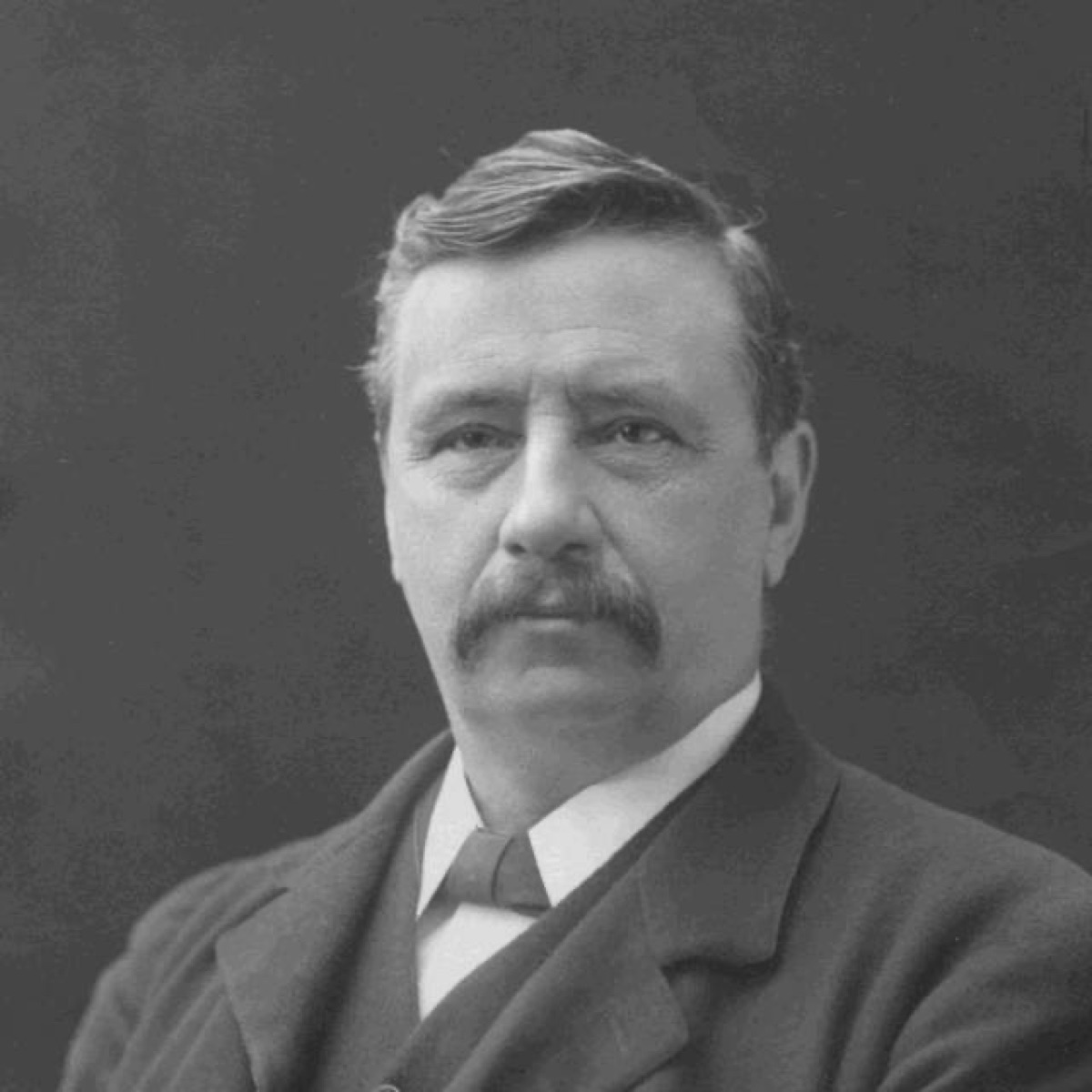
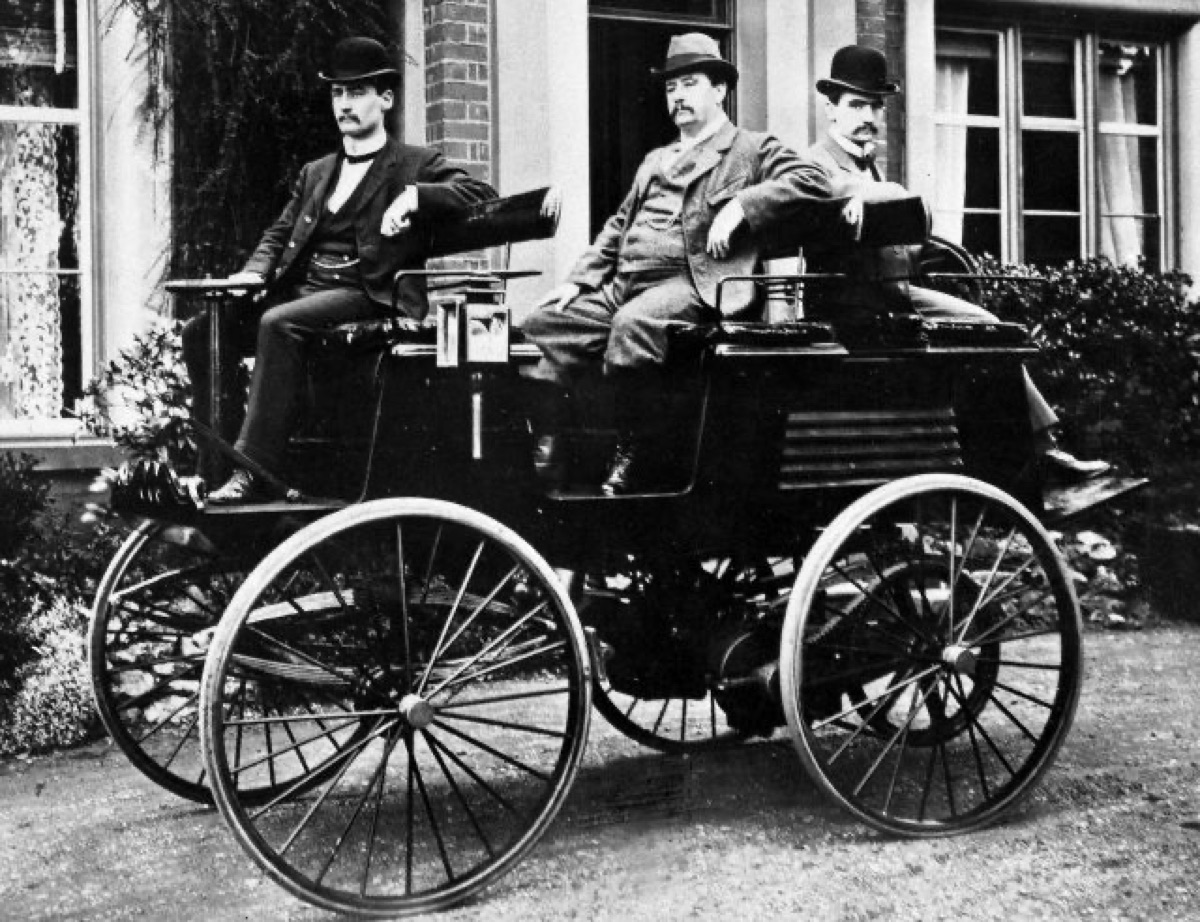
British engineer Thomas Parker — already well known for electrifying sections of the London Underground, building overhead tramways in Liverpool and Birmingham, and even inventing the smokeless fuel coalite — built his own electric car in Wolverhampton in 1884, motivated partly, by his own account, by concern over the smoke and pollution already choking London's streets. He commuted to work in it at a leisurely top speed of around 2 miles per hour; the only surviving documentation of the car is a photograph taken over a decade later, in 1895. Parker's production company, Elwell-Parker, later merged with rivals to become the Electric Construction Corporation, which came to dominate the British electric car market through the 1890s — and while Parker is very often credited in popular accounts as building “the first practical electric car,” Trouvé's Paris demonstration three years earlier has a genuine claim to that title instead.
Thomas Parker
His 1884 Wolverhampton-built electric car
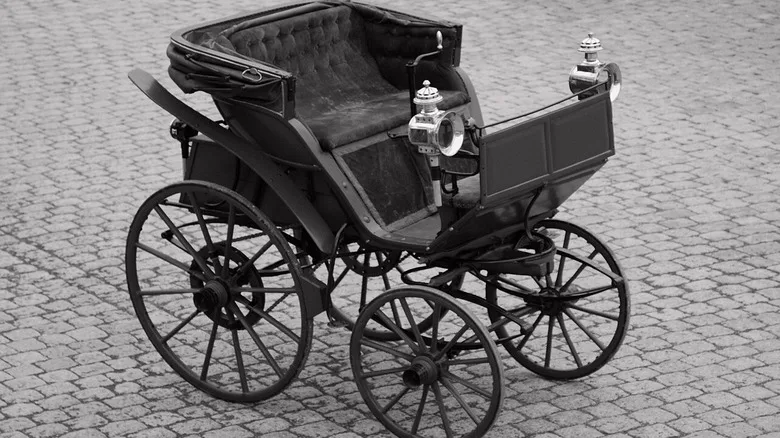
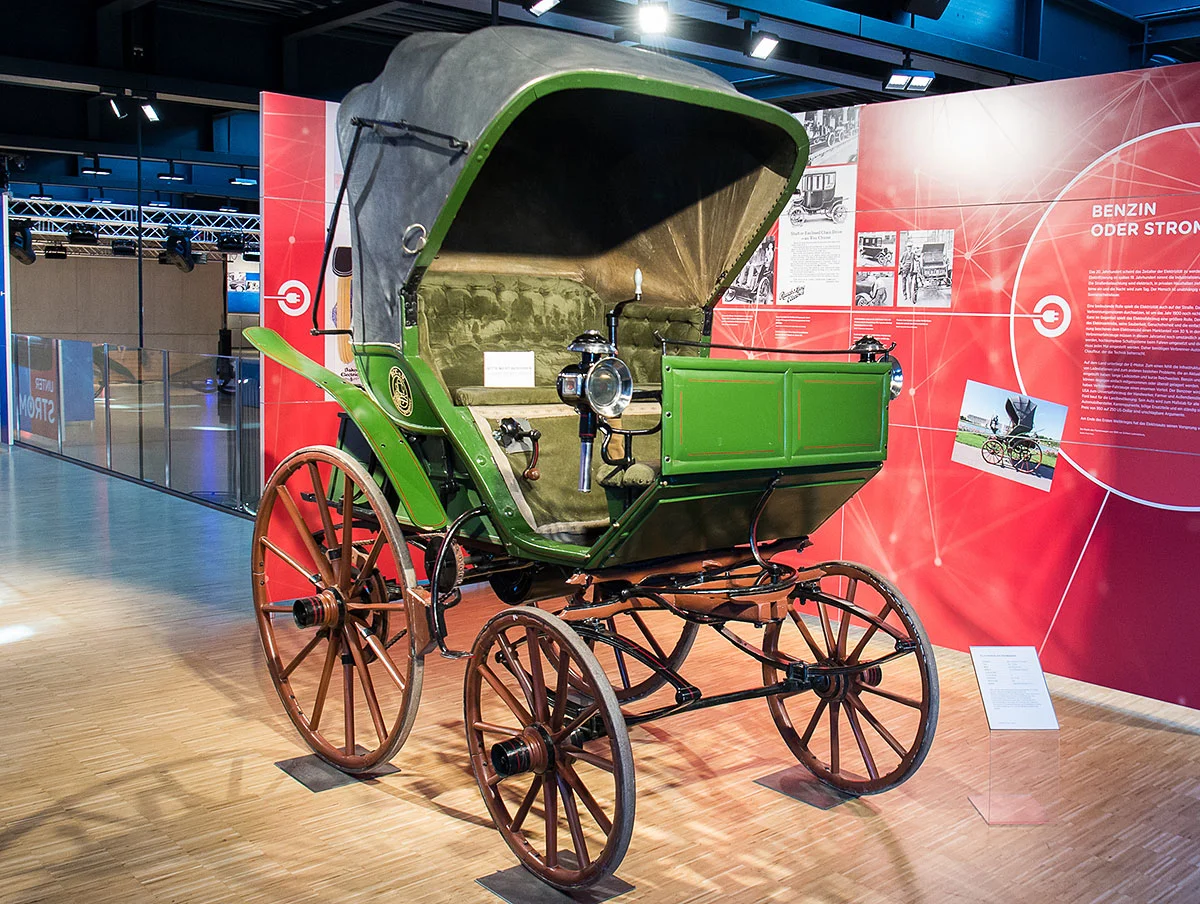
The first four-wheeled electric car to achieve any real recognition arrived a few years later still: the Flocken Elektrowagen, built in Germany in 1888 by engineer Andreas Flocken — often cited today as the true “first electric car” in the more familiar four-wheeled sense, even though Trouvé's tricycle had already proven the underlying concept seven years earlier.
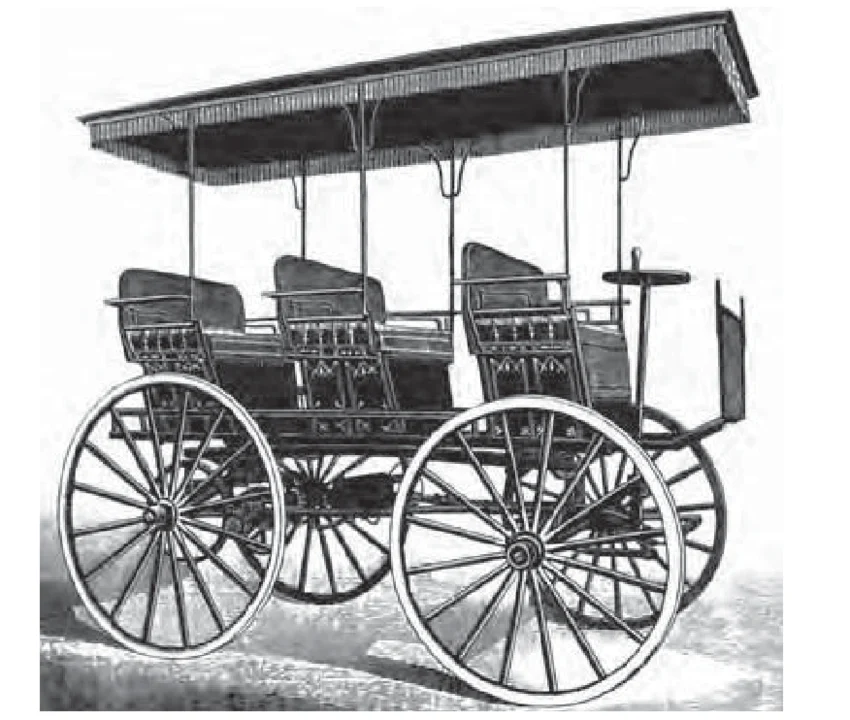
America's own first real attempt came from William Morrison of Des Moines, Iowa — a Scotland-born chemist who built the country's first electric car in 1890-91: an 800-pound, four-horsepower wagon with a 24-cell battery, capable of about 14 mph and seating six passengers. It was exhibited to considerable acclaim at the 1893 World's Columbian Exhibition. It took several more years for American consumers to really pay attention: only in 1895 did inventor A.L. Ryker introduce the first electric tricycles to the US market, by which point Europeans had already been building and riding electric tricycles, bicycles, and cars for almost fifteen years.
William Morrison's 800-pound electric wagon — America's first electric car, exhibited at the 1893 World's Columbian Exhibition.
Columbia: America's first great car company was electric, not gasoline
Once America did catch up, it caught up fast — and for a few remarkable years, the largest car company in the entire United States wasn't a gasoline maker at all.
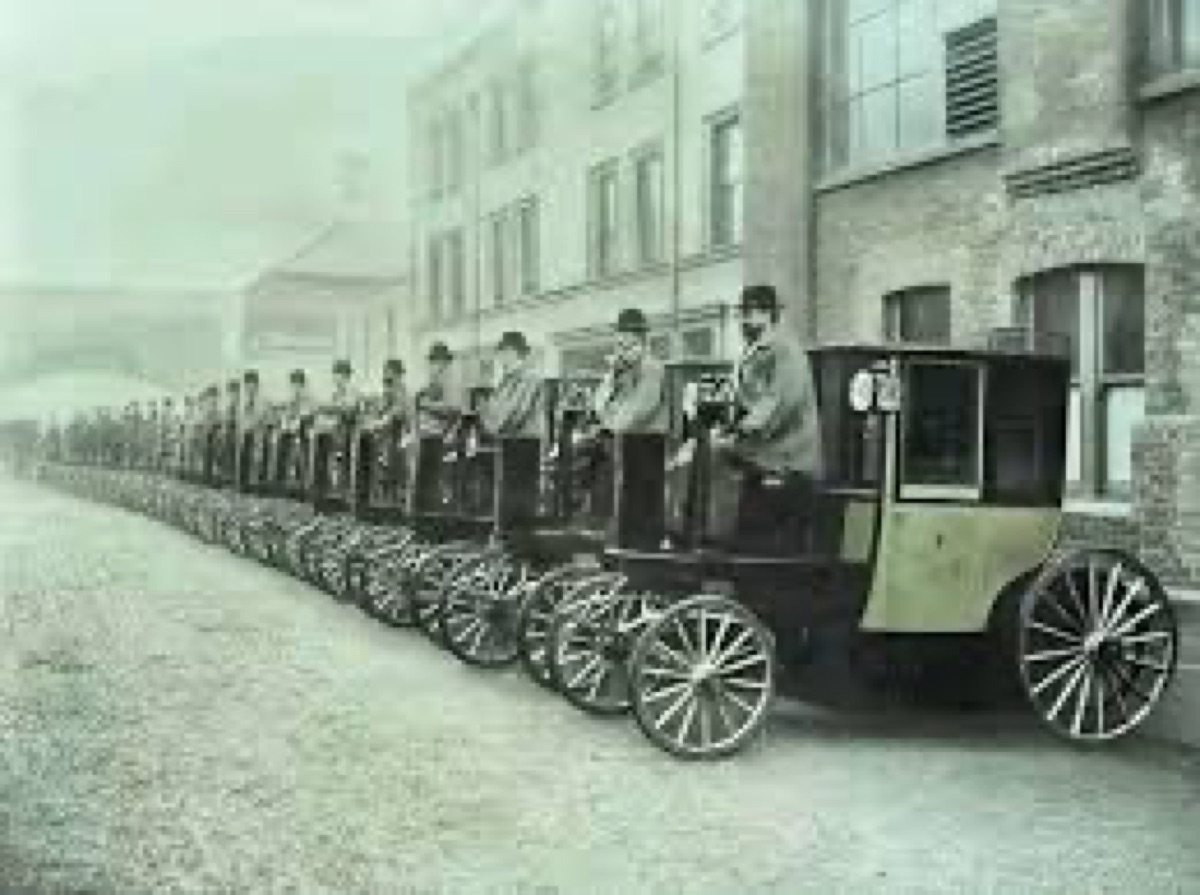
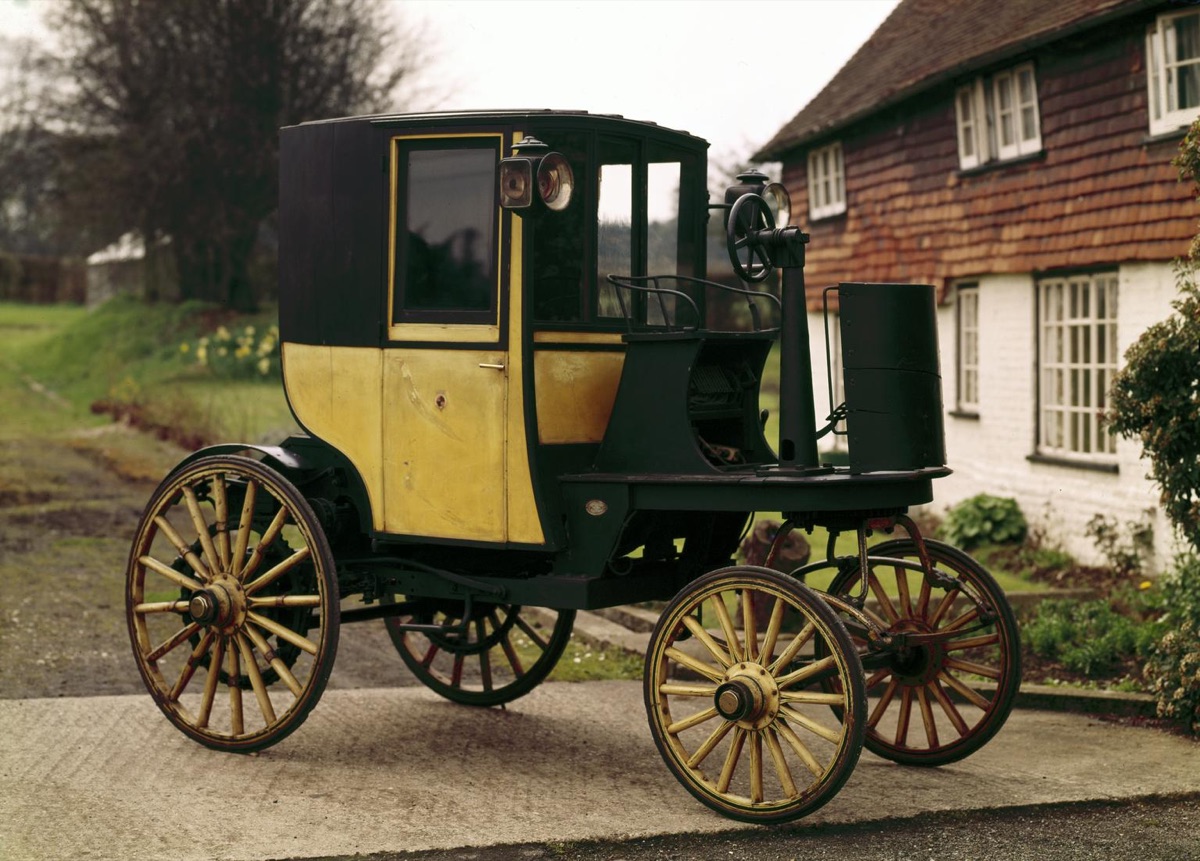
The story starts, unusually, with two rival electric cab operations forming almost simultaneously in 1897. In London, engineer Walter Bersey designed and introduced a fleet of electric taxi cabs, which locals promptly nicknamed “Hummingbirds” for the distinctive humming sound their motors made. That same year in New York, Samuel's Electric Carriage and Wagon Company began running twelve electric hansom cabs, scaling up to as many as 62 before its financiers — led by streetcar tycoon, former Navy Secretary, and noted playboy William Collins Whitney — reorganised the struggling operation in 1898 into a new entity: the Electric Vehicle Company, which kept its Manhattan cabs on the street using battery-swapping stations, though the whole enterprise expanded too fast and folded by 1907.
Bersey's London “Hummingbird” cabs, 1897
It was into that same emerging landscape that Colonel Albert Augustus Pope, a Civil War veteran who'd already built the largest bicycle manufacturing company in America, made his move. Sensing the bicycle boom was ending, Pope founded the Columbia Electric Vehicle Company in Hartford, Connecticut in 1896 and hired engineer Hiram Percy Maxim — son of the man who invented the fully automatic machine gun — to lead development.
On 13 May 1897, outside his Hartford factory, Pope unveiled the battery-powered Columbia Motor Carriage to the public — widely regarded as the first demonstration of a mass-produced electric car in American history. It weighed 1,800 pounds, reached 15 mph, and thrilled onlookers by climbing steep, mud-slicked city streets without difficulty. The Hartford Courant's review the next day ran under the headline “HORSELESS ERA COMES,” noting that even a complete novice could operate it “with as much comfort and success as they would have in driving the gentlest horse.”
The Columbia Motor Carriage — unveiled outside Pope's Hartford factory on 13 May 1897, to a headline reading “HORSELESS ERA COMES.”
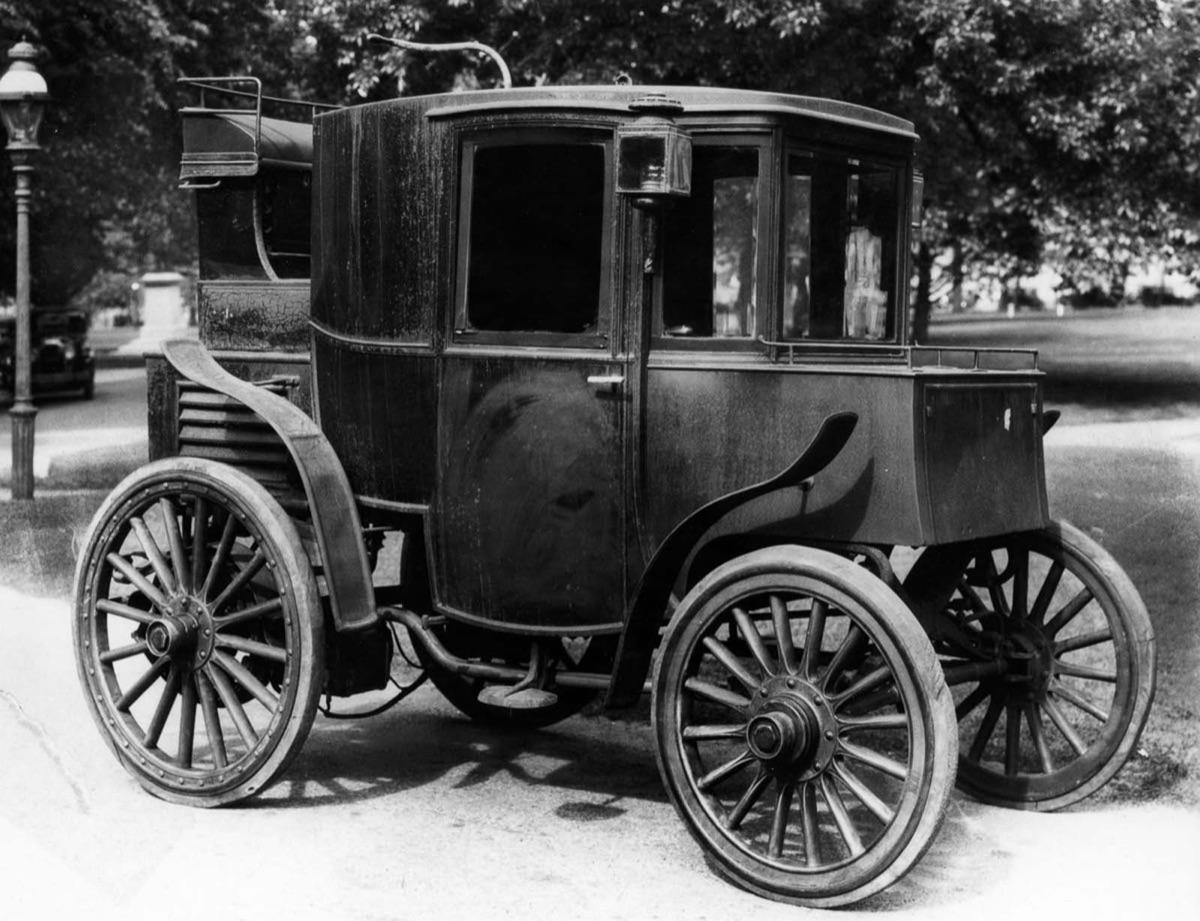
Pope's timing and conviction were genuinely remarkable. He was certain electricity, not gasoline, was the future of transportation, and he built factories with capacity for over 2,000 cars a year to prove it. It worked, briefly, on a scale that's hard to overstate: in 1899, Pope's combined production of 2,092 cars — the large majority electric — accounted for nearly half of every automobile built in the United States that year. By 1900, a Columbia Runabout set the electric vehicle range record of the era, travelling 96 miles on a single charge. By 1902, Columbia became the first American manufacturer ever to deliver more than 1,000 cars in a single year, beating even Oldsmobile to that milestone.
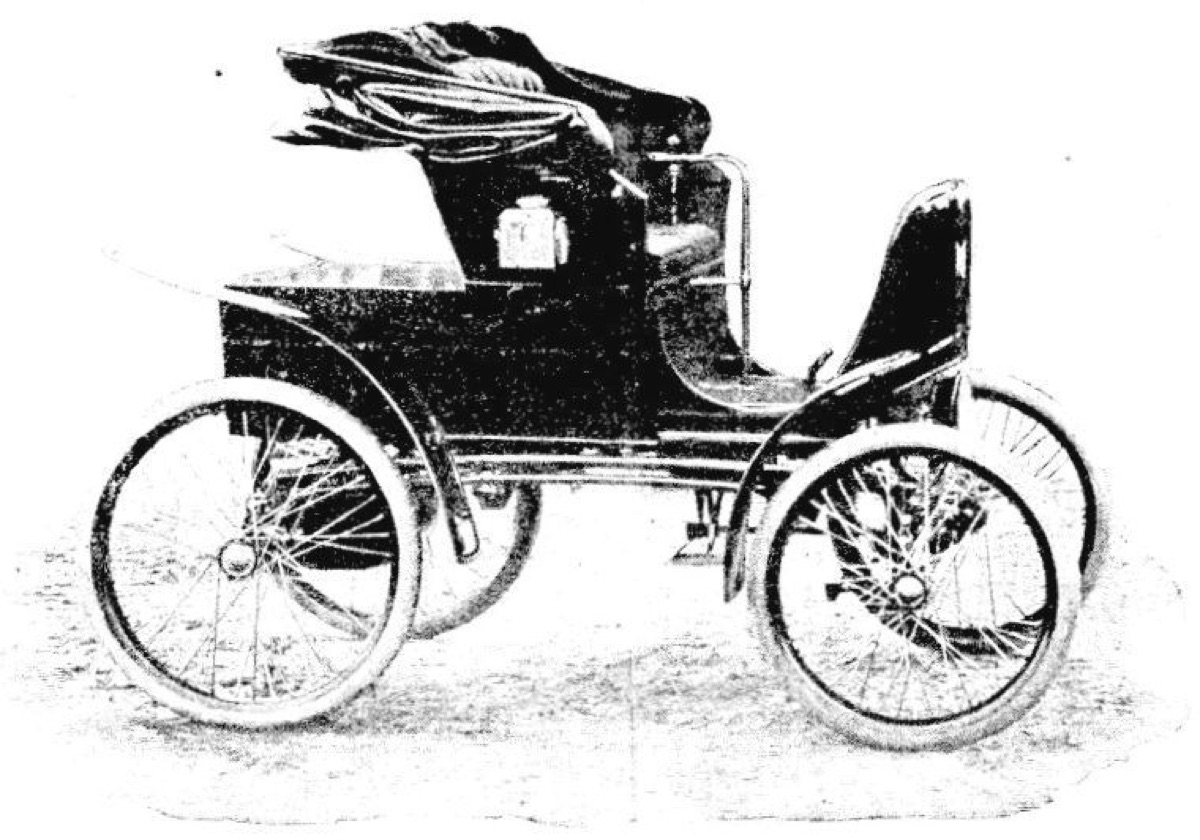
A 1899 Columbia
The Columbia Mark 68 Victoria
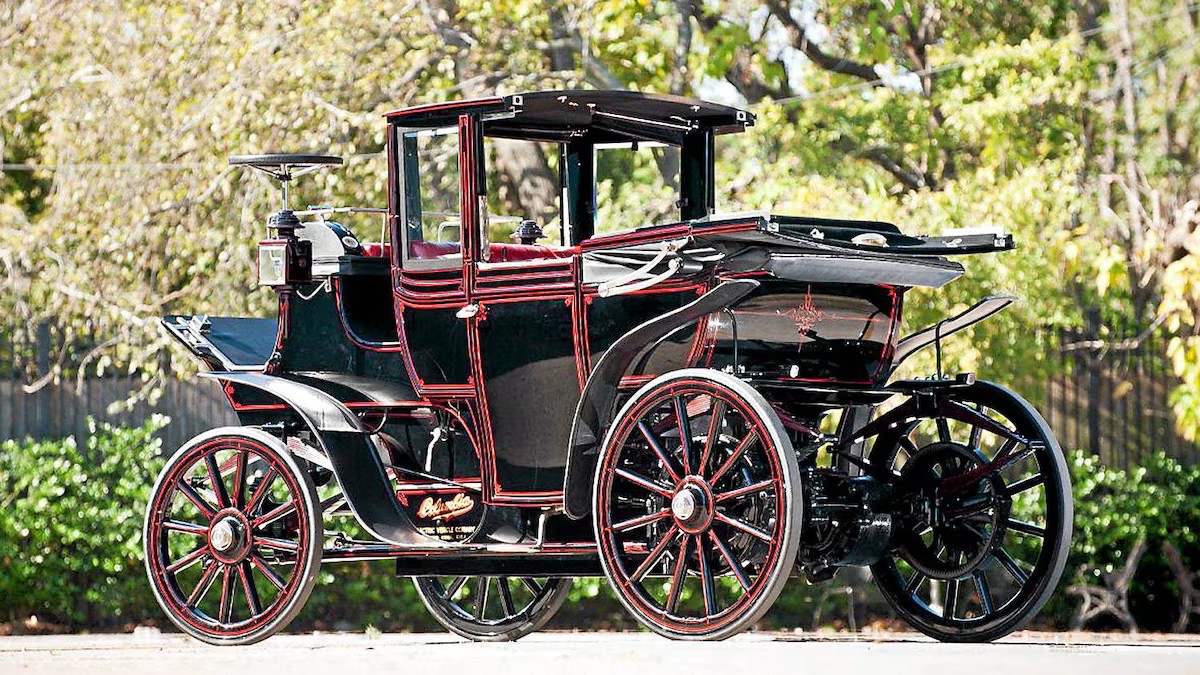
It didn't last. Electricity itself was expensive, and most of America outside major city centres had no electrical grid at all to recharge a car from, which meant Columbia's appeal was hard-capped to wealthy urban buyers from the start. Pope also tangled the company in a costly legal battle after acquiring the notorious Selden patent, which claimed licensing rights over essentially every American automobile before eventually being overturned. Pope died in 1909; the company, renamed the Columbia Motor Car Company, staggered on before finally ceasing production entirely in 1912-1913, having built a cumulative total of just 27,211 vehicles across its entire run — a company that once briefly out-produced almost every rival in America, reduced to a historical footnote within fifteen years. One measure of just how far Columbia has been forgotten: an 1899 Columbia Electric Landaulet sold at a 2011 auction for $550,000, a price that would have seemed like science fiction to anyone watching that first Hartford demonstration.
This 1899 Columbia Electric Landaulet sold at auction in 2011 for $550,000 — from a company that had ceased to exist a century earlier.
New York's speed demon: Andrew Riker and the Torpedo
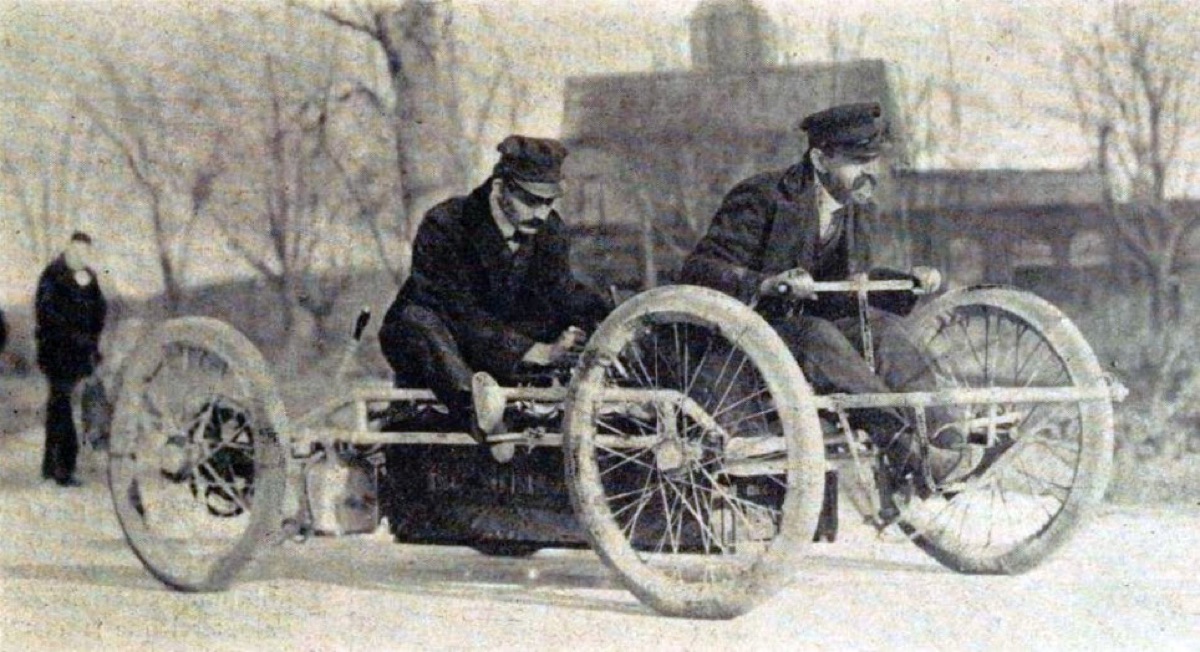
One more American pioneer deserves real credit here. Andrew Riker, a brilliant young New York engineer, built his own first electric car in 1894 — at just 26 years old, cobbling it together from a pair of Remington bicycles. Two years later, he won America's first ever car race of any kind. In November 1901, driving his battery-powered ‘Riker Torpedo’ at Coney Island, New York, he covered a mile in 63 seconds — about 57 mph. Most popular retellings, including the Henry Ford Museum's own description of the artifact, call this ‘a world speed record for electric cars.’ That claim doesn't hold up against the timeline: Jenatzy had already driven an electric car to 65.79 mph over two and a half years earlier, in April 1899 — making Riker's run, at best, an American achievement at a single domestic race, not a genuine world record even within its own category. Riker's mark also stood for barely five months before Léon Serpollet's steam-powered Œuf de Pâques — French for ‘Easter Egg’ — took the outright land speed record away from electric cars entirely in April 1902, reaching 75.06 mph. One source specifically calls Riker's run a US land speed record for electric motor carriages rather than a world one, which is the more defensible framing, and the ‘world record’ label appears to be nothing more than uncritical repetition of an earlier unverified claim, copied by museums and historians ever since.
The Riker Torpedo — 57 mph in November 1901, often miscalled a ‘world’ record; Jenatzy had already gone faster two and a half years earlier.
Léon Serpollet's Œuf de Pâques — the steam car that took the outright land speed record away from electric cars in April 1902, reaching 75.06 mph.
Riker went on to become the first president of the Society of Automotive Engineers, and — unlike almost every other electric pioneer in this story — he saw the technology's limits coming early and switched to building gasoline cars himself, joining Bridgeport's Locomobile in 1902, where he developed “Old 16,” the first American-built car to win the prestigious Vanderbilt Cup. One of his original 1898 electric racers survives today, unrestored, in a Connecticut showroom — among only six Rikers known to exist, three of which sit in the Henry Ford Museum.
The car that broke 100 km/h — decades before anyone thought it possible
If there's one fact that most completely upends the modern assumption that electric cars are slow and fragile, it's this: for the first several years of automotive history, electric cars were faster than anything else on the road. An electric vehicle held the outright land speed record until around 1900.
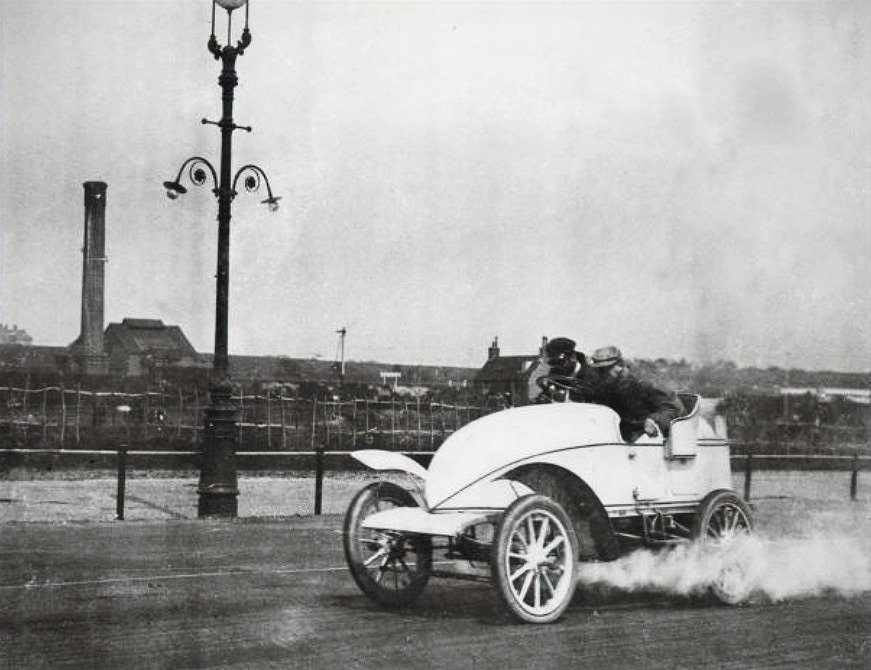
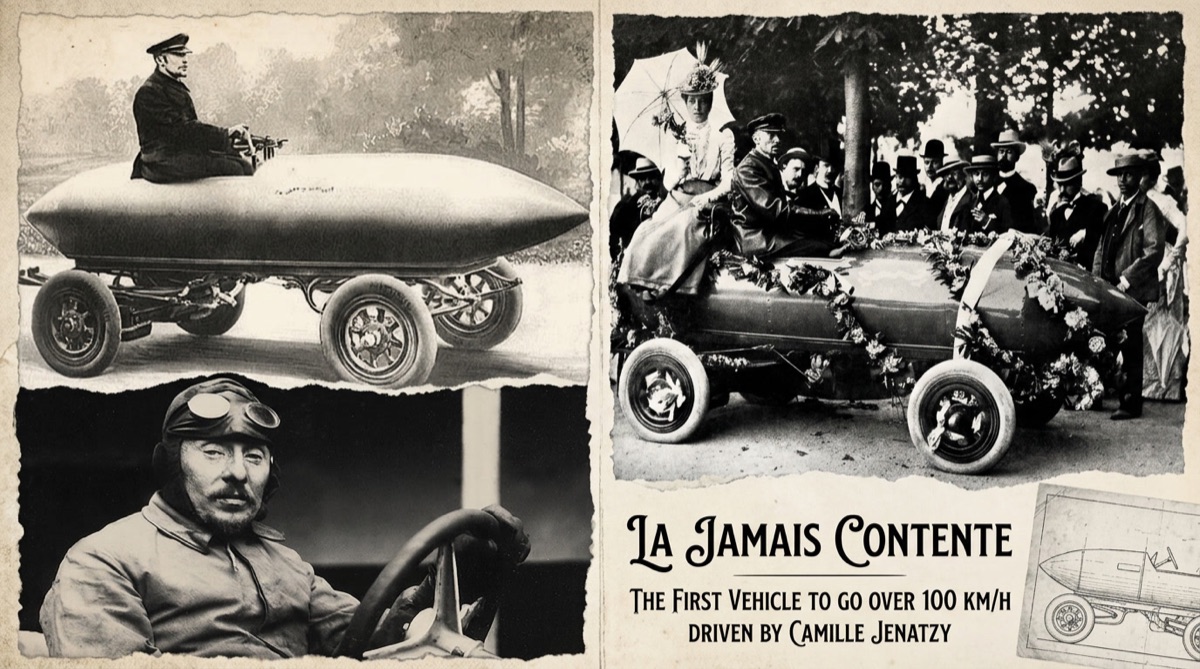
The record-breaking moment came on 29 April 1899, when Belgian racing driver Camille Jenatzy became the first person in history to exceed 100 km/h in any vehicle, reaching 105.88 km/h (65.79 mph) in a purpose-built electric racer with the memorably defiant name La Jamais Contente — “The Never Satisfied.” It was shaped like a torpedo standing on end, driven by two direct-drive electric motors, and it beat every steam and petrol competitor of the era outright.
La Jamais Contente — “The Never Satisfied” — the first vehicle of any kind to exceed 100 km/h, on 29 April 1899.
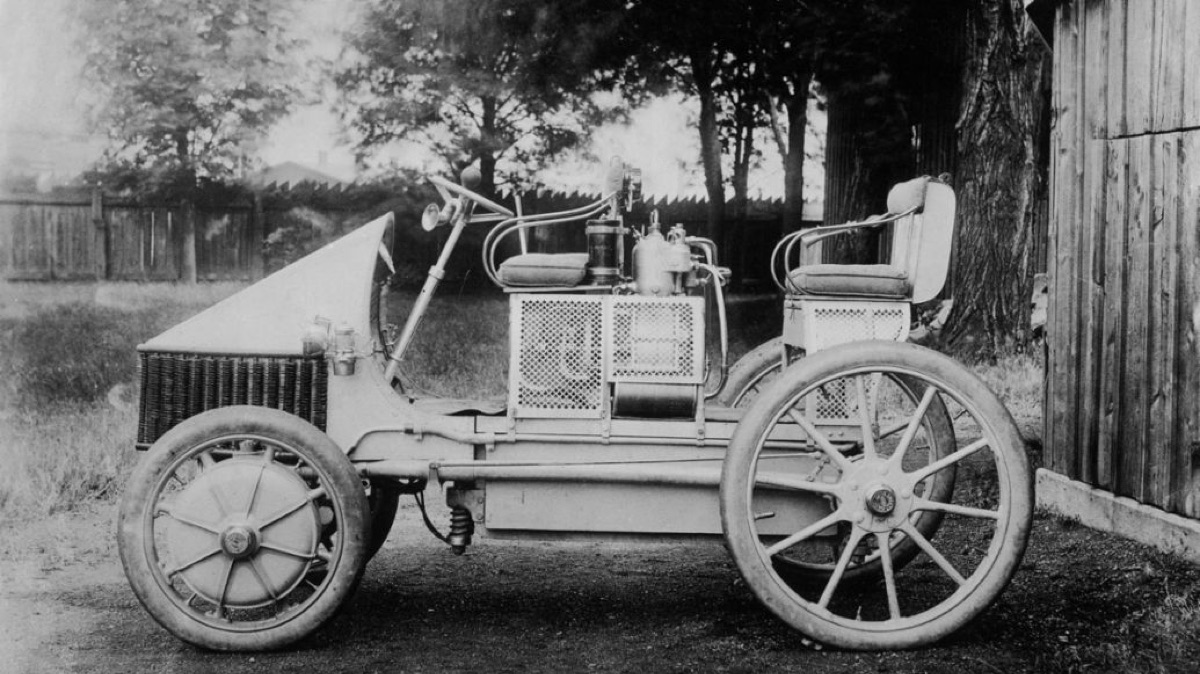
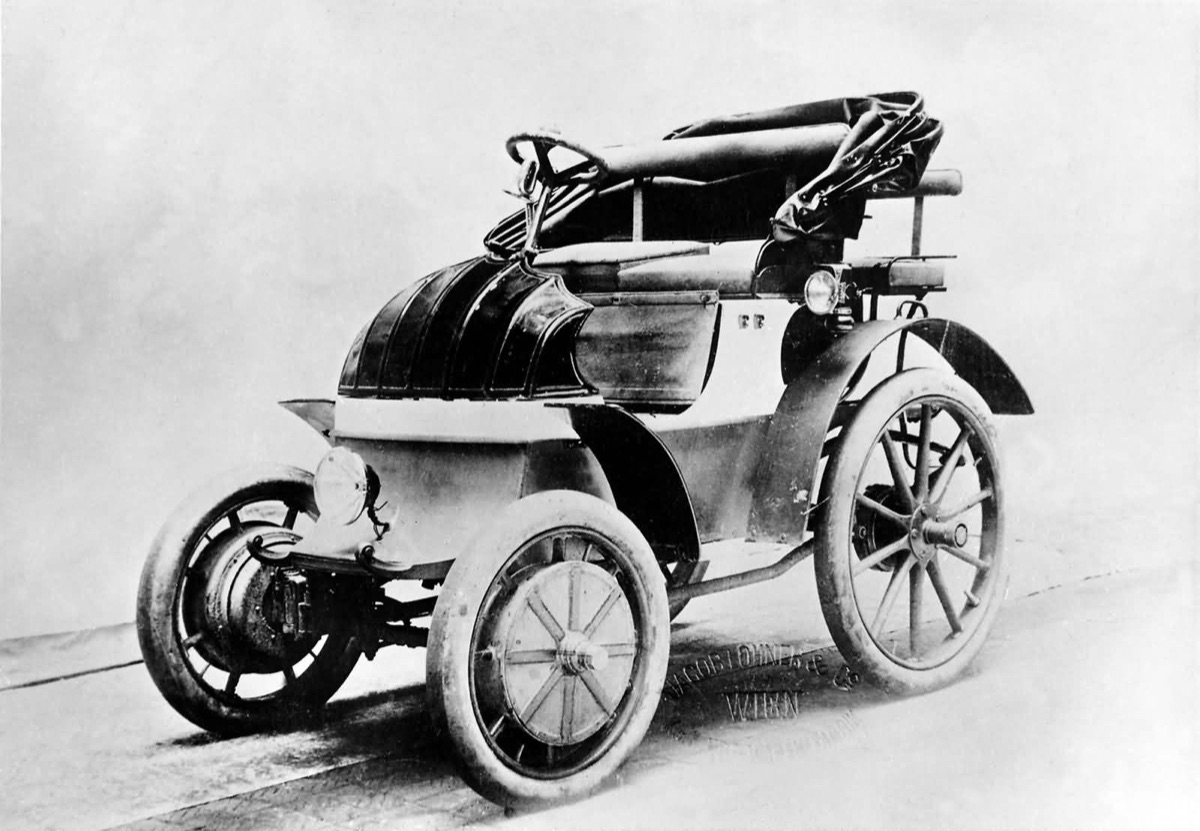
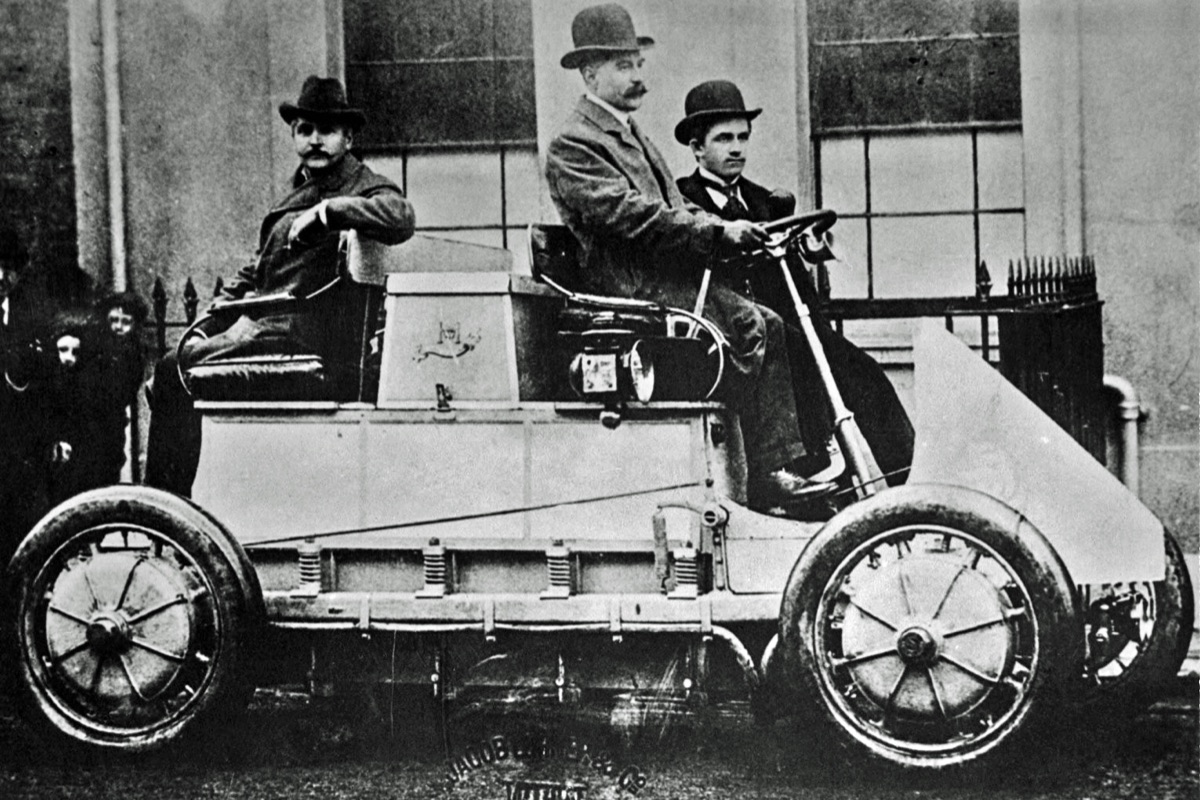
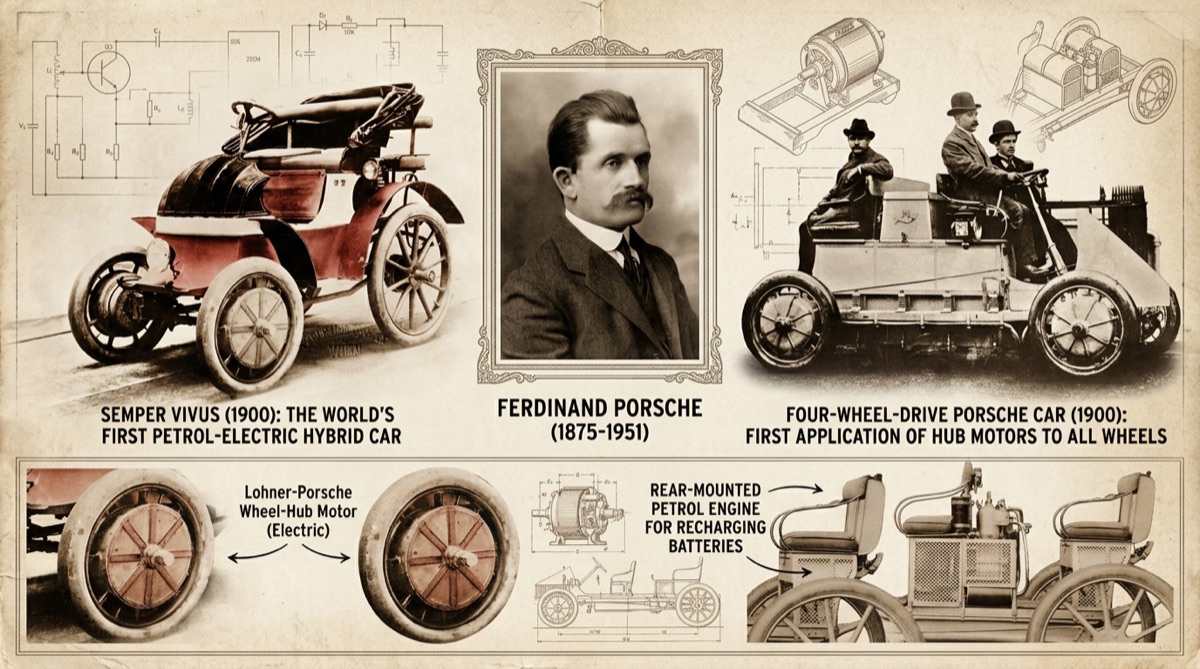
Ferdinand Porsche — yes, that Porsche, decades before the Carrera 911 or anything wearing his family name existed — designed his own competing all-wheel-drive electric vehicle around the same period, powered by a motor built into each wheel hub, which went on to set several further records in the hands of its owner, E.W. Hart — a configuration so advanced it wouldn't become mainstream again for well over a century.
The Semper Vivus, 1900 — Latin for ‘always alive.’ Widely considered the first hybrid car, it carried two single-cylinder De Dion-Bouton petrol engines (2.5 hp each) on board, acting purely as generators with no mechanical link to the wheels, charging the batteries and feeding the electric hub motors — a series-hybrid setup that extended its range well beyond what batteries alone could manage.
Porsche's first electric vehicle
Porsche's wheel-hub motor design — a motor built directly into each wheel, a configuration that wouldn't become mainstream again for over a century.
Porsche's electric lineage, decades before anyone had heard of a Taycan — the company's founder was building EVs before he ever built a petrol sports car.
Golden age: quiet, clean, and preferred by presidents' wives
By the early 1900s, electric cars weren't a curiosity — they were, for a genuine window of time, the dominant, preferred choice in American cities, alongside steam. It's worth pausing on just how contested the field really was: at the turn of the century, roughly 40% of American automobiles ran on steam, 38% on electricity, and only 22% on gasoline — meaning the internal combustion engine was, for a brief window, the least popular of the three competing technologies, not the inevitable winner it's now assumed to have always been.
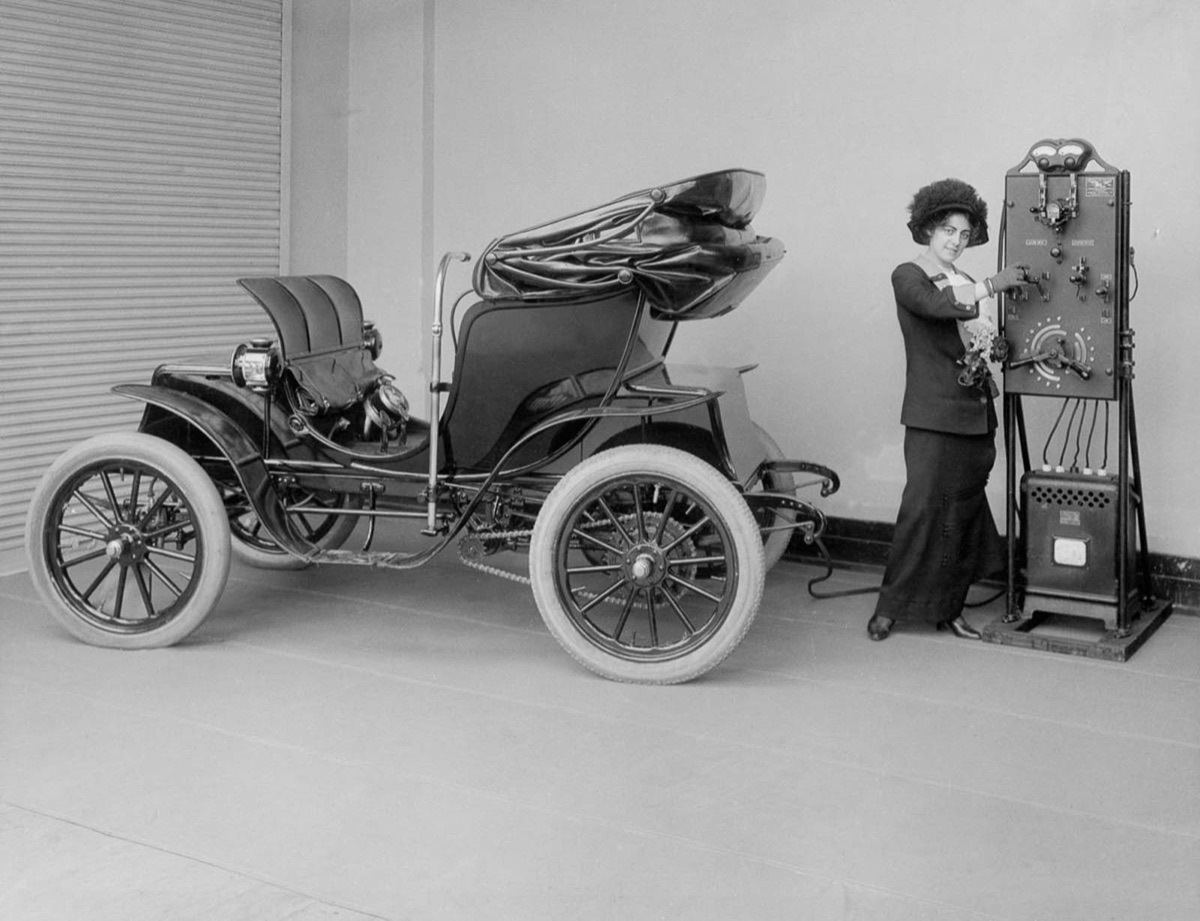
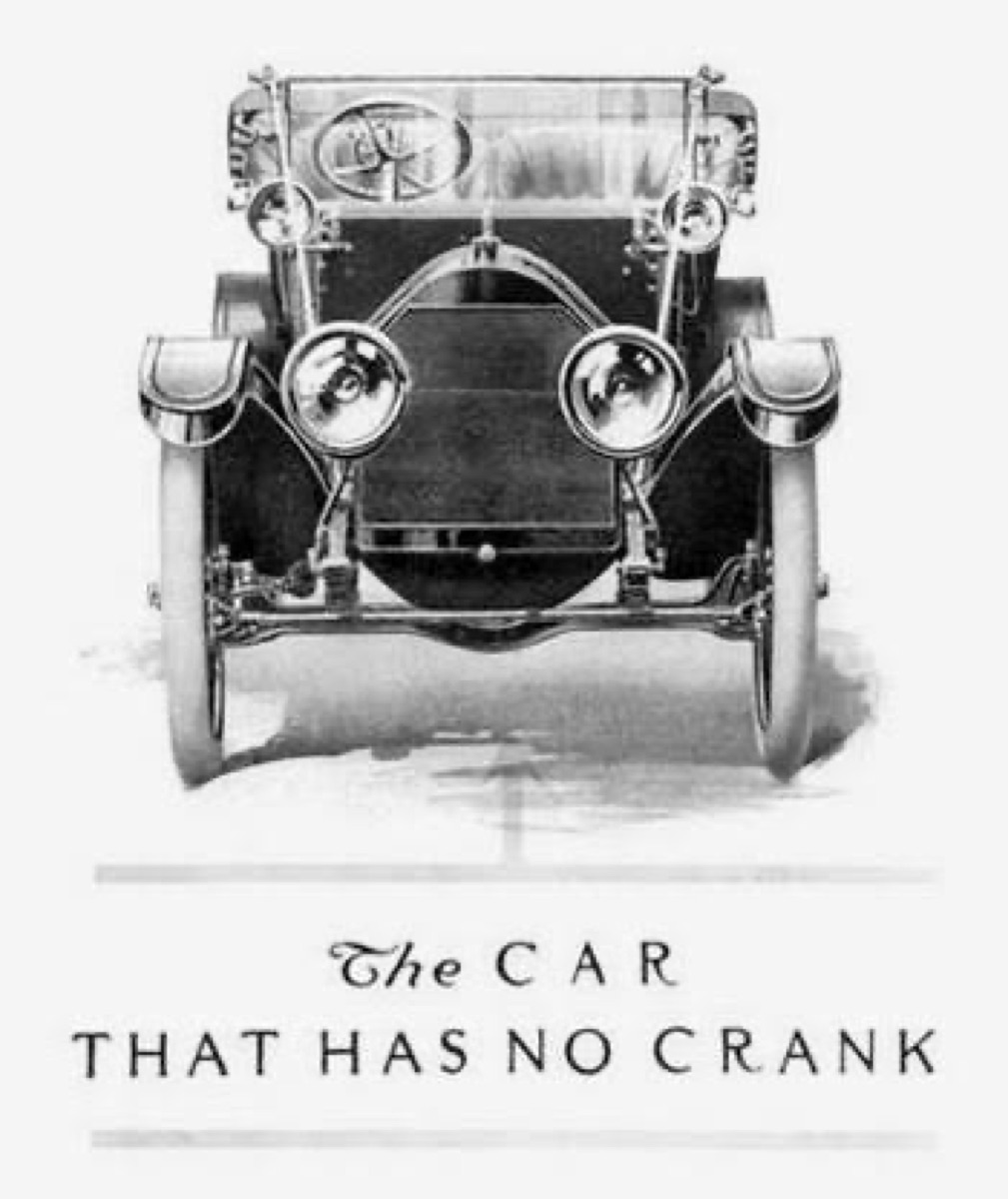
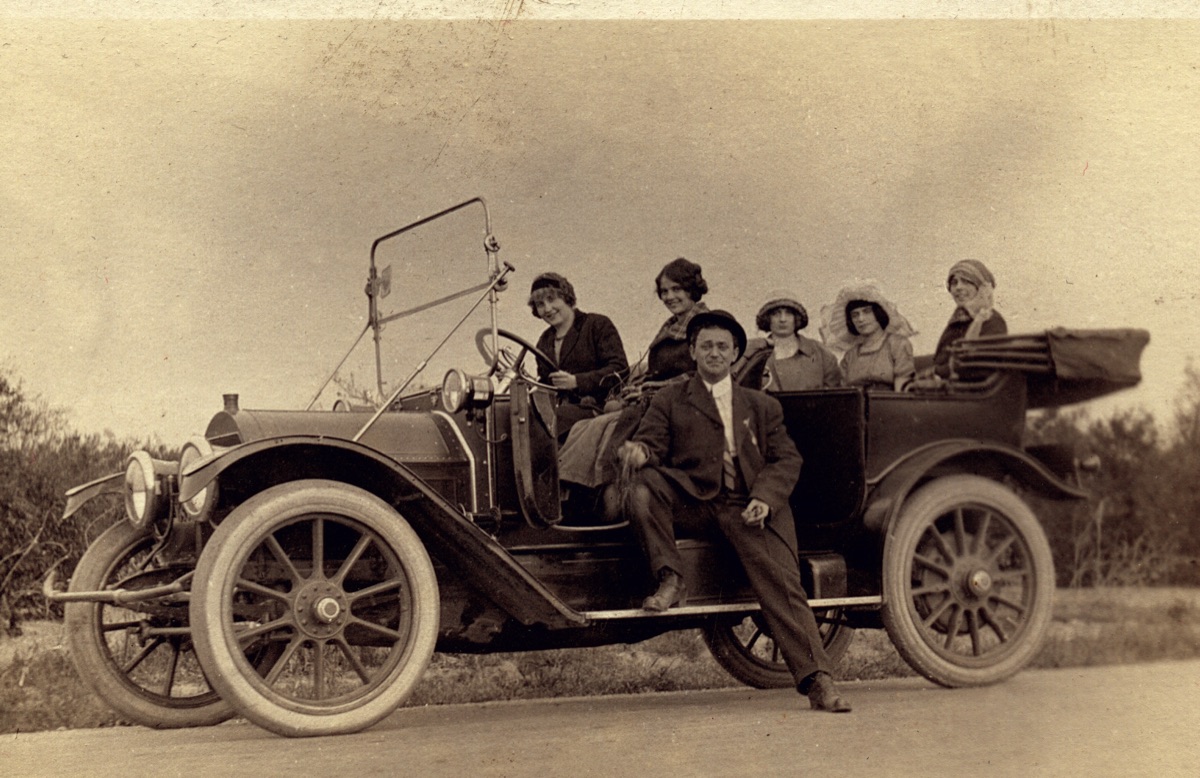
Electric cars were quiet. They didn't require the genuinely dangerous business of hand-cranking an engine to life, a task that could — and sometimes did — break the arm of whoever was cranking it if the engine backfired. They didn't leave drivers smelling of exhaust or oil. And critically, they were overwhelmingly preferred by women drivers specifically because of that hand-crank problem, at a time when hand-cranking a temperamental gasoline engine was viewed as unpleasant, unreliable, and physically risky. That reputation, though, cut both ways — electric cars became stigmatised in some circles as “women's cars,” and some manufacturers responded by bolting fake radiator grilles onto the front of their electrics, purely to visually disguise the absence of an engine and make the car look more like a “serious” gasoline vehicle to status-conscious male buyers.
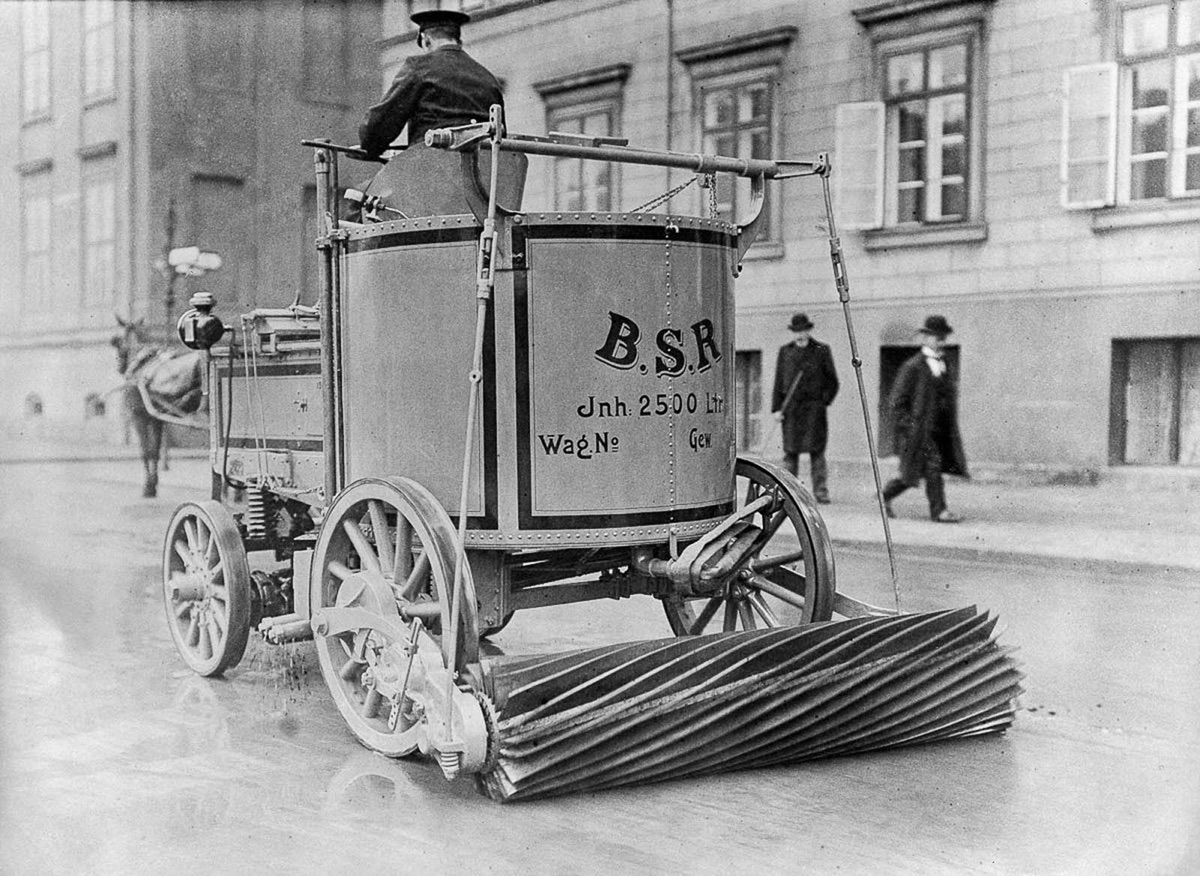
Electric vehicles weren't just for passengers — this electric street sweeper worked Berlin's roads in 1907, part of a much wider golden age for the technology.
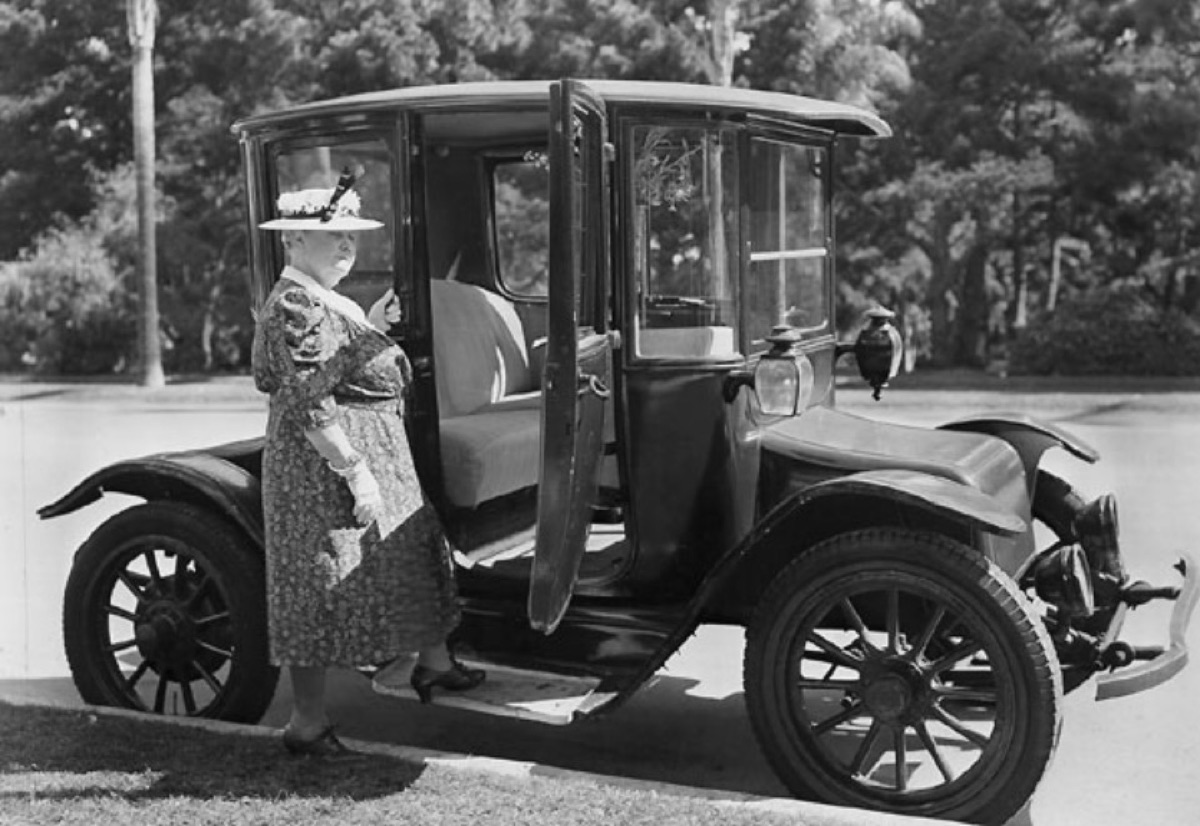
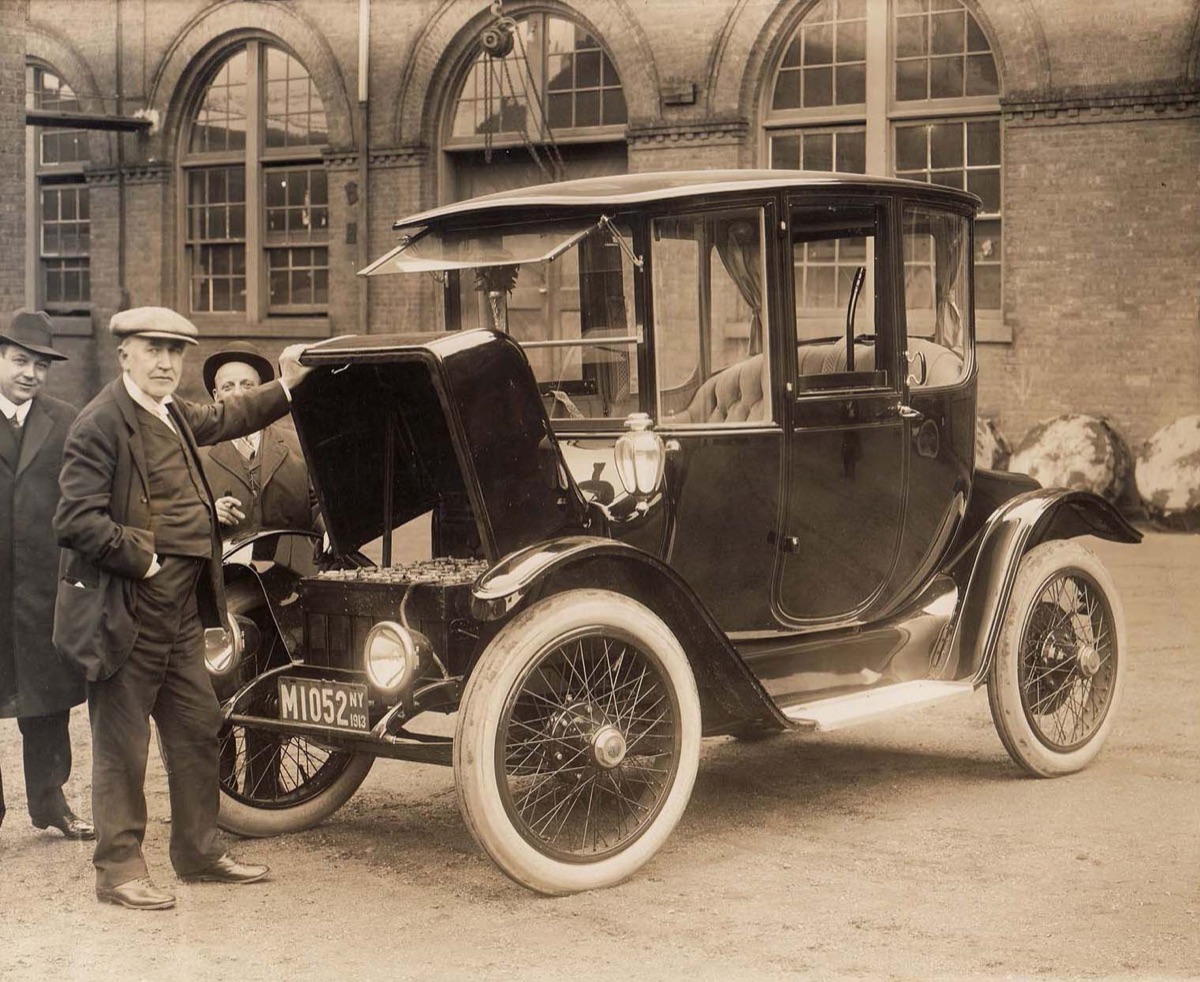
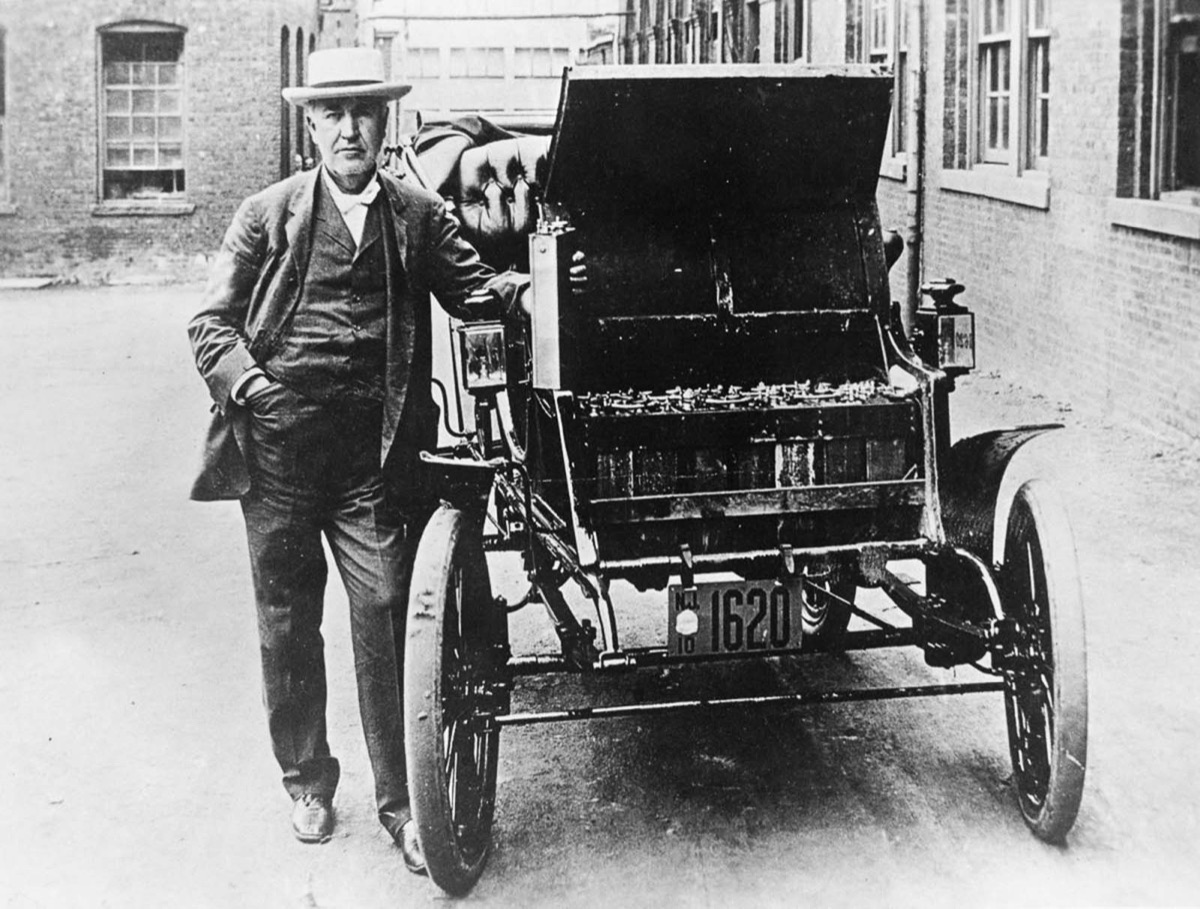
The social proof of the female preference is genuinely striking regardless. Clara Ford — wife of Henry Ford, the man who would soon do more than anyone else to kill the electric car — drove a Detroit Electric, not one of her husband's own gasoline vehicles. Thomas Edison kept a Baker Motor Vehicle Company Imperial Runabout in his own garage and believed passionately that electric propulsion was the technologically superior path forward, personally working for years to build a better EV battery. Manufacturers like Baker Electric, Detroit Electric, and Studebaker — yes, the same Studebaker that later built petrol and diesel cars for decades — all built and sold electric cars at real commercial volume. By 1912, 33,842 electric cars were registered in the United States, making America the country where the electric car had gained the widest acceptance anywhere in the world, and a well-equipped 1912 electric roadster commanded a genuinely serious $1,750 price tag — nearly three times what a gasoline Ford Model T cost that same year.
Clara Ford, wife of Henry Ford, drove a Detroit Electric — not one of her husband's own gasoline cars.
Edison with his Baker Motor Vehicle, 1913
Edison and an early Baker electric, 1895
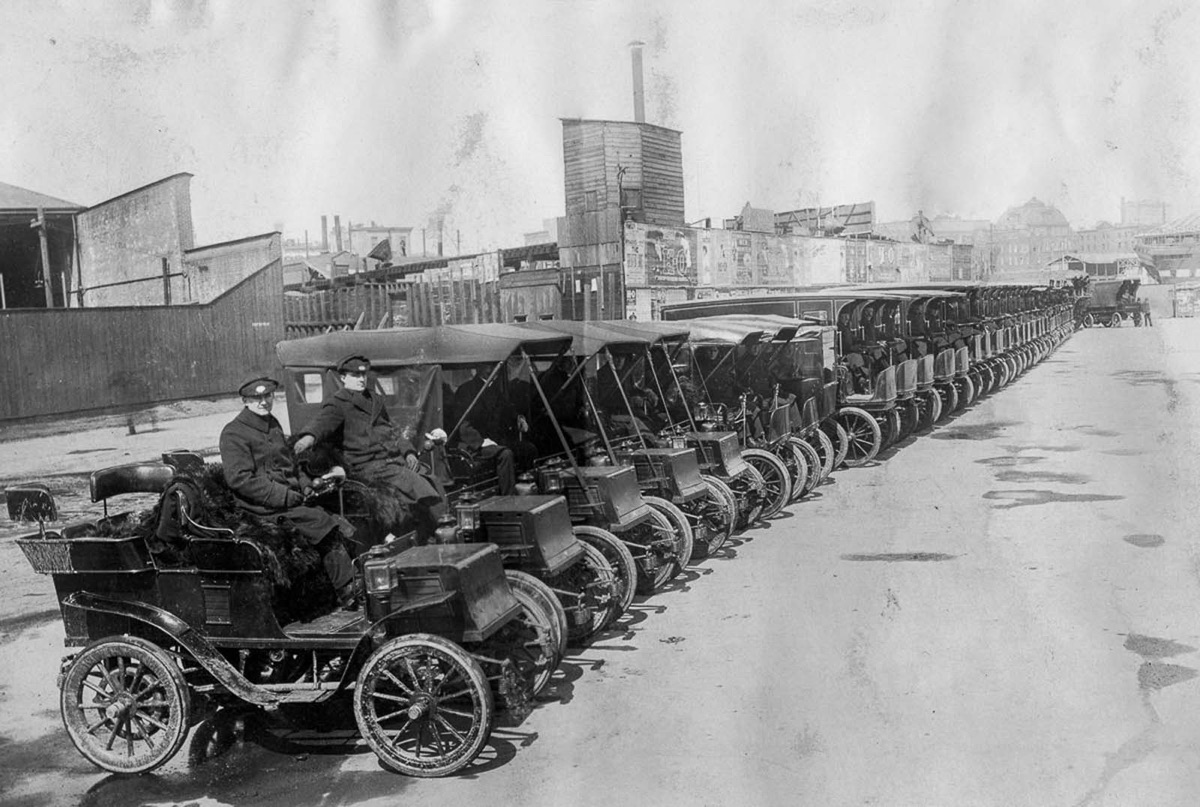
A fleet of early American electric vehicles — by 1912, over 33,000 were registered in the US, more than anywhere else on Earth.
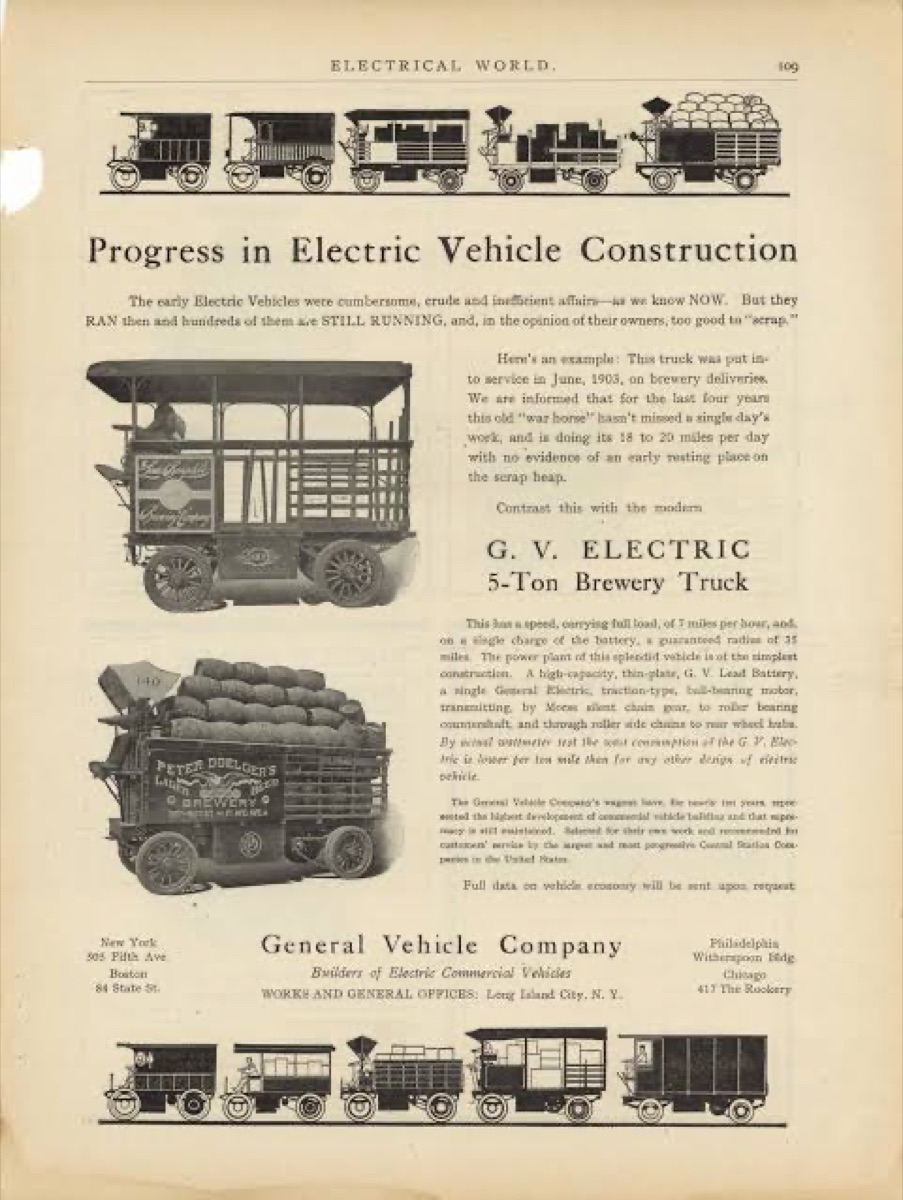
One of the more remarkable, and largely forgotten, solutions to the era's range problem was a genuine battery-swap network. To get around limited range and patchy charging infrastructure, the Hartford Electric Light Company launched the GeVeCo battery service in 1910, initially for electric delivery trucks: customers bought the vehicle without a battery from General Vehicle Company, a subsidiary of General Electric, then paid Hartford Electric a per-mile fee plus a monthly service charge, swapping in a freshly charged battery at a depot rather than waiting to recharge their own — both trucks and batteries specifically engineered for a fast exchange. The service ran for fourteen years, from 1910 to 1924, covering more than 6 million miles in that time, and a very similar scheme launched in Chicago from 1917 for owners of Milburn Wagon Company electrics. It was, in every meaningful sense, a commercially operating battery-swap network — the same idea modern EV companies have occasionally proposed as a novel solution to charging anxiety — running successfully more than a century before anyone thought to reinvent it.
An advertisement for the GeVeCo battery-swap service — a commercially operating battery-swap network running from 1910 to 1924, decades before anyone thought to reinvent the idea.
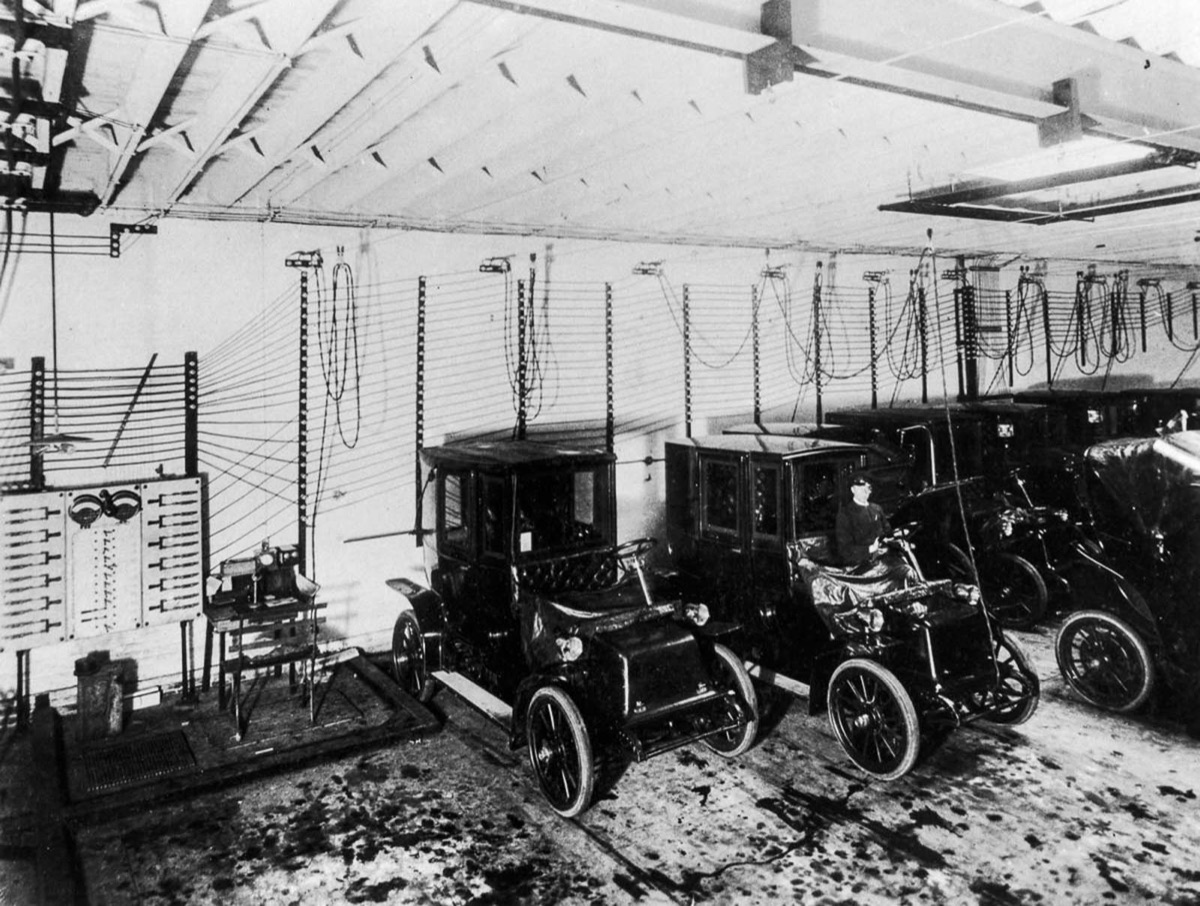
A 1909 electric vehicle recharging station — charging infrastructure existed well over a century before the modern EV era.
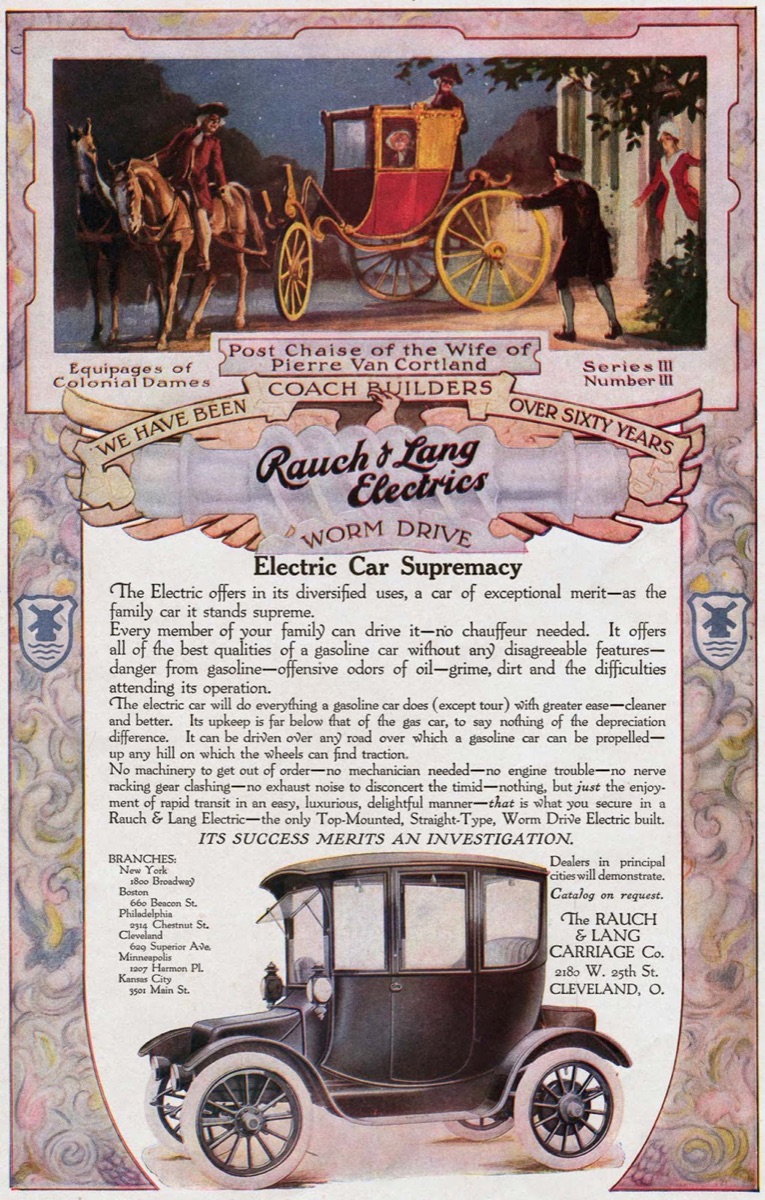
An electric vehicle advertisement from 1910, during the technology's genuine golden age in American cities.
The three inventions that killed it
The end, when it came, arrived from three directions at once, in the space of barely a decade.
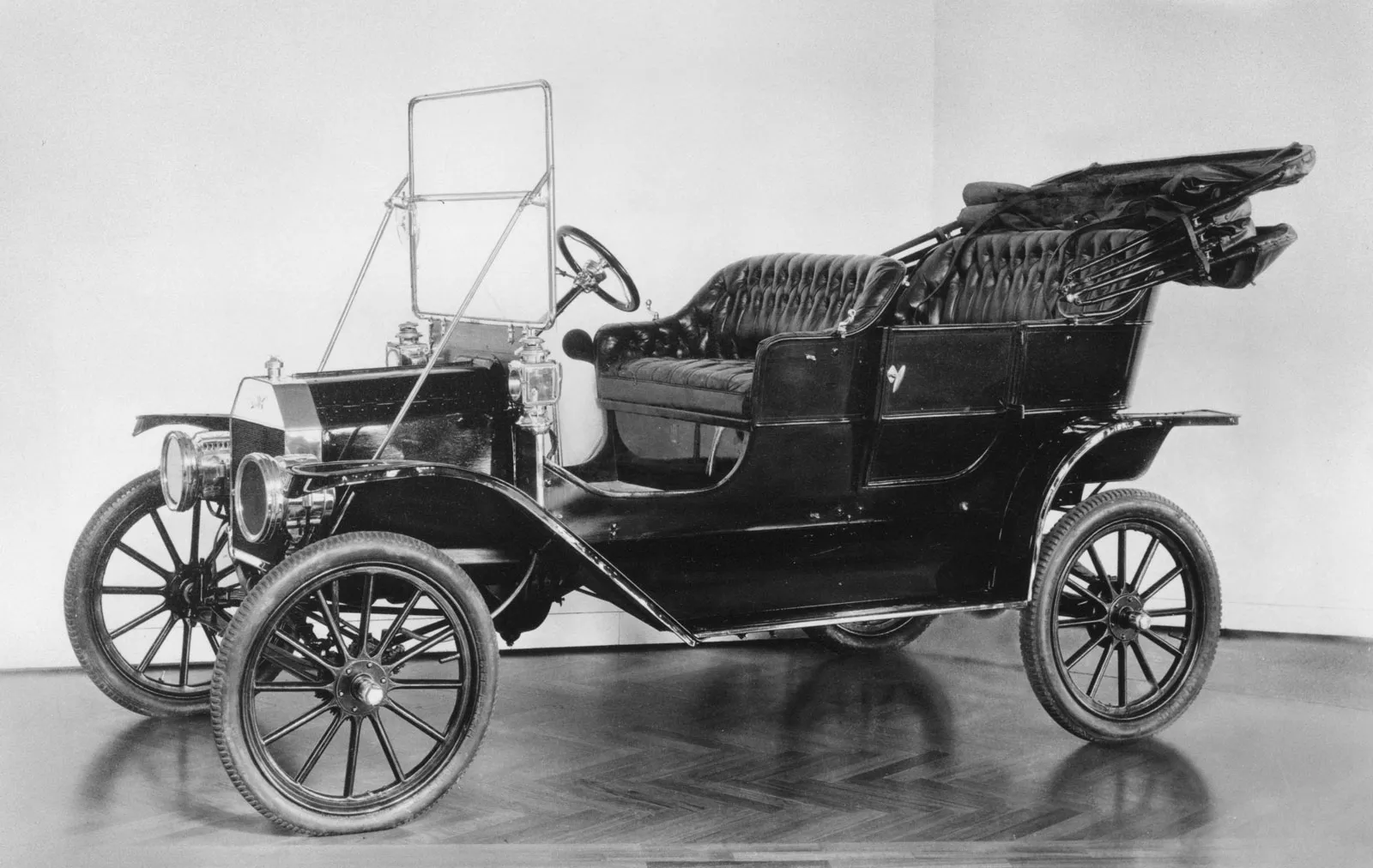
Henry Ford's assembly line. Introduced in 1908, the Model T made mass-produced gasoline cars dramatically, relentlessly cheaper than anything electric. A Model T cost roughly $850 in 1908; by 1912 Ford had driven that down to $590 while an equivalent electric still cost $1,750; by 1923 the Model T's price had collapsed further still to just $290. No electric manufacturer of the era could match that curve, because none of them had anything resembling Ford's manufacturing scale.
The Ford Model T — $850 in 1908, $290 by 1923. No electric manufacturer of the era could come close to matching that price curve.
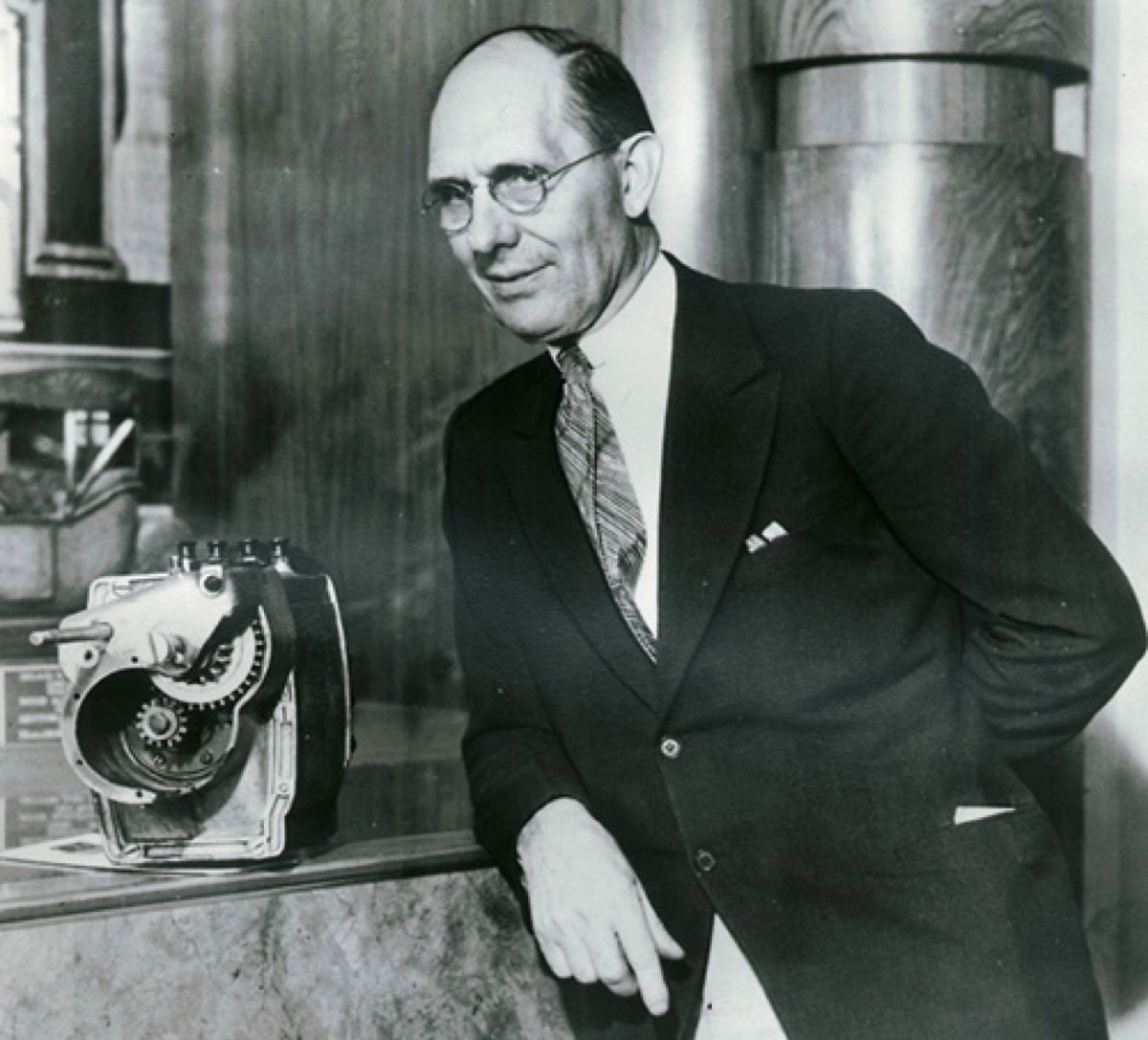
Charles Kettering's electric starter. In 1912 — in a genuinely ironic twist, given that “electric” is right there in the name — engineer Charles Kettering invented the electric starter motor for gasoline engines, eliminating the dangerous hand crank that had been one of the EV's single biggest practical advantages. General Motors' 1912 Cadillac Model Thirty was the first car to offer Kettering's starter as standard equipment, and by 1927 even Ford's own second mass-market car, the Model A, included one as standard. Almost overnight, the one advantage that had made electrics genuinely more pleasant and less intimidating to operate simply disappeared for everyone.
Charles Kettering
His 1912 electric starter motor
The 1912 Cadillac Model Thirty — the first car to offer Kettering's electric starter as standard equipment.
Cheap oil and better roads. The discovery of abundant, easily drilled oil reserves in Texas and Oklahoma made gasoline itself remarkably cheap, and improving road networks across America began to favour the longer range of petrol-powered cars over the shorter range electric batteries of the era could manage. Between all three factors combined, electric vehicle manufacturers were put out of business almost entirely by the mid-1920s.
Even Henry Ford himself, remarkably, tried to buck the trend he was largely responsible for creating. In 1914 he partnered directly with his friend Thomas Edison to explore building a genuinely affordable electric car. It never came to anything. The economics Ford's own assembly line had unleashed were simply too overwhelming, working against the very project he was personally trying to fund.
Decades in the wilderness, then a strange false start
For most of the 20th century, the electric car essentially disappeared from mainstream consciousness, surviving only in niche industrial applications — electric forklifts, delivery platform trucks, ambulances — anywhere the total absence of exhaust fumes mattered more than range or speed.
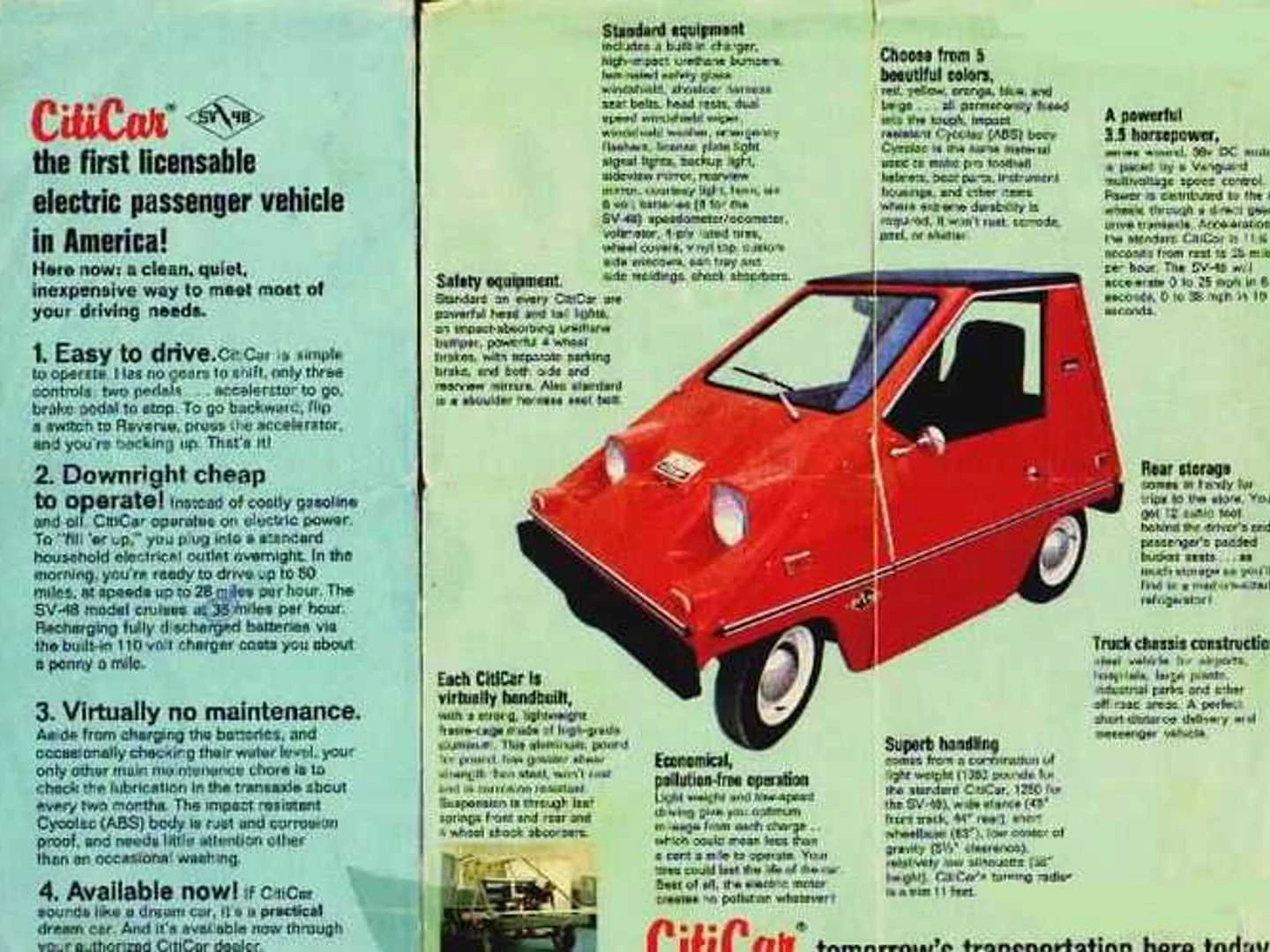
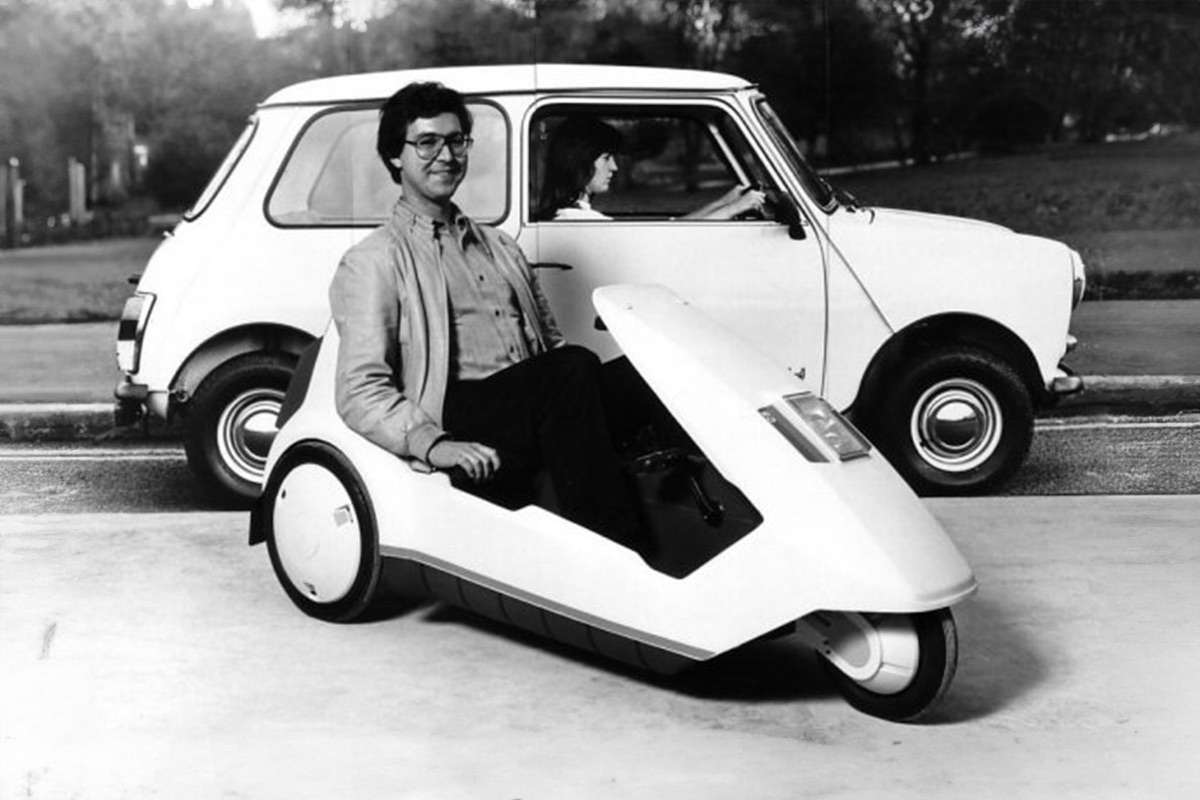
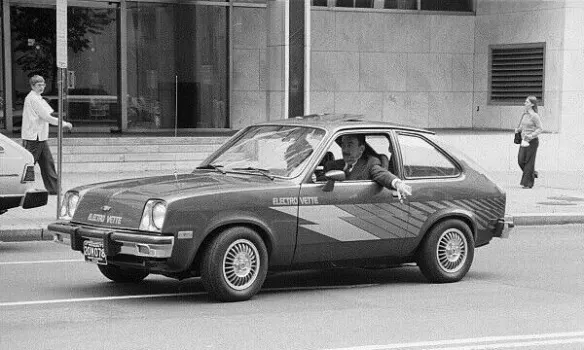
The energy crises of the 1970s and 1980s briefly revived interest, as oil shocks reminded governments and manufacturers of the vulnerability of depending entirely on imported petroleum. Most of what emerged from that period, though, was genuinely underwhelming — the British-market Sinclair C5, an ill-fated battery-powered tricycle launched in 1985, became a byword for commercial failure almost overnight. General Motors quietly built a converted-gasoline-car EV concept, the Electrovette, in 1976, but nothing resembling a serious production commitment followed for another decade and a half.
The CitiCar — a small electric car born of the 1970s oil crises, and typical of the era's underwhelming attempts to revive the EV.
The Sinclair C5, launched in 1985 — a commercial failure that became a byword for how not to relaunch the electric vehicle.
GM's Electrovette, built in 1976 — a converted gasoline car, and nothing more than a quiet concept for another decade and a half.
GM builds a real one — then crushes almost all of them
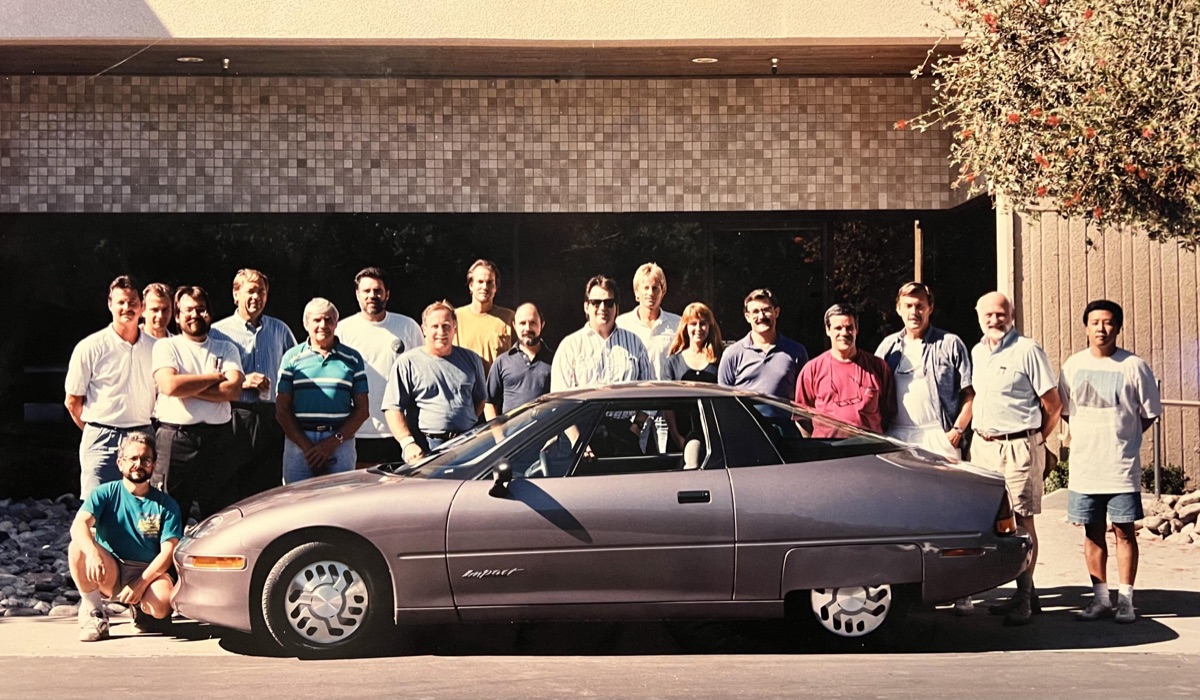
The genuine modern EV era begins in 1990, when California passed sweeping air quality regulations through the California Air Resources Board mandating that automakers selling cars in the state produce a rising percentage of zero-emission vehicles — 2% by 1998, rising to 10% by 2003. General Motors responded not with a converted gasoline car but with something built from a clean sheet: the EV1, unveiled in concept form as the “Impact” at the 1990 Los Angeles Auto Show, itself descended from Sunraycer, a solar racing car GM had built with AeroVironment and Hughes Aircraft that won the first World Solar Challenge outright in 1987.
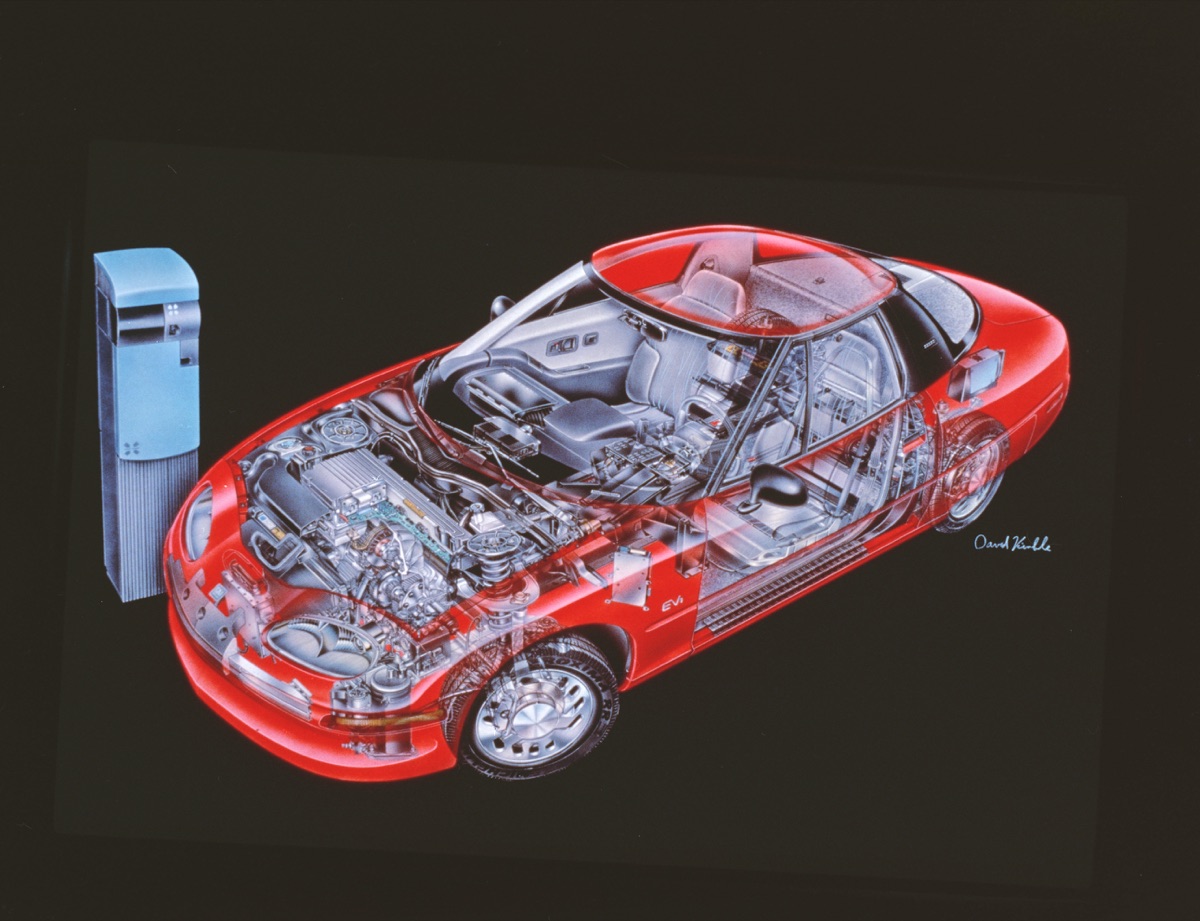
The production EV1, launched in 1996, was a genuinely serious, purpose-built two-seater — aerodynamic bodywork, regenerative braking, a real engineering effort rather than a compliance afterthought. It was never sold outright, only leased, for between $399 and $549 a month, exclusively to residents of Southern California, metro Phoenix, and later Sacramento and Atlanta. First-generation cars ran lead-acid batteries good for 70-100 miles; the improved 1999 second generation, switching to nickel-metal hydride batteries, stretched that to 100-140 miles. Over the entire 1996-1999 production run, GM built just 1,117 examples — a tiny fraction of the 5,000 to 20,000 per year analysts had originally projected.
The 1990 “Impact” concept
The production EV1, launched 1996
What happened next is the single most controversial chapter in modern automotive history. Once California relaxed its zero-emission mandate, GM chose not to renew the EV1 leases. Despite offers from devoted drivers to buy the cars outright — including a reported $1.9 million offer for the 78 remaining Burbank-area vehicles — GM refused to sell, loaded the cars onto trucks, hauled almost the entire fleet to Mesa, Arizona, and crushed them into scrap. Only around 40 cars, out of 1,117 built, escaped the crusher, donated in deactivated form to museums and universities including the Smithsonian. Activists including actresses Alexandra Paul and Colette Divine were arrested attempting to physically block the trucks. The episode became the subject of the 2006 documentary Who Killed the Electric Car?, which laid much of the blame at the feet of GM and the oil industry, and interviewed EV1 devotees including Mel Gibson and Tom Hanks.
GM's own official explanation was more mundane: the EV1 used roughly 2,000 unique parts found in no other GM vehicle, the company had no interest in maintaining a permanent parts and service inventory for such a tiny fleet, and it was wary of the liability risk of independent mechanics working on cars carrying dangerous 312-volt battery packs. Whichever explanation carries more weight, the outcome was the same either way — and it left a scar deep enough that, in March 2009, outgoing GM CEO Rick Wagoner publicly called killing the EV1 and failing to invest further in electrics the single biggest mistake of his entire tenure as chief executive.
A Silicon Valley entrepreneur, a laptop battery idea, and a very different ending
The EV1's destruction, rather than closing the book on the electric car, became the origin story of the company that would finally make it stick. Martin Eberhard, a serial entrepreneur who'd already sold one startup for $187 million, began noticing something in 2003 while driving around Palo Alto: driveways that held a Toyota Prius — which he privately called the “dork mobile” — very often also held a Porsche 911 or another genuine sports car. His insight was simple: what if you didn't have to choose between environmental conscience and something genuinely fast and desirable?
Martin Eberhard — co-founder of Tesla Motors, whose insight was that people didn't want to choose between conscience and a genuinely desirable car.
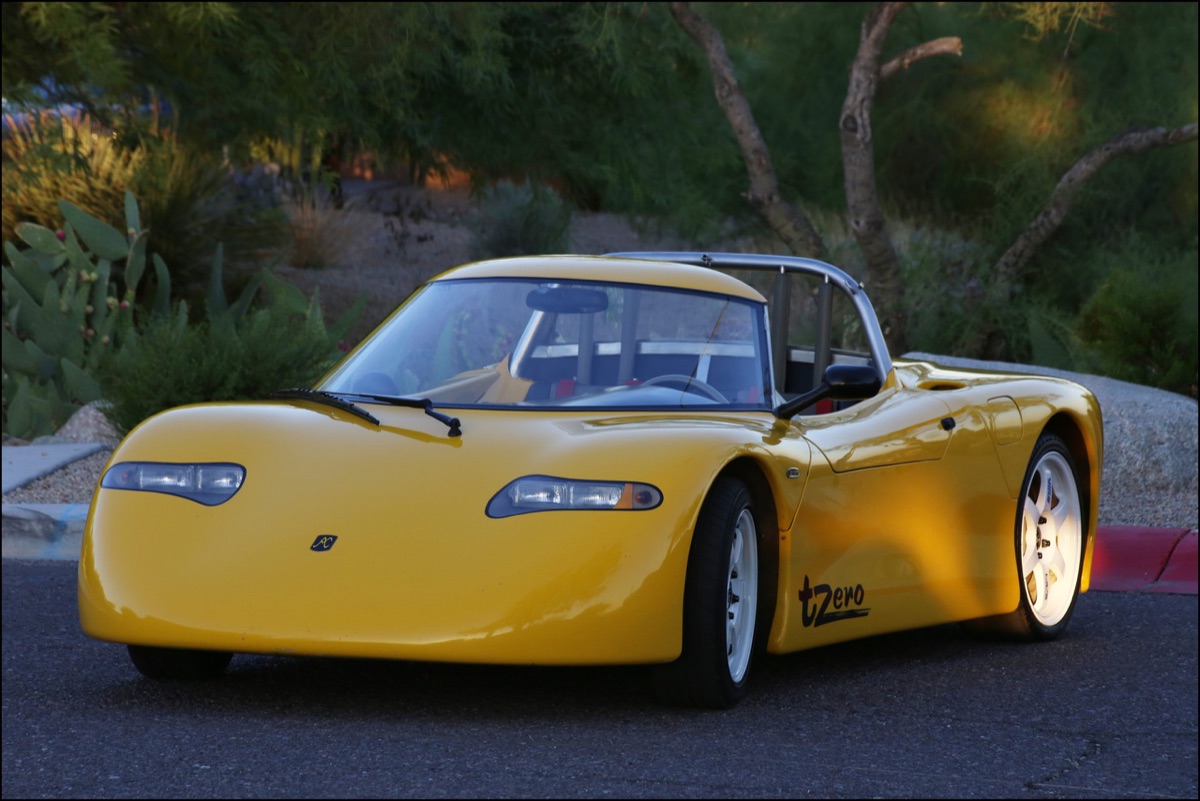
Eberhard's plan was to license an existing electric drivetrain from a small firm called AC Propulsion and build the car using an outside manufacturer, borrowing the “fabless” model semiconductor companies had long used. He co-founded Tesla Motors — named for Nikola Tesla — with Marc Tarpenning in July 2003. Unable to raise venture capital on his own at a time when petrol cost roughly $1.50 a gallon and nobody in Detroit took a Silicon Valley EV startup seriously, Eberhard eventually found his way to Elon Musk, fresh off the sale of PayPal, who became Tesla's primary financial backer and chairman.
AC Propulsion's T-Zero, built by engineer Alan Cocconi — the prototype that inspired the Tesla Roadster.
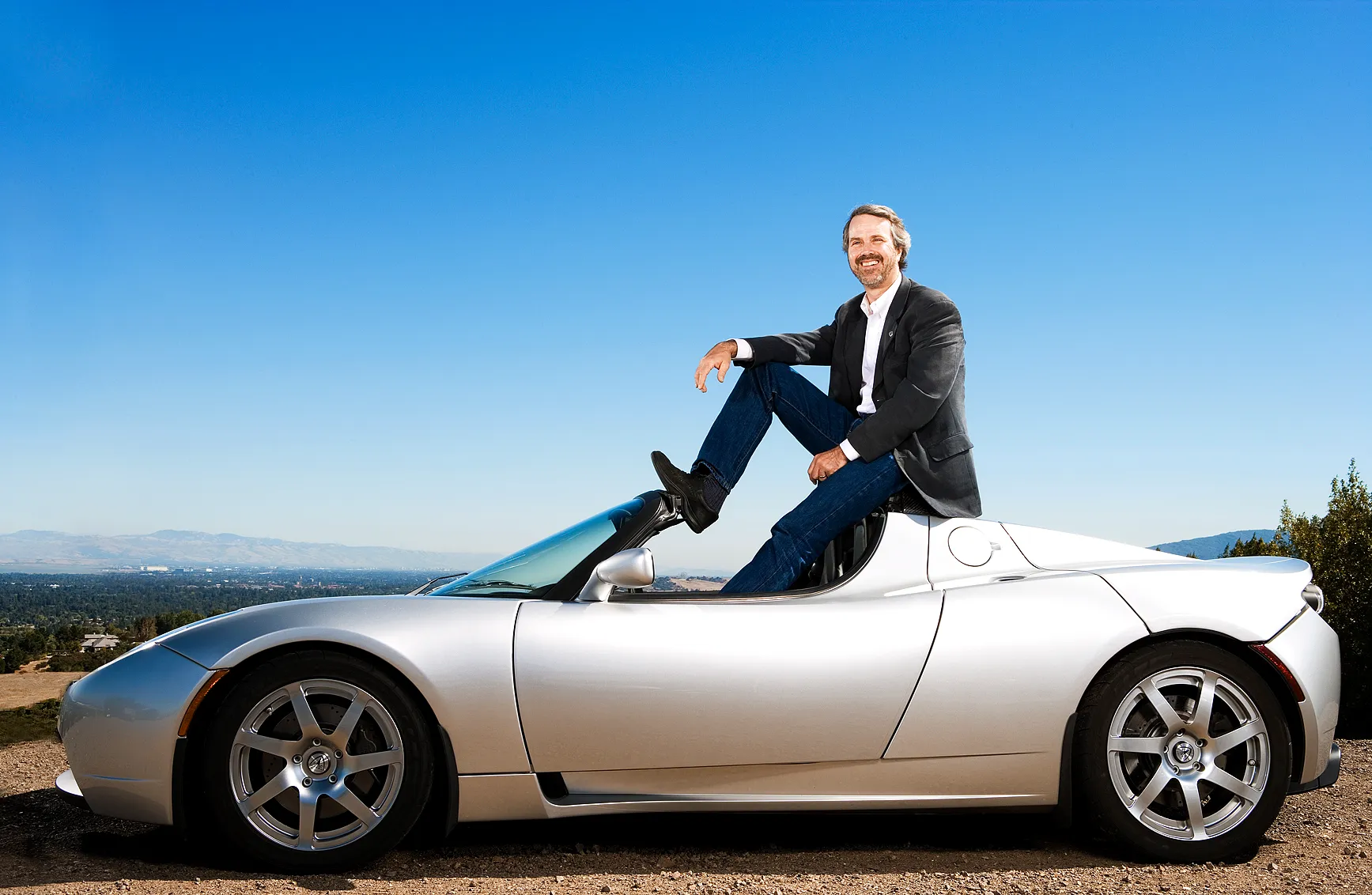
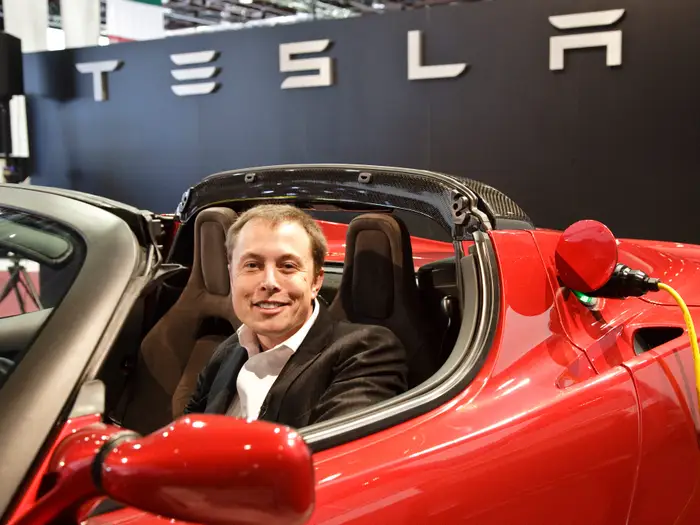
Tesla's first car, the Roadster, launched in 2008 — just five years after GM crushed the last of its EV1s, and built directly on lithium-ion laptop-cell battery technology that Alan Cocconi, the engineer behind the T-Zero prototype that inspired the Roadster, argued could have given the EV1 itself up to 300 miles of range had GM pursued it. Musk has been explicit, publicly and repeatedly, that GM's treatment of the EV1 was part of what motivated Tesla's founding in the first place.
Elon Musk with the Tesla Roadster, launched in 2008 — five years after GM crushed the last of its EV1s.
From niche curiosity to genuine market force
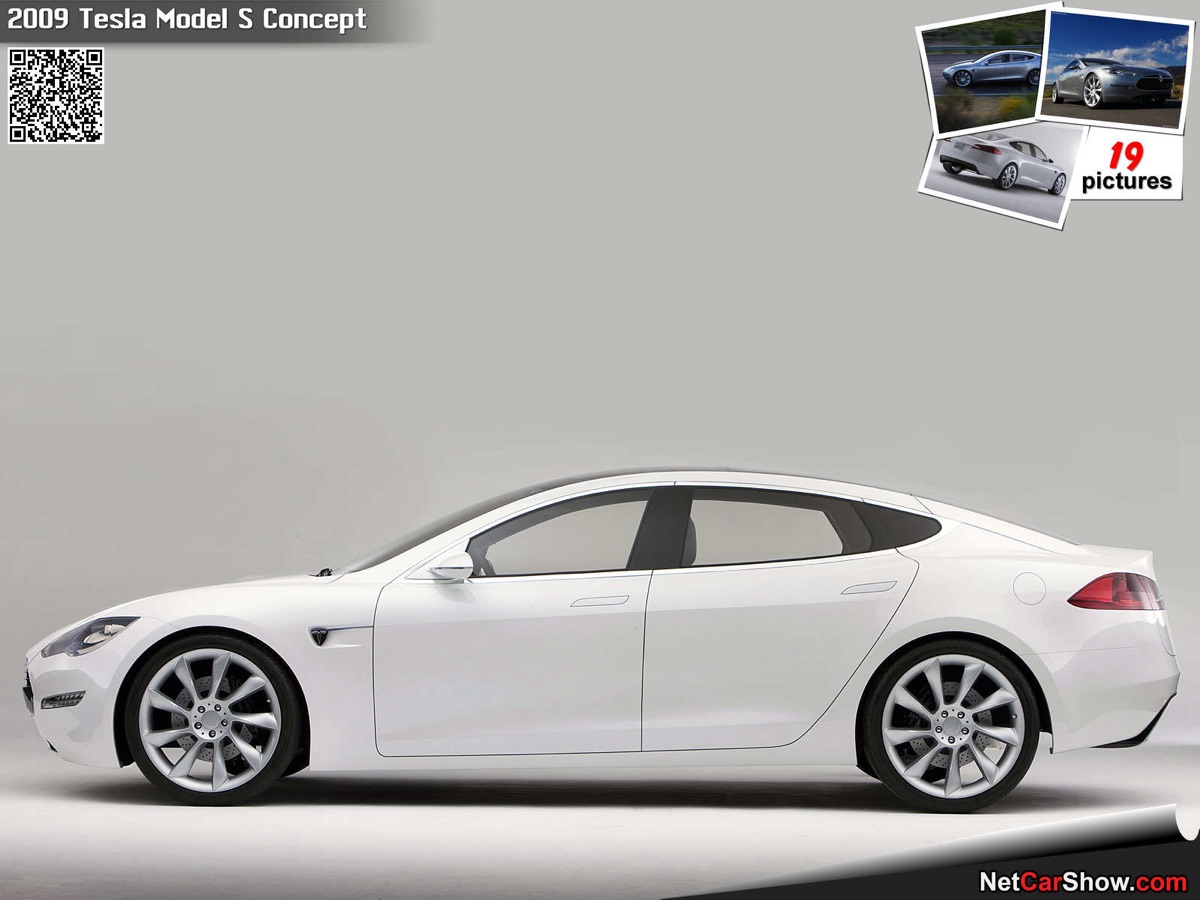
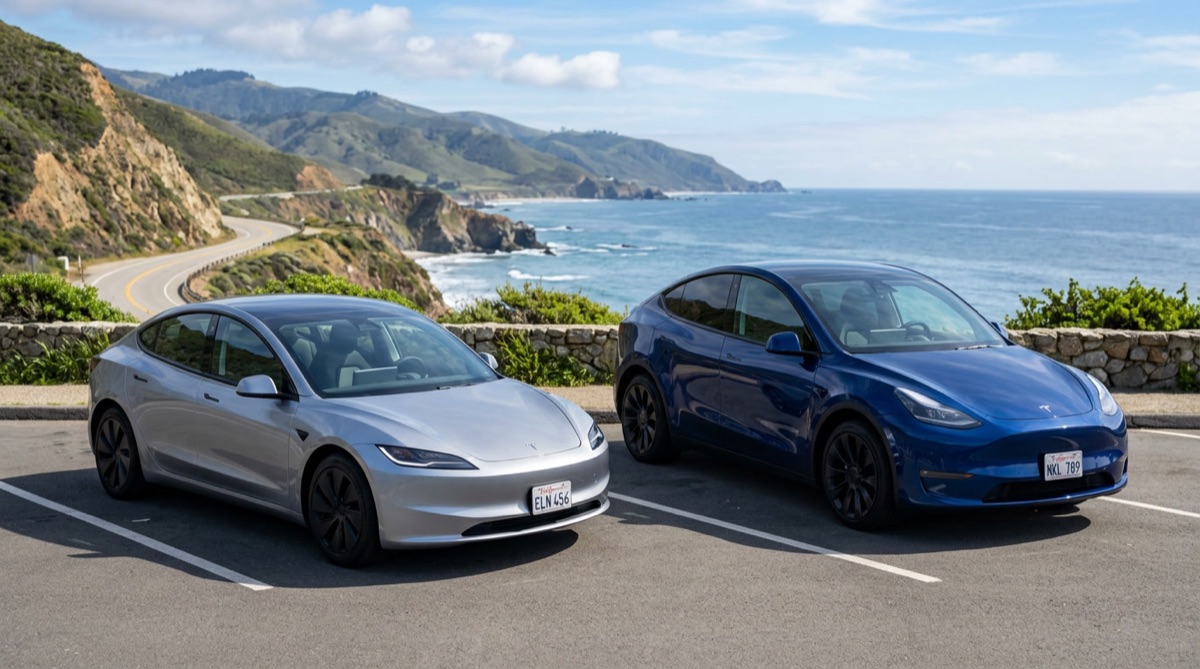
What followed was a compounding, decade-long shift that has genuinely reshaped the auto industry. Tesla received a $465 million Department of Energy loan in 2010 to build its California factory — a loan it repaid nine years ahead of schedule. The Model S arrived in 2012, the Model 3 in 2017 became the car that finally brought EV pricing into genuinely mainstream territory, and by the early 2020s Tesla had become the most valuable automaker in the world by market capitalisation, despite selling a fraction of the volume of legacy giants like Toyota or Volkswagen.
The 2009 Tesla Model S concept — the car that arrived in 2012 and helped make Tesla the world's most valuable automaker within a decade.
Legacy manufacturers, having watched Tesla prove the market existed, poured in behind it — Nissan's Leaf, GM's own belated Chevrolet Bolt and Volt, and eventually a wave of European and Chinese manufacturers that has now made electric vehicles a genuinely global mainstream product rather than a Californian compliance curiosity. Global EV sales surpassed 10 million units in a single year by 2023, and Norway — through an aggressive, decades-long policy of tax incentives — became the first country where EVs represent the overwhelming majority of new car sales, demonstrating what's genuinely possible when policy, battery cost, and consumer appetite all align at once.
The Model 3 and Model Y — the cars that finally brought EV pricing into mainstream territory.
Tesla in 2026: still dominant, no longer unchallenged
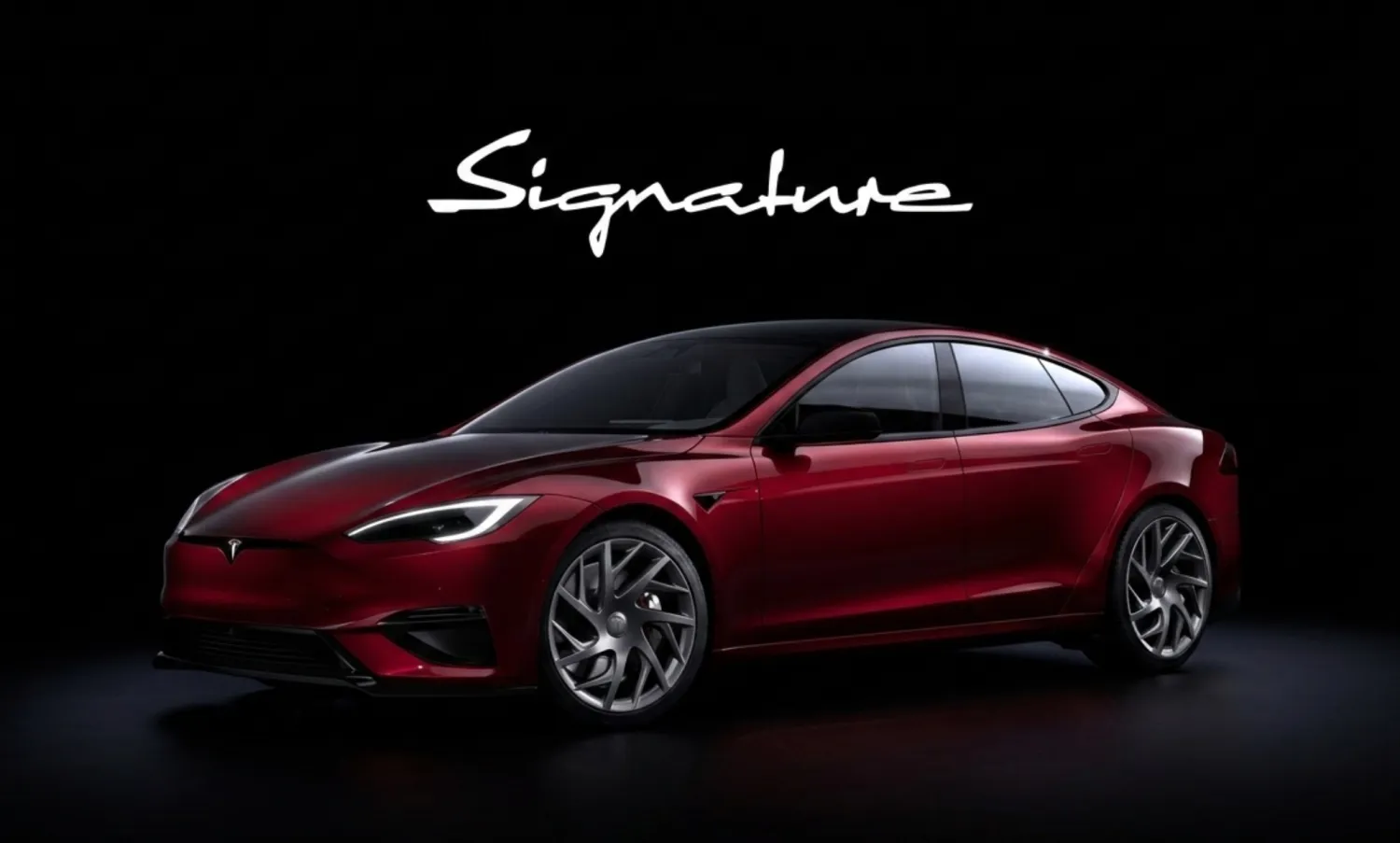
2026 finds Tesla in a genuinely strange position — simultaneously the most dominant EV brand in America and a company whose own numbers tell a story of real strain. Tesla posted its first annual revenue decline as a public company in 2025, deliveries down 8.6% to 1.64 million, and BYD formally overtook it as the world's largest EV maker, selling 2.26 million pure-electric vehicles that year. Tesla hasn't launched a genuinely new passenger model since the Cybertruck in late 2023 — a Cybertruck that has itself used barely a quarter of its Texas production capacity against its original target.
And yet Tesla's US market share actually grew through early 2026, past 54%, not because it's winning new customers but because the rest of the American EV market is contracting even faster as federal tax credits expired. The company now leans almost entirely on one model — the Model Y alone made up two-thirds of Tesla's US sales in early 2026 — a concentration of risk that would look entirely familiar to Detroit Electric or the EV1 programme a century apart.
The international picture looks like a different company: US deliveries were down 15% by May 2026 even as European sales surged 138% and Chinese deliveries grew nearly 40%, helped by cheaper “simplified” Model 3 and Model Y variants built specifically to fend off increasingly capable domestic Chinese rivals. Musk's own framing of Tesla's future has shifted accordingly — ending Model S and Model X production, converting Fremont lines to build Optimus robots, and launching unsupervised robotaxi rides in Austin, betting the company's next chapter on autonomy and robotics rather than simply building more cars.
The end of an era — Tesla wound down Model S and Model X production in 2026, betting its future on autonomy and robotics instead.
China's deliberate bet, in brief
While Tesla was proving the market existed, one government was running a very different, far larger playbook. Starting with 2009's “Ten Cities, Thousand Vehicles” pilot programme, China spent over a decade directing subsidies, cheap financing, and purchase incentives specifically toward domestic battery makers — a 2016 policy tying EV subsidies to Chinese-made batteries alone is estimated to have shifted billions of dollars in global battery production toward BYD and CATL. The result: China now accounts for roughly 62% of all EVs sold worldwide, and CATL and BYD together control more than half the global battery market, with China producing over 80% of the world's lithium-ion cells. It's a different kind of history-making entirely from Trouvé's tricycle or Tesla's Roadster — not one inventor's insight, but one government's decade-long industrial bet, and for now, it's paying off.
China now accounts for roughly 62% of all EVs sold worldwide — the product of a deliberate, decade-long industrial policy rather than a single inventor's breakthrough.
Where the world's automakers actually stand today
Every major manufacturer, on every continent, made bold electrification pledges between 2020 and 2023. Almost all of them have since walked at least part of that pledge back, and the specifics — platform names, real losses, real percentages — tell a far more textured story than the original headlines did.
BMW Group (Germany, spanning BMW, Mini, and Rolls-Royce) is targeting 50% of global deliveries as fully electric by 2030 — a figure that pointedly excludes hybrids and plug-in hybrids, counted separately. In 2025, one in four vehicles BMW Group delivered worldwide were electrified in some form, rising to 40% of sales in Europe specifically, with pure EVs alone at 17.9% of global deliveries — a long way short of the 2030 goal but growing quickly. The centrepiece is Neue Klasse, a genuinely clean-sheet EV platform whose name is a deliberate callback: the original 1960s “Neue Klasse” sedans are widely credited with saving BMW from near-bankruptcy and setting the template for every 3 Series since, and the company is consciously invoking that history now. The first Neue Klasse model, the iX3, launched for 2026 with an 800-volt architecture, a roughly 108kWh battery good for around 400 miles of EPA range, and fast-charging adding over 150 miles in just 10 minutes. BMW plans 40-plus Neue Klasse models by 2027, a new dedicated factory in Debrecen, Hungary, and full electrification of its Munich plant by 2027, while Rolls-Royce's Spectre already accounted for 38% of that brand's deliveries in one recent quarter.
Ford (US) targeted 50% of North American sales as electric by 2030 and an all-electric European range by the same date. The financial reality has been genuinely brutal: Ford's dedicated Model e EV division has now lost more than $16 billion since 2022 — $2.2 billion in 2022, $4.7 billion in 2023, $5.1 billion in 2024, and $4.8 billion in 2025 — working out to a loss of roughly $23,000 on every single electric vehicle Ford sold in early 2026. The company announced a $19.5 billion pre-tax restructuring charge in December 2025, discontinued the F-150 Lightning electric pickup entirely, and cancelled a planned three-row electric SUV once, in CEO Jim Farley's own words, “the math wasn't working.” Ford's response has been to pivot hard toward hybrids and extended-range EVs — vehicles with a small combustion engine acting purely as an onboard generator, not mechanically connected to the wheels, similar in concept to Mazda's MX-30 R-EV — alongside developing a new, deliberately cheaper Universal EV Platform explicitly aimed at matching the cost efficiency of BYD and other Chinese rivals, with breakeven not expected before 2029.
General Motors (US) originally targeted 1 million EVs of annual North American production capacity by 2025, then quietly paused that goal, with CEO Mary Barra acknowledging “the market just isn't developing” as fast as hoped. The reality has been volatile rather than simply declining: GM's US EV sales jumped 110% to 66,501 units in Q3 2025 as buyers rushed to beat the expiry of the federal tax credit, then fell 42% to 25,219 units in Q4 once that credit actually disappeared — Cadillac alone swinging from 40% electric to 27% of its own sales in a single quarter. GM's EV push is built around its in-house Ultium battery platform, underpinning the Chevrolet Equinox EV, Blazer EV, and Cadillac Lyriq, and — in a genuinely notable reversal — GM confirmed it will reintroduce plug-in hybrids to the North American market in 2027, something almost every competitor already offers and GM had previously bypassed entirely in favour of going straight to full electric.
Volkswagen Group (Germany, encompassing VW, Audi, Škoda, SEAT/Cupra, and Porsche) remains, per BloombergNEF analysis, “far from” its 2030 targets. Its current EV range across every one of those brands runs on the shared MEB (Modular Electric Drive Matrix) platform, flexible enough to underpin everything from compact hatchbacks to larger SUVs with scalable battery sizes — the same platform, notably, that Ford licenses from VW for its own European electric models. The group is now transitioning toward a more advanced successor, the SSP (Scalable Systems Platform), intended to deepen the software and digital capability of the next generation of VW Group EVs, though the timeline for that shift has itself slipped as the group manages weaker-than-expected demand across its existing MEB-based range.
Mercedes-Benz (Germany) pushed its interim 50% EV sales target back roughly five years and shifted full electrification out of the 2020s entirely into “the 2030s.” Structurally, the company has been quietly winding down its separate EQ sub-brand — used for the EQS, EQA, and EQB — in favour of simply badging electric versions of its existing core nameplates (an electric E-Class, eventually an electric S-Class expected around 2029-2030), the same core-model-electrification strategy Ford is also pursuing. Mercedes has simultaneously reintroduced V8 petrol engines for select high-performance variants after the backlash to the four-cylinder hybrid C63.
Stellantis (Netherlands-headquartered, spanning Jeep, Fiat, Peugeot, Citroën, Vauxhall/Opel, and more) originally targeted 100% EV sales in Europe and 50% in the US by 2030. It has instead booked €22.2 billion ($27 billion) in writedowns in the second half of 2025 alone, cancelled its planned fully electric Ram 1500 pickup before it ever reached market, axed the high-performance 800-volt Dodge Charger Daytona SRT Banshee variant, and discontinued the base electric Charger Daytona R/T for 2026 — deprioritising EVs across Jeep and other brands in favour of hybrids and a full-throttle return to the V8 Hemi. Stellantis has, however, found genuine success at the affordable end through its European city-car EV lineup — the Peugeot e-208, Fiat 500e, and Citroën ë-C3 among them — and through Leapmotor, a Chinese EV brand now selling in Europe as a Stellantis joint-venture partner.
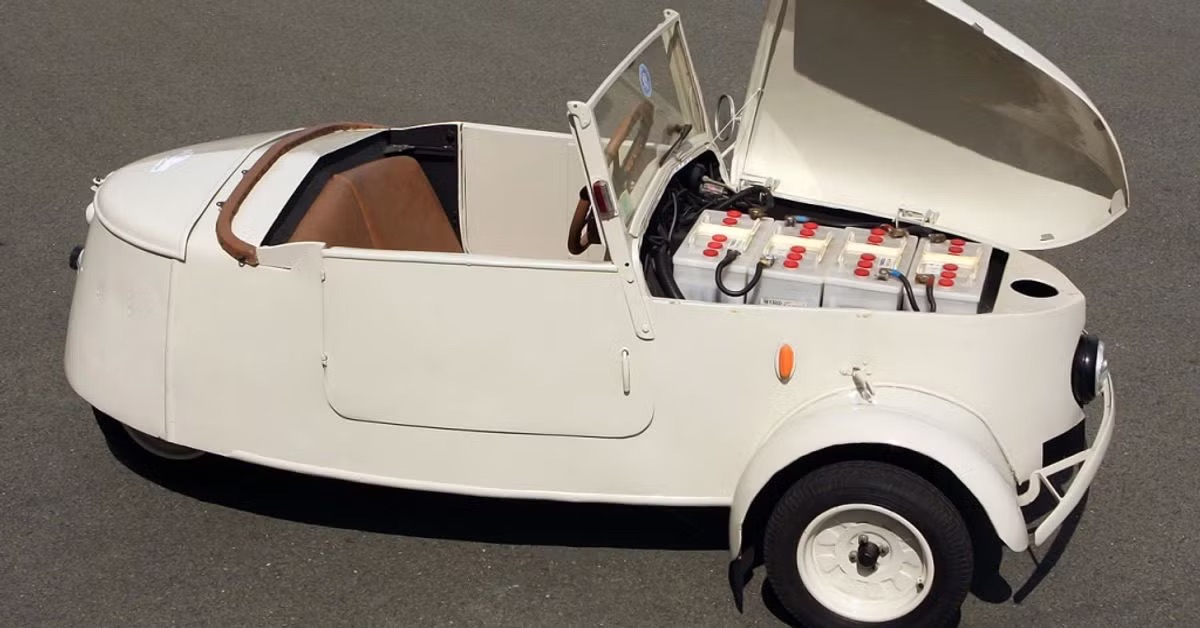
Peugeot was building electric cars before the Second World War — the brand's modern e-208 is far from its first attempt at an EV.
Toyota (Japan), true to Chairman Akio Toyoda's long-stated “multi-pathway” philosophy — hybrids, plug-in hybrids, hydrogen, and EVs running side by side rather than one replacing the others — cut its 2026 EV sales target from 1.5 million to 1 million units, a considerably smaller retreat than most rivals simply because Toyota never bet as heavily on EVs alone in the first place, leaning instead on its long-dominant hybrid lineup — the same Prius technology, incidentally, that Martin Eberhard was driving past in Palo Alto driveways when he first conceived of Tesla.
Honda (Japan) set an ambitious target of exclusively selling EVs and hydrogen fuel-cell vehicles in North America by 2040, but has since been forced into a strategic overhaul after EV-related losses and expenses reached roughly ¥267.1 billion (around $1.71 billion) in just nine months.
Renault (France) represents one of the more genuine European EV success stories: the retro-styled, affordably priced Renault 5 E-Tech became France's best-selling EV in its very first year on sale, real evidence that European buyers will adopt EVs when price and product both land correctly. The group's dedicated EV division, Ampere, was intended to be spun off in its own stock market listing, but that IPO remains delayed pending better market conditions.
Across the industry worldwide, BloombergNEF found combined 2030 EV production targets from 16 major automakers have fallen from an original peak of 17.6 million units to just 11.9 million — millions of electric vehicles that, on paper, simply won't be built by the dates once promised. And the picture looks entirely different depending on where in the world you're standing: US EV market share fell to just 5.7% of new car sales in Q4 2025 once federal tax credits expired, while Europe's EV share reached 28% in 2025 under the direct pressure of tightened EU CO2 emissions standards, and China — where 16.5 million of the 32 million cars sold domestically in 2025 were EVs or plug-in hybrids — continues to operate on an entirely different scale and timeline from the rest of the world combined.
The bottom line
The electric car's second life didn't arrive as the clean, inevitable sweep of history the 2021-era headlines promised. It arrived the way its first life did — messily, unevenly, driven as much by government mandate, subsidy, real financial losses, and corporate hedging as by pure technological triumph. A forgotten Parisian watchmaker proved electric propulsion could actually move a person down a real street in 1881, decades before anyone had heard of range anxiety or a lithium-ion cell, and he died with almost nobody remembering his name for it. An eccentric Brighton clockmaker's son electrified an entire seaside town and built a car for a sultan while going bankrupt. A Hartford bicycle magnate briefly out-produced almost every rival in America with a car powered by nothing but batteries. Whether the 2020s prove to be the decade EVs finally, permanently displace the internal combustion engine worldwide, or merely another chapter in a technology that has now been “the future” twice and quietly buried once already, is still being written — this time not by one entrepreneur in a garage, but by governments and boardrooms across three continents simultaneously, each one still trying to work out how fast the rest of the world is actually willing to move.
Whether you're driving a century-old idea in a brand-new EV or a car with a combustion engine that traces its own lineage back just as far, autOracle can help you understand exactly what it needs and what to check before your next MOT.
Know your EV before you buy it.
Electric or combustion, autOracle reads your car's diagnostics and explains exactly what's going on underneath.
Join autOracle waitlistSources
- Rare Historical Photos, “The Story in Pictures of the Early Electric Cars, 1880-1920” — rarehistoricalphotos.com
- Car Talk, “Plugging In: The First Electric Cars” — cartalk.com
- Paléo-Énergétique, “The electric tricycle of Gustave Trouvé” — paleo-energetique.org
- UPS Battery Center Blog, “Gustave Trouve Pioneers Electric Transport in 1881” — blog.upsbatterycenter.com
- Guinness World Records, “First electric road vehicle” — guinnessworldrecords.com
- Grokipedia, “Gustave Trouvé,” “Columbia (automobile brand),” “Electric vehicle industry in China” — grokipedia.com
- Wikipedia, “Gustave Trouvé,” “Magnus Volk,” “History of the electric vehicle,” “Who Killed the Electric Car?,” “Columbia (automobile brand)” — en.wikipedia.org
- The Gussies, “About Gustave Trouvé” — thegussies.com
- The Vintagent, “A History of Electric Motorcycles (Part 1)” — thevintagent.com
- The Mobility House, “Short history of the electric vehicle” — mobilityhouse.com
- Engine Stories, “The Story of the First Electric Car” — enginestories.com
- My Brighton and Hove, “One of the greatest of all Brightonians | Magnus Volk” — mybrightonandhove.org.uk
- Graces Guide, “Magnus Volk” — gracesguide.co.uk
- The Autopian, “Over A Century Ago, A Man Tried To Reinvent Coastal Transportation With A Train That Was Also A Boat And A Pier” — theautopian.com
- Science Photo Library, “Electric dogcart, 19th century” — sciencephoto.com
- InsideEVs, “Electric Vehicle History: The 1800s And Early 20th Century,” “Electric Vehicles Had Their First Golden Age In The Early 1900s,” “Tesla's U.S. Sales Tanked In Q1. It Still Gained Market Share” — insideevs.com
- HandWiki, “Engineering:History of the electric vehicle” — handwiki.org
- History Tools, “The Early History of the Electric Car” — historytools.org
- EN Plus, “The History of Electric Cars: A Journey from Past to Present” — en-plustech.com
- The Business Download, “Road To Innovation: The History Of EVs, 1830 To 1950 (Part 1)” — thebusinessdownload.com
- Kiddle, “History of the electric vehicle facts for kids” — kids.kiddle.co
- Sytner Group, “History of Electric Cars” — sytner.co.uk
- EV Daily, “The Ultimate Electric Vehicle Guide” — ev-daily.com
- U.S. Department of Energy, “The History of the Electric Car” — energy.gov
- Business Standard / EVSHIFT, “Electric cars: Forgotten past, repeated rise and fall before latest revival” — business-standard.com / evshift.com
- Loup Power District, “The Evolution of the EV” — loup.com
- Interesting Engineering, “Here's the very brief history and evolution of electric cars” — interestingengineering.com
- arXiv, “Hairpin Motors for Electromobility” — arxiv.org
- Fortune, “Tesla's Wild Ride” (2008) — fortune.com
- TopSpeed, “Here's What Really Happened To The GM EV1 Electric Car” — topspeed.com
- Green Car Reports, “Report: With EV1, GM sparked the era of the electric car but didn't follow through,” “BMW sticks to 50% EV target by 2030” — greencarreports.com
- OPB, “This little electric car made history. 25 years ago, GM stopped making it” — opb.org
- Forbes, “GM Lost A 10-Year Battle With Tesla, Pulling The Plug On A Long Line Of EVs” — forbes.com
- CNBC, “Elon Musk: We started Tesla after big auto companies tried to ‘kill’ the electric car,” “EV euphoria is dead,” “EV realism is here” — cnbc.com
- Quora, “Why did GM destroy all the EV1 car samples?” — quora.com
- Auto History Preservation Society, “The Rise and Fall of Columbia” — autohistorypreservationsociety.org
- Hyman Ltd, “1903 Columbia Electric Runabout” — hymanltd.com
- Today in CT History, “May 13: Hartford's Pope Company Debuts Electric Automobile in 1897” — todayincthistory.com
- Conceptcarz, “1901 Columbia Electric” — conceptcarz.com
- The Drive, “What It's Like To Drive a Groundbreaking Electric Car From 1908” — thedrive.com
- Connecticut History, “Albert Augustus Pope, Transportation Pioneer” — connecticuthistory.org
- KCStudio, “The Columbia Cars are Born... Pope Manufacturing” — kcstudio.com
- The Globe and Mail, “1899 electric car (yes, that's right) sells for $550,000” — theglobeandmail.com
- Today in Detroit, “Tesla's Sales Drop in 2026: Market Share Gains and Model Y Dominance” — nationaltoday.com
- Gasgoo, “Tesla's 2026 mission, Navigating Through Competition with ‘Chinese Automakers’” — autonews.gasgoo.com
- Tesery, “Tesla May 2026 Global Sales by Country” — tesery.com
- EVDances, “Why Tesla's U.S. Sales Fell in Q1 2026 but Market Share Grew” — evdances.com
- Phemex, “Tesla (TSLA) Stock in 2026: Robotaxis, Optimus, Declining EV Sales” — phemex.com
- CarBuzz, “The Electric Automaker People Love To Hate Is Selling Cars Like Crazy” — carbuzz.com
- Manufacturing Today, “Tesla struggles with sales and shifts focus to AI and robotics” — manufacturing-today.com
- Stanford FSI, “It's Not Just Subsidies: How China's EV Battery Firms Learned Their Way to Dominance” — sccei.fsi.stanford.edu
- Inkwood Research, “China EV Battery Market: Government Incentives & Battery Manufacturing” — inkwoodresearch.com
- The Experiment, “BMW invests €10B in Neue Klasse, targets 50% EV sales by 2030” — md-eksperiment.org
- BMW Group, “Annual Conference 2026 Overview” — bmwgroup.com
- Recharged, “2026 BMW Neue Klasse EV: Range, Tech, Pricing Guide” — recharged.com
- Bike-EV, “Ford Model E 2026 Losses Hit $4.5B Amid EV Pivot” — bike-ev.com
- Electrive, “Ford's EV losses narrow to $777M in Q1 2026,” “Ford reports $4.8 billion loss for its EV business in 2025” — electrive.com
- Ford Authority, “Ford EV Division Expected To Lose Billions Through 2026” — fordauthority.com
- GM Authority, “GM EV Sales Post Massive Jump During Q3 2025,” “GM EV Sales Dropped Significantly During Q4 2025” — gmauthority.com
- General Motors, Form 10-K and 10-Q FY2025 — sec.gov
- CarEdge, “Electric Vehicle Sales and Market Share (US - 2026 Updates)” — caredge.com
- Automotive IQ, “Top 5 EV Platforms in 2025” — automotive-iq.com
- Grand View Research, “EV Platform Market Size & Share, Growth Opportunity 2025-2034” — gminsights.com
- Motorwatt, “EV manufacturers: the complete global guide 2026” — motorwatt.com