Jul 14, 2026History
Back to blogHistory
The 4x4 That Was Only Ever Meant to Buy Time
The autOracle Team
Jul 23, 2026
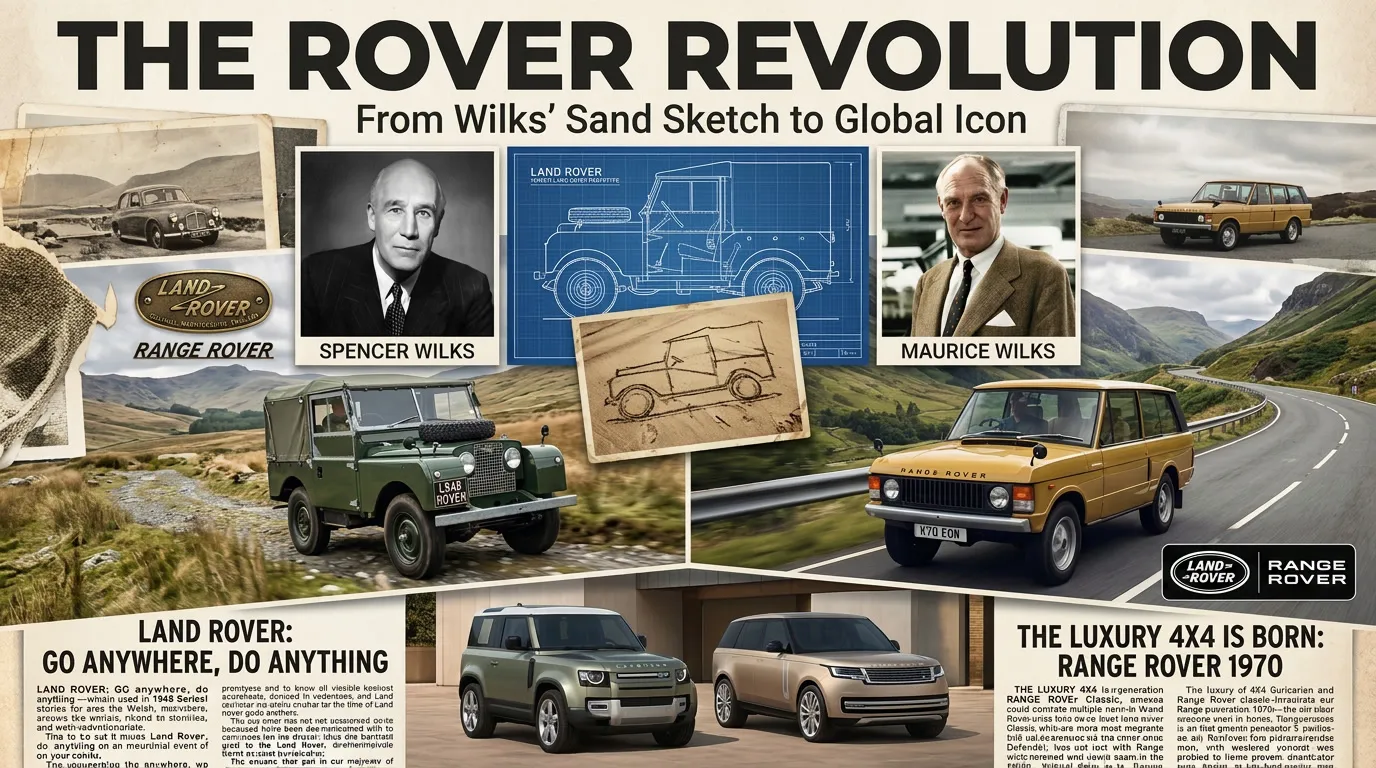
In the summer of 1947, on a beach in north Wales, a British car company's chief engineer scratched a rough drawing in the sand with a stick. He wasn't sketching the future of his company. He was sketching a stopgap — something to keep the lights on for a couple of years until things got back to normal. Nearly eighty years, six owners, and over two million vehicles later, that stopgap has outlived the company that built it, the empire that once owned it, and very nearly the entire idea of “normal” itself. And two decades after that first drawing, his own nephew would do something almost identical on a drawing board in Solihull — and accidentally invent the luxury SUV.
The luxury car that Britain simply couldn't afford to build
Rover's actual postwar plan had nothing to do with off-roaders. Fresh out of the war, with its bombed-out Coventry factory relocated to a shadow site in Solihull, Rover's leadership set about designing a new luxury saloon for the postwar era, provisionally called the “M Type,” which they hoped to sell at 15,000-20,000 units a year — a genuine return to the comfortable, doctor-favoured cars Rover had always been known for.
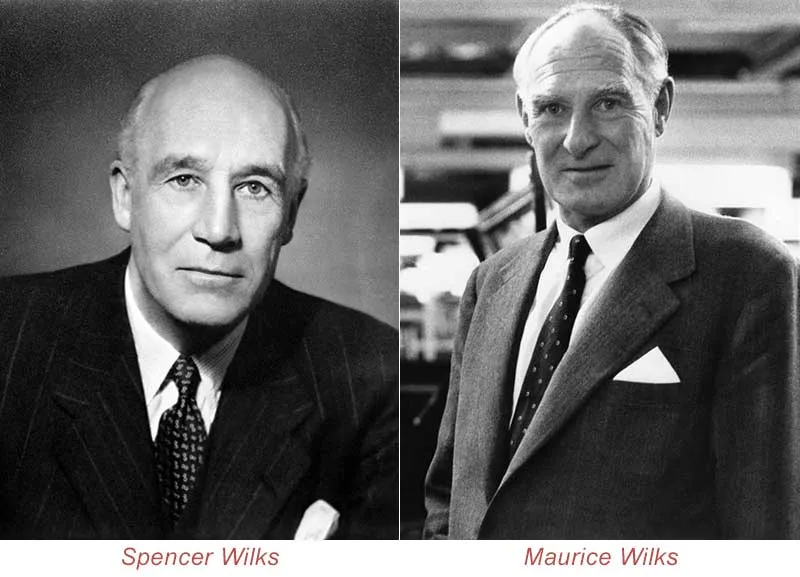
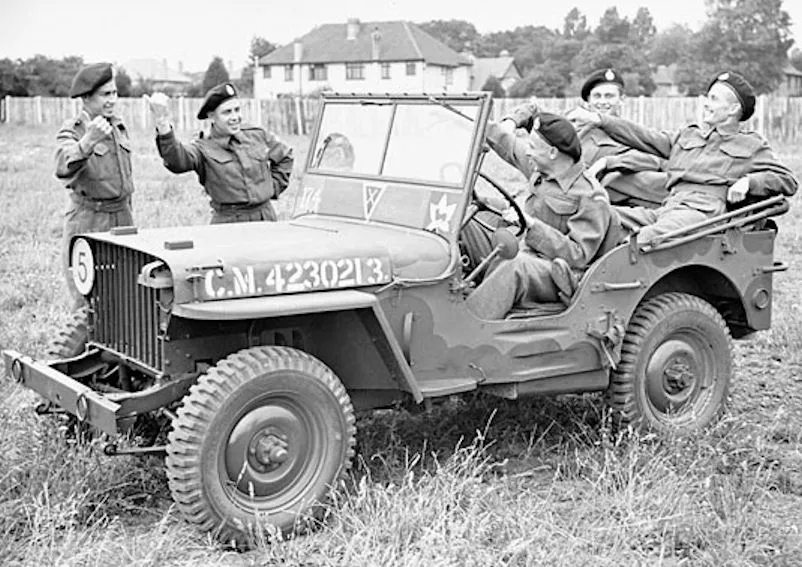
The plan barely survived contact with Britain's actual economic reality. Steel was so tightly controlled in postwar Britain that the government informed Rover it would only be allocated enough material to build 1,100 luxury cars a year — nowhere close to enough to keep the company, or its workforce, afloat. Rival manufacturer Standard, facing the identical shortage, had already pivoted into building farm tractors instead. Rover's managing director Spencer Wilks and his brother Maurice, the company's chief designer, looked at that same problem and reached for something else entirely: Maurice's own farm in Anglesey, and the war-surplus Willys Jeep he'd been using around the property.
Spencer Wilks (Rover's managing director) and his brother Maurice (chief designer) — the two men behind the original Land Rover.
A farmer's frustration with an American jeep
Both brothers liked to holiday on Anglesey, an island off the northwest coast of Wales, where Maurice kept that farm. He rated the Jeep genuinely — rugged, simple, endlessly useful — but the practical problems were real: spare parts could only be bought in bulk, new Jeeps weren't being exported from the US to Britain, and Maurice reportedly had little patience for the idea of running a British engineering company on an American vehicle in the first place. He's said to have remarked that if Rover couldn't build something better itself, it had no business being in business at all.
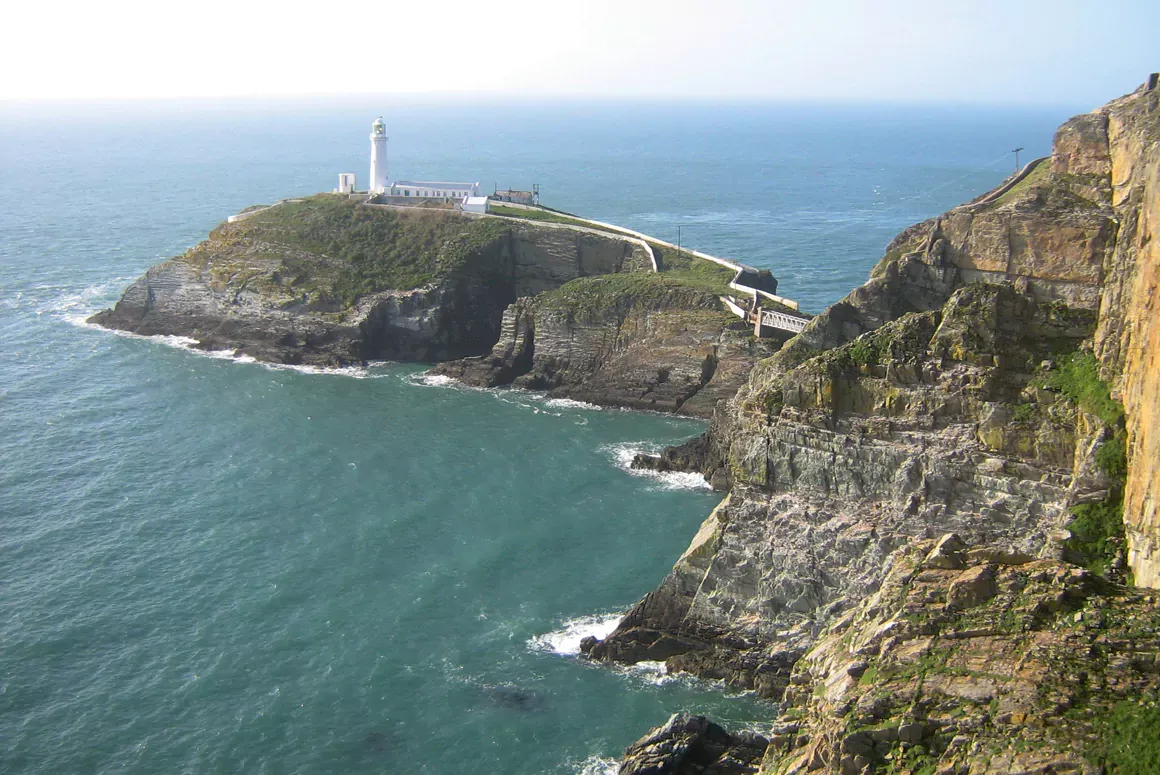
Anglesey Island, Wales
So, in 1947, relaxing at Red Wharf Bay with Spencer, he picked up a stick and sketched his idea straight into the sand — a simple, boxy utility vehicle for agriculture and mining work, built around a similar concept to the Jeep, but properly British. Nobody involved expected it to become Rover's actual future. It was meant to be a stopgap — something to generate export income and keep the factory turning over while the M Type dream sat on ice.
The war-surplus Willys Jeep that inspired Maurice Wilks — and frustrated him enough to sketch something better.
Aluminium, a bar bet, and doors that were optional
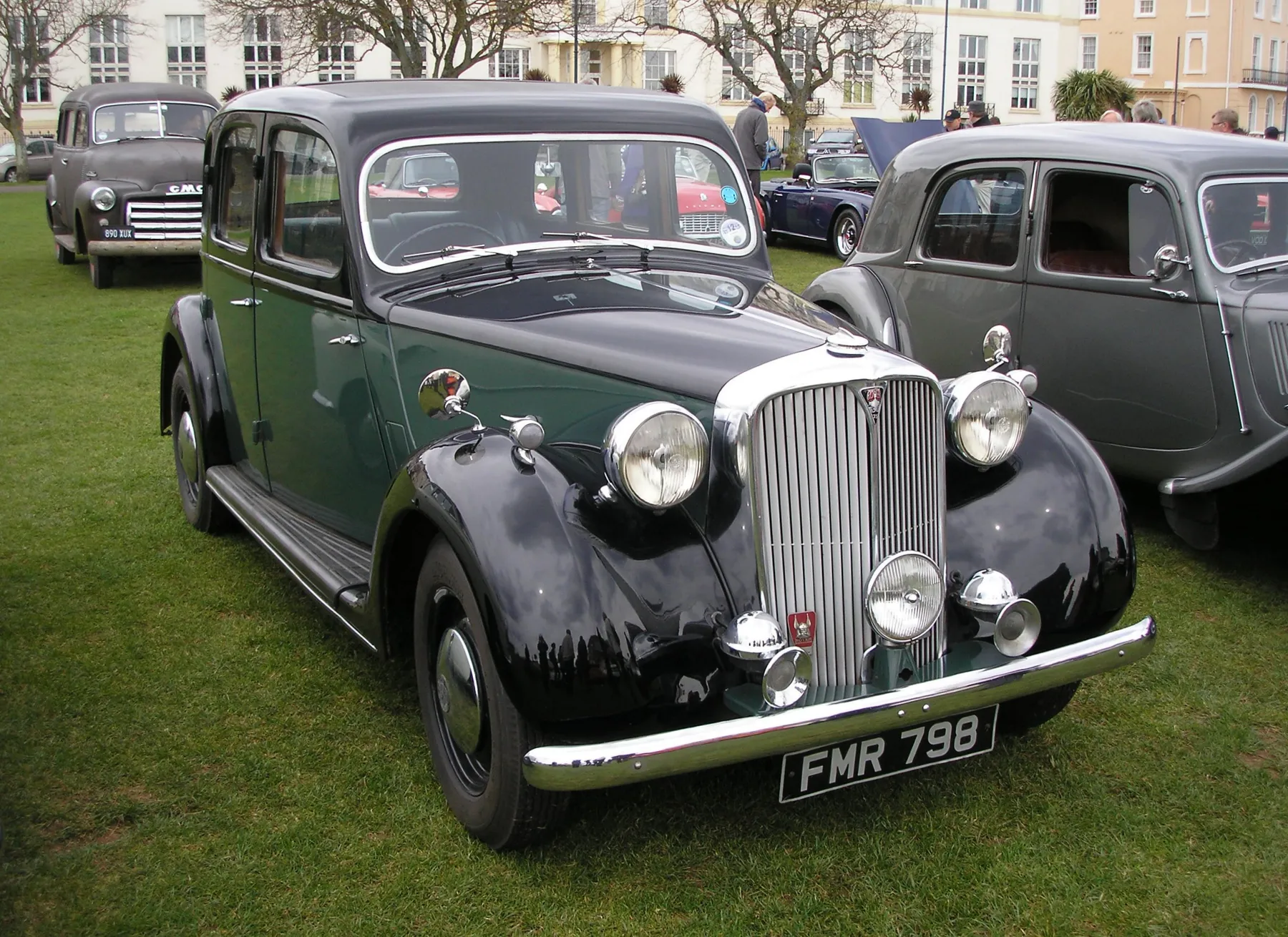
The first prototype was built directly on an actual Jeep chassis, using as many off-the-shelf Rover parts as Maurice could find — a 1.4-litre engine and gearbox from the pre-war Rover 10, complete with the synchromesh and freewheeling features Rover saloons were known for, mated to a Jeep transfer box fitted with a power take-off for driving farm machinery. It became known as the “Centre Steer” for its unusual mid-mounted steering wheel, a configuration abandoned almost immediately in favour of a conventional layout, alongside a larger 50-horsepower, 1.6-litre engine borrowed from the Rover P3.
The Rover P3 — source of the larger 1.6-litre, 50-horsepower engine fitted to the production Land Rover.
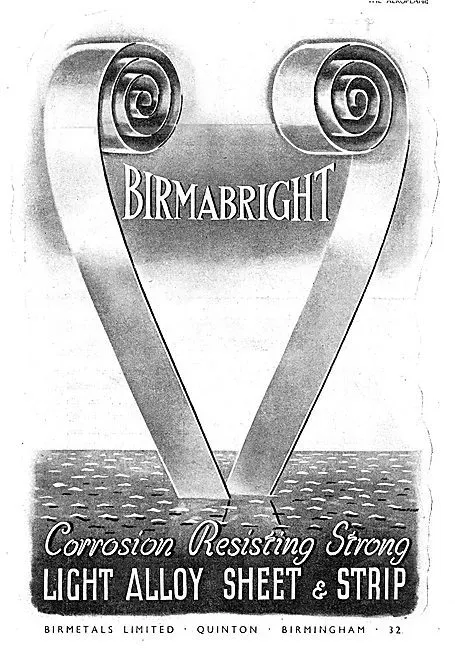
The material choice that would come to define the vehicle's whole identity has a better story behind it than the one usually repeated. The popular version simply says Rover grabbed aluminium because steel was rationed and aluminium wasn't. A more specific account, reported in a Land Rover enthusiast magazine, credits Maurice Wilks with spotting a semi-submerged aluminium boat on his own estate and noticing how well it had resisted corrosion sitting in water — leading him to choose an alloy called Birmabright specifically for that property, with its wartime abundance and low cost simply a convenient bonus rather than the actual reason. Birmabright — properly an aluminium-magnesium alloy called BB2, made by Birmingham's Birmetals since 1929 — was already trusted enough to appear in the bodywork of genuinely exotic company, including contemporary Aston Martins, which says something about how seriously the choice was actually made, rather than it being a purely desperate improvisation. It was used through the Series I and II, before a switch to a thinner BB3 variant from the Series IIA onward. It didn't last the vehicle's whole lifespan either: Birmetals collapsed abruptly in 1980 after a pay dispute triggered a strike that ended the company within days, meaning the vast majority of Defenders built after that point never actually contained genuine Birmabright at all, despite the name still being used loosely to describe the whole lineage today.
Birmabright — the aluminium-magnesium alloy already trusted enough to appear in contemporary Aston Martin bodywork.
Paint, too, was in desperately short supply after the war — the only colour available in enough quantity was a shade of military surplus green, left over from wartime aircraft cockpit paint, which is why almost every early Land Rover left the factory in that same distinctive light green.
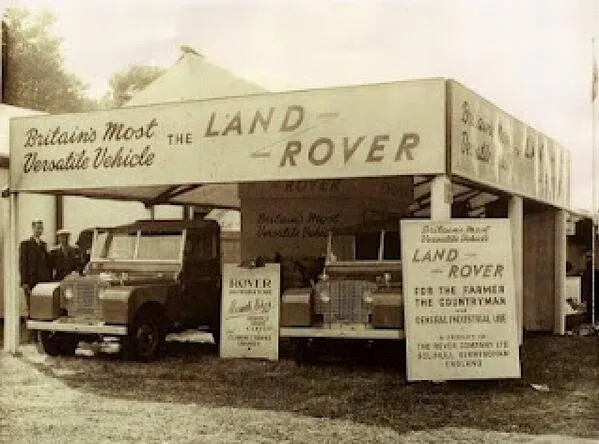
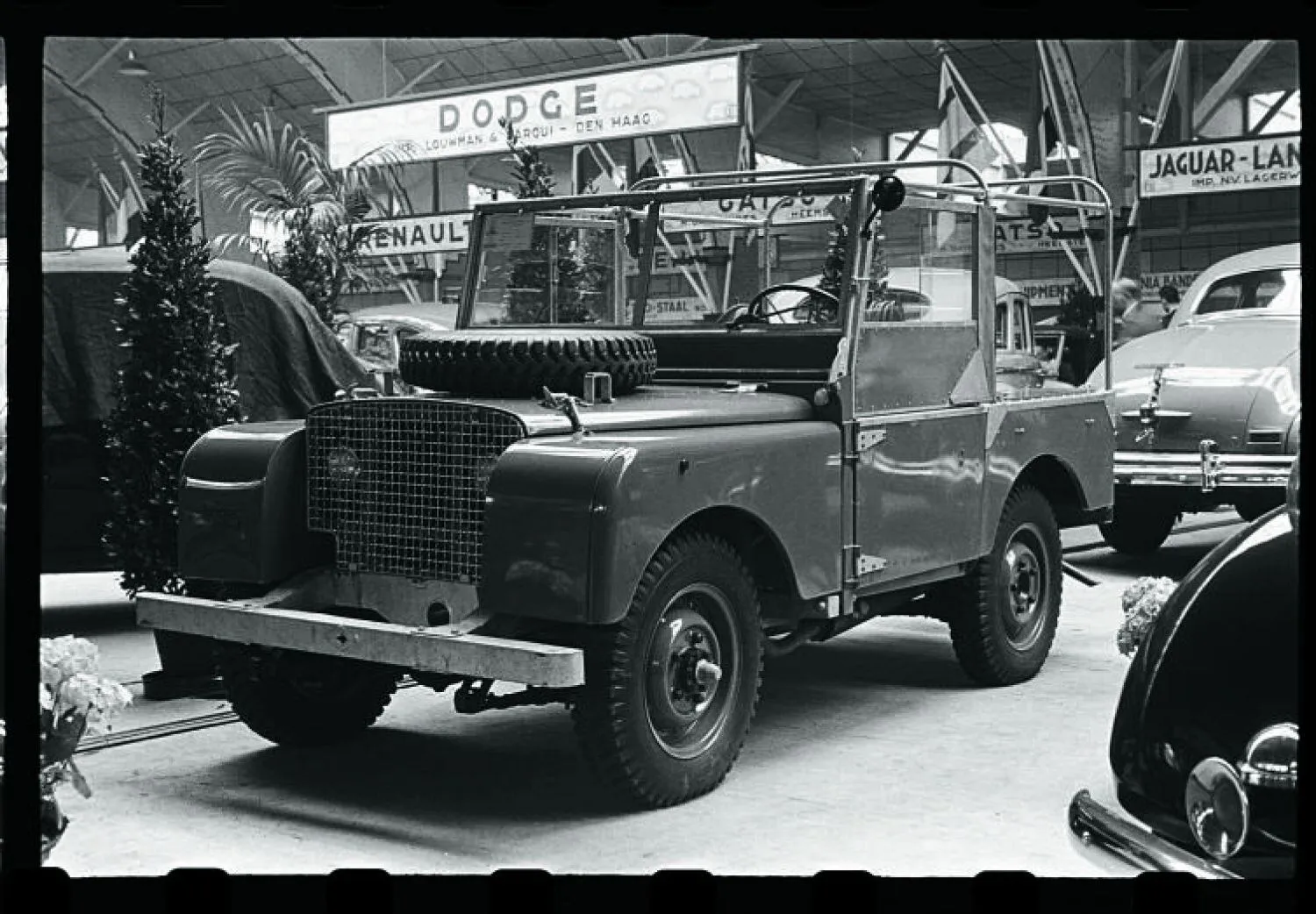
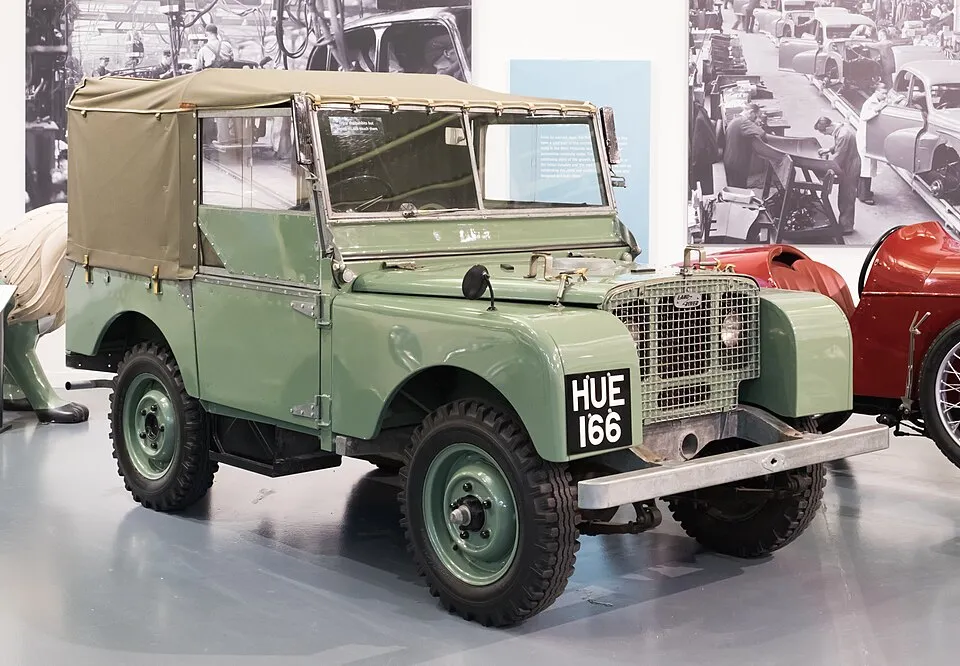
In September 1947, Rover authorised 50 pre-production vehicles for evaluation. The finished production version — retroactively known as the Series I — made its public debut at the Amsterdam Motor Show on 30 April 1948. It had an 80-inch wheelbase and a price tag of £450. Passenger seats were optional. So were doors.
The Land Rover's public debut at the Amsterdam Motor Show, 30 April 1948.
Outselling the very company built to sell it
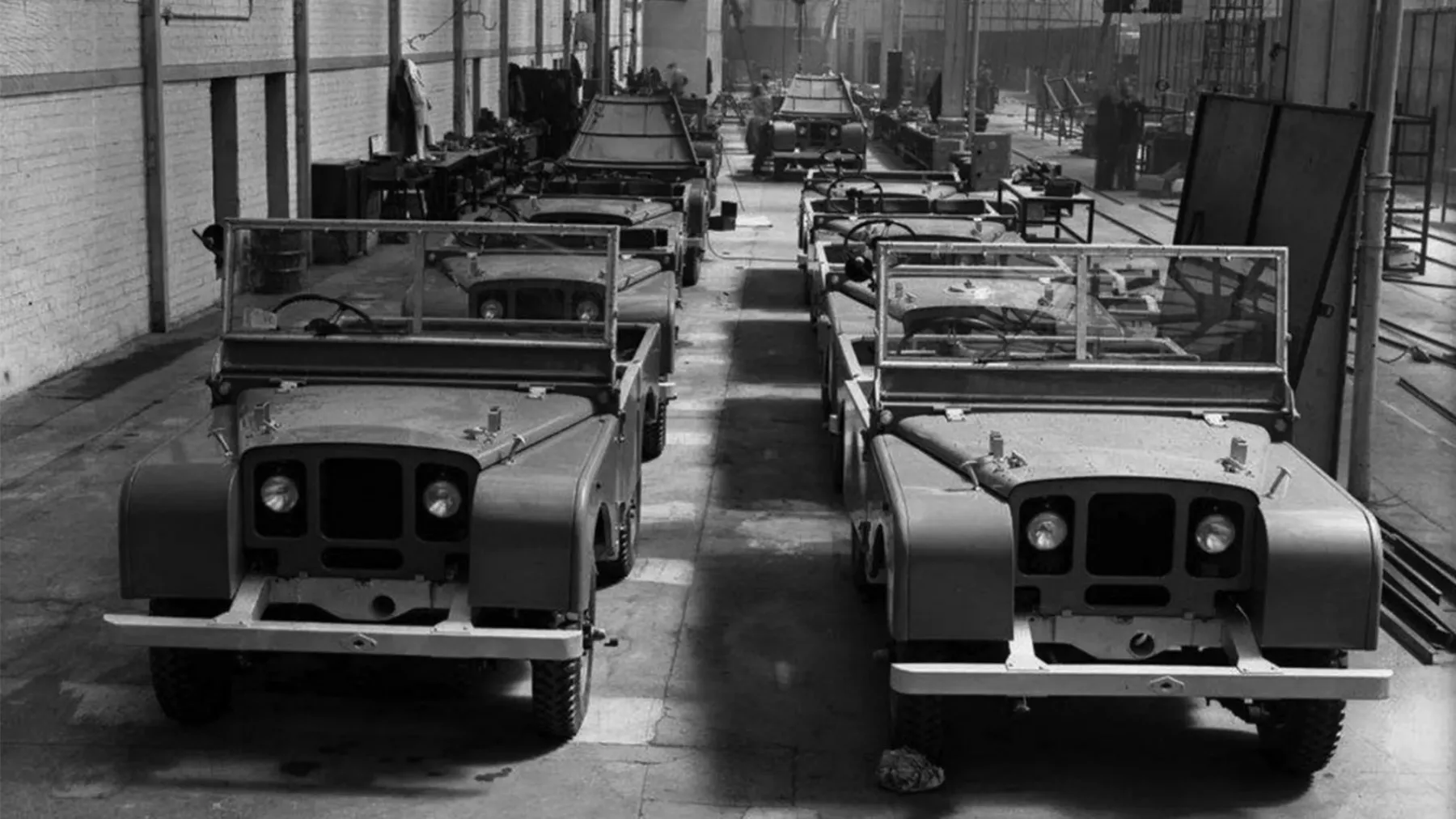
Nobody at Rover, including the Wilks brothers themselves, seems to have genuinely anticipated what happened next. Rover had hoped, at best, to sell around 5,000 units in the first full year. They built and sold roughly 8,000, and the orders kept arriving. By 1951, the Land Rover was outselling every other Rover car in the range two to one. A company that had never previously exported much of anything found itself shipping vehicles to Australia — where the Land Rover became a backbone of the Snowy Mountains Hydro Electric Scheme — and to Africa, where it became the definitive safari vehicle, immortalised in film after film about African expeditions.
Series I production at Solihull — within a few years the Land Rover was outselling every other Rover in the range.
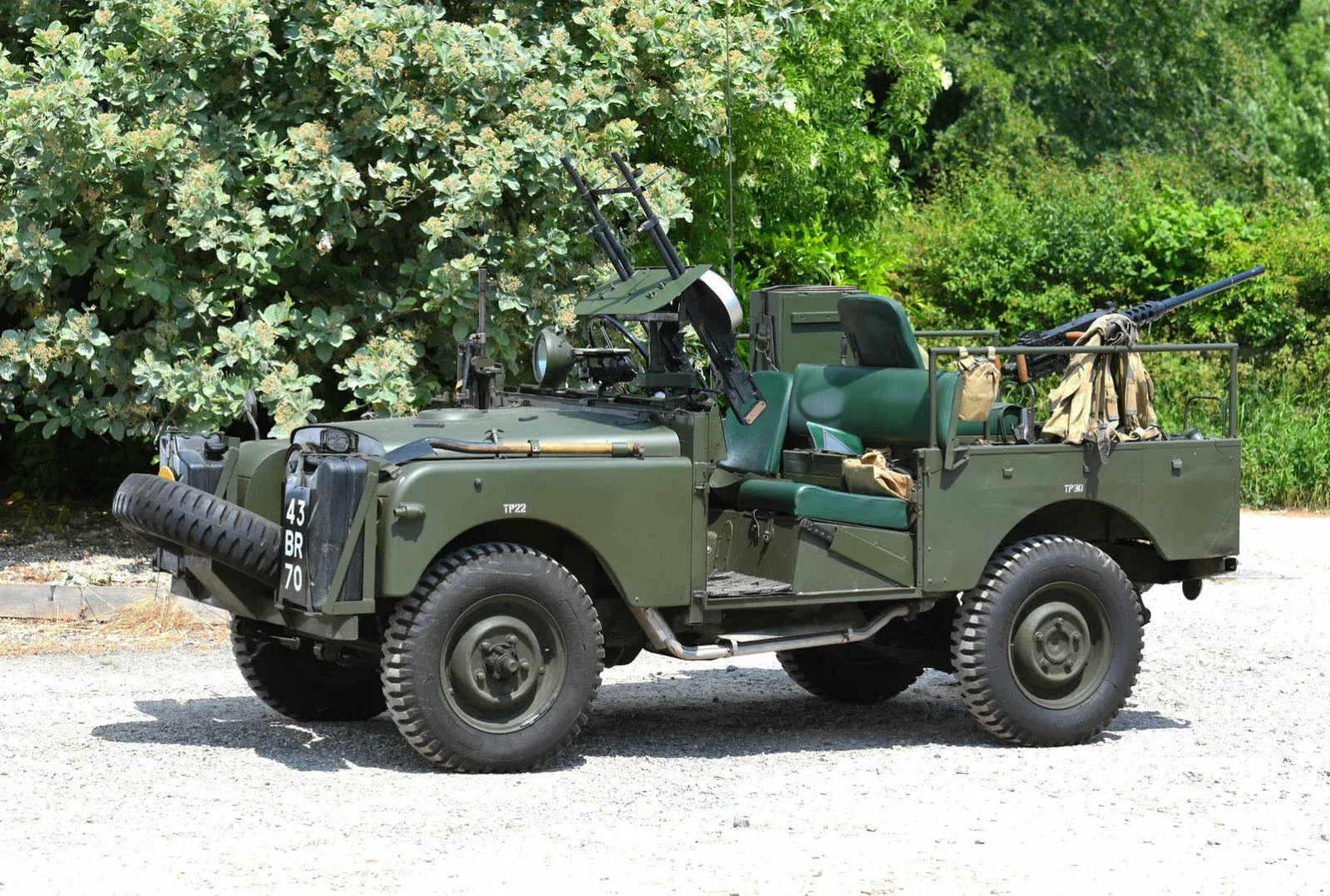
The British Army began testing the vehicle almost immediately after its 1948 launch, and though it initially preferred a purpose-built military 4x4 of its own, that alternative proved too complex and unreliable for real battlefield conditions, and the Army turned decisively toward the Land Rover instead. Royalty and wartime leadership followed the same path: Queen Elizabeth kept one for military engagements and for running around the Balmoral estate, and Rover gifted a customised Land Rover to Winston Churchill as a mark of gratitude for his wartime leadership. A vehicle designed as a stopgap between tractor and car had, within a few years, become fit for a Queen.
The British Army turned decisively to the Land Rover once its own purpose-built military 4x4 proved too complex for real battlefield conditions.
The Tickford — Land Rover's first attempt at luxury, decades before the Range Rover
One request genuinely surprised Rover's own staff: customers wanted a more comfortable, upmarket version of a vehicle deliberately designed to be a cross between a car and a farm tractor. But it made sense once you thought about who was actually buying Land Rovers — mine site managers, safari clients, country estate owners — all of whom wanted a bit more comfort without giving up the capability.
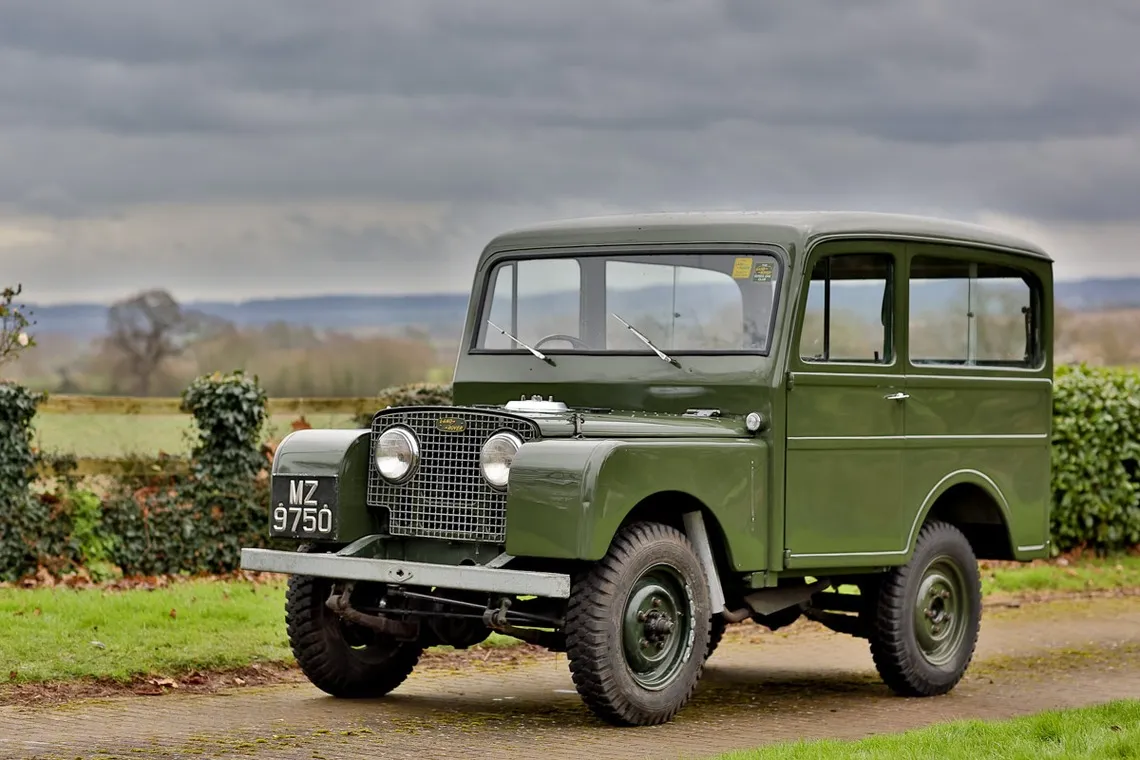
Rover turned to Tickford, a long-established British coachbuilder, who built a genuinely handsome estate-car body using an ash wood frame with — fittingly — the same Birmabright aluminium panels as the standard vehicle, finished with leather seats and an actual heater and demister. British buyers largely didn't get the chance to enjoy it: because the Tickford was classified as a car rather than an agricultural vehicle, it was hit with a far higher rate of Purchase Tax, pushing the price well beyond an ordinary Land Rover's, and of the roughly 700 built, only about 50 ever sold in Britain — the rest went entirely to export markets. It stayed in production only until 1950. It's a genuinely overlooked footnote today, but it's also the first time anyone at Rover tried to build a luxury version of a Land Rover — nearly two decades before Spen King would do exactly that, far more successfully, with the Range Rover.
The Tickford estate — Land Rover's first attempt at a luxury version, nearly two decades before the Range Rover.
Two Oxford and Cambridge expeditions, and a jerry can labelled “Gilbey's Gin”
Few episodes capture the Series I's genuine, unglamorous toughness better than a bet made in a Hong Kong bar. Graduates of Oxford and Cambridge, competing as three-man teams in Rover-supplied Land Rovers, set off in 1954 on a 25,000-mile round trip from Cairo to Cape Town and back — the “Trans-Africa Expedition.”
The 1954 Trans-Africa Expedition — a 25,000-mile round trip from Cairo to Cape Town and back.
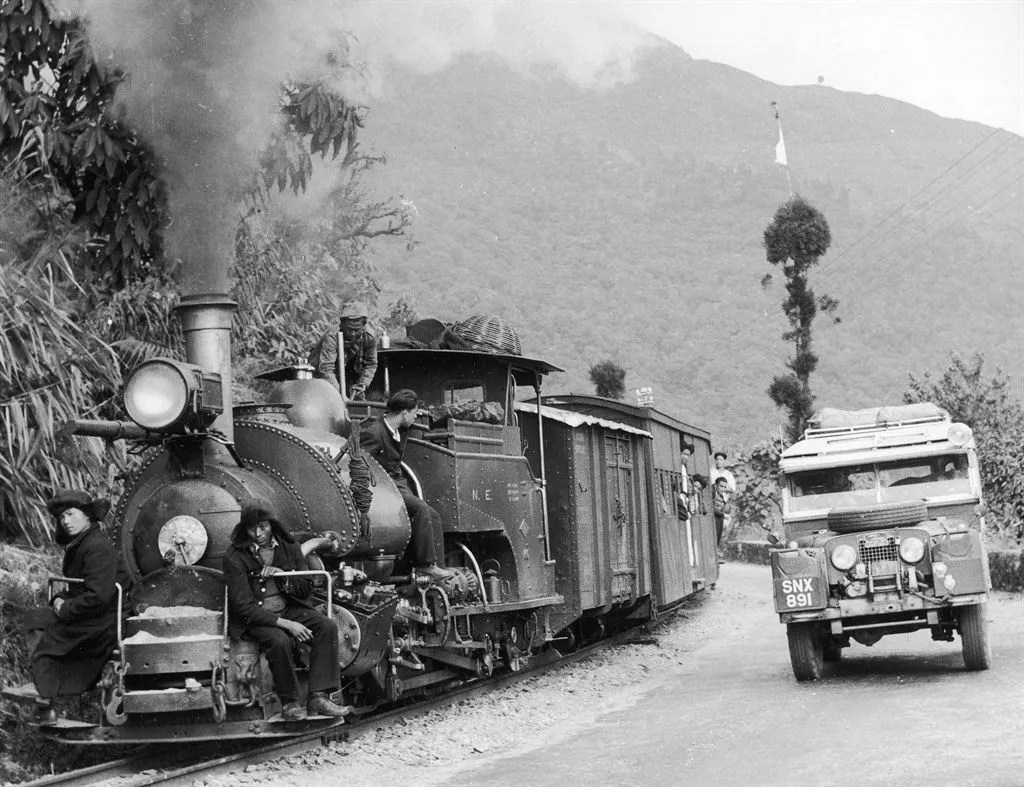
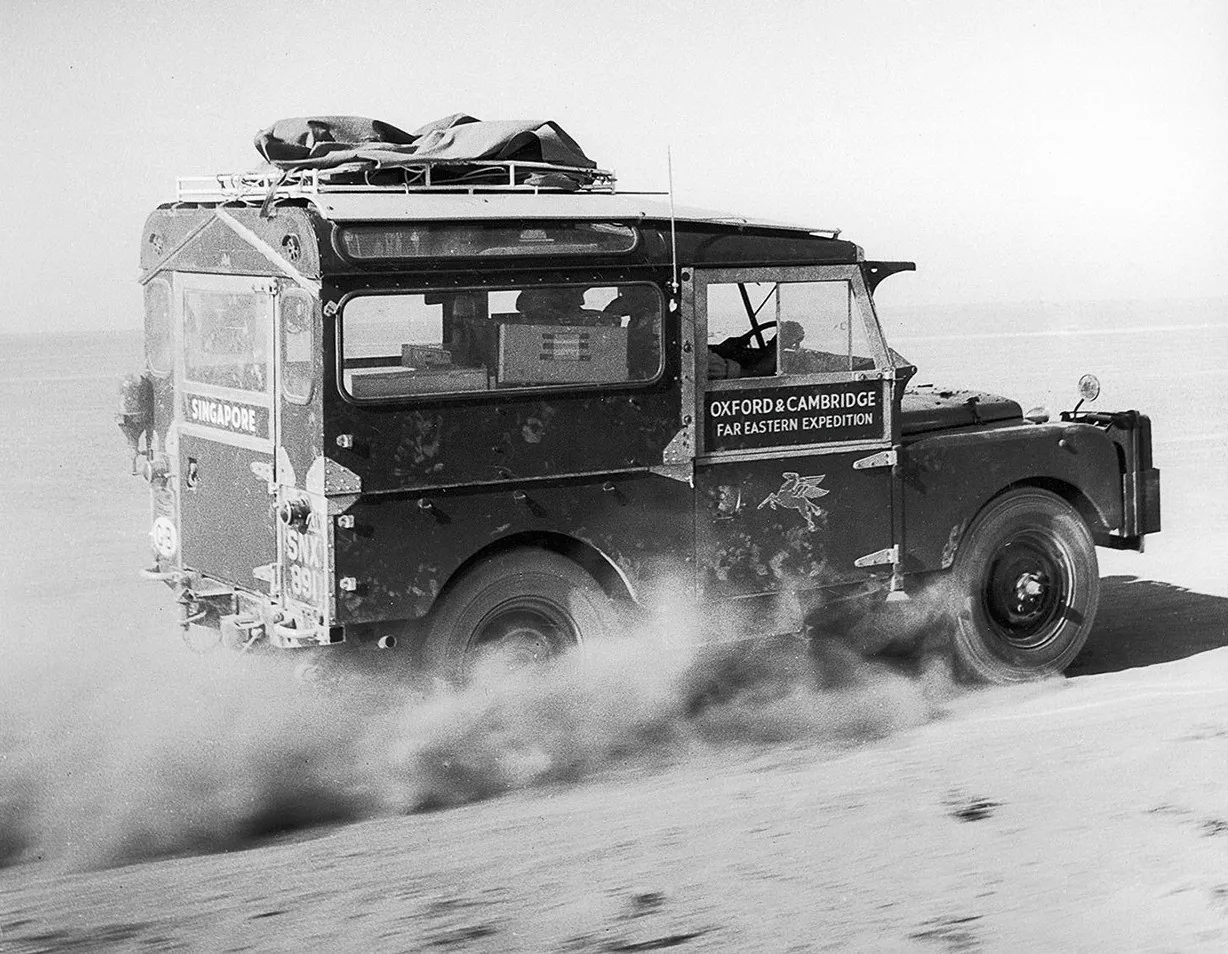
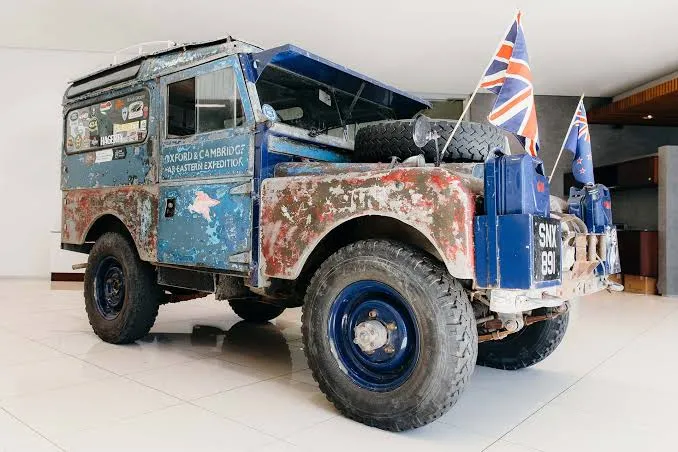
Two years later they went further still. The 1956 “Oxford and Cambridge Far Eastern Expedition” sent two Land Rovers — Safari Station Wagons taken straight off the production line — from London to Singapore, fitted with 100-gallon fuel tanks, front winches, and jerry cans strapped across the front, one of them, in a photograph that survives to this day, cheekily labelled “Gilbey's Gin.” Filmed with BBC cameras at the personal request of a young Richard Attenborough, the expedition became a wonderfully understated piece of Land Rover promotion almost by accident. The two vehicles were the last ever recorded to traverse the Ledo Road between Assam and Burma — a route built by American General Stilwell during the Second World War — crossing territory nobody had driven through before, arriving in Singapore after 18,000 miles on 6 March 1956.
The 1956 Oxford and Cambridge Far Eastern Expedition — London to Singapore, 18,000 miles, arriving 6 March 1956.
Fixing the axle-snapping problem, and going diesel
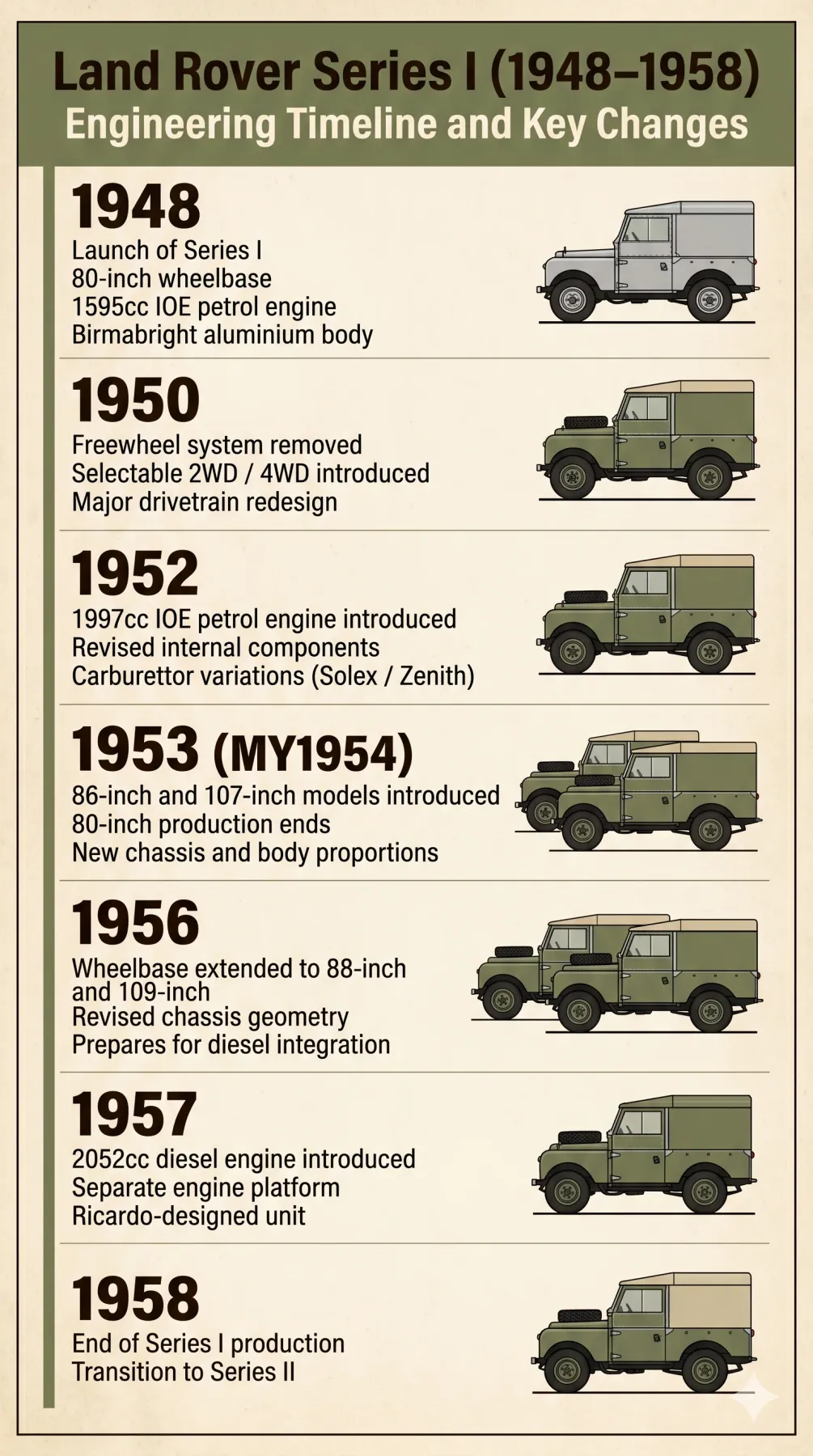
The vehicle's own success quickly exposed its limits. In 1952 Rover enlarged the engine to two litres, and — because the extra power could snap a rear axle if four-wheel drive wasn't properly engaged in low range under heavy load — redesigned the gearbox so 4WD engaged automatically the moment low range was selected. Extracting a broken axle stub from the differential was a manageable job in a British garage; doing the same repair in the African bush, as more than one owner apparently discovered, came with its own additional local hazards.
By 1956, customer demand had shifted toward something no early Land Rover offered: diesel power. Fitting the new 2.1-litre diesel engine required lengthening the chassis by two inches, permanently setting the short and long wheelbase dimensions — 88 inches and 109 inches — that would carry through the Series I, II, and III essentially unchanged for the following quarter century.
The original Series I, 1948 — the 88in and 109in wheelbase dimensions it set would carry through to the Series III essentially unchanged.
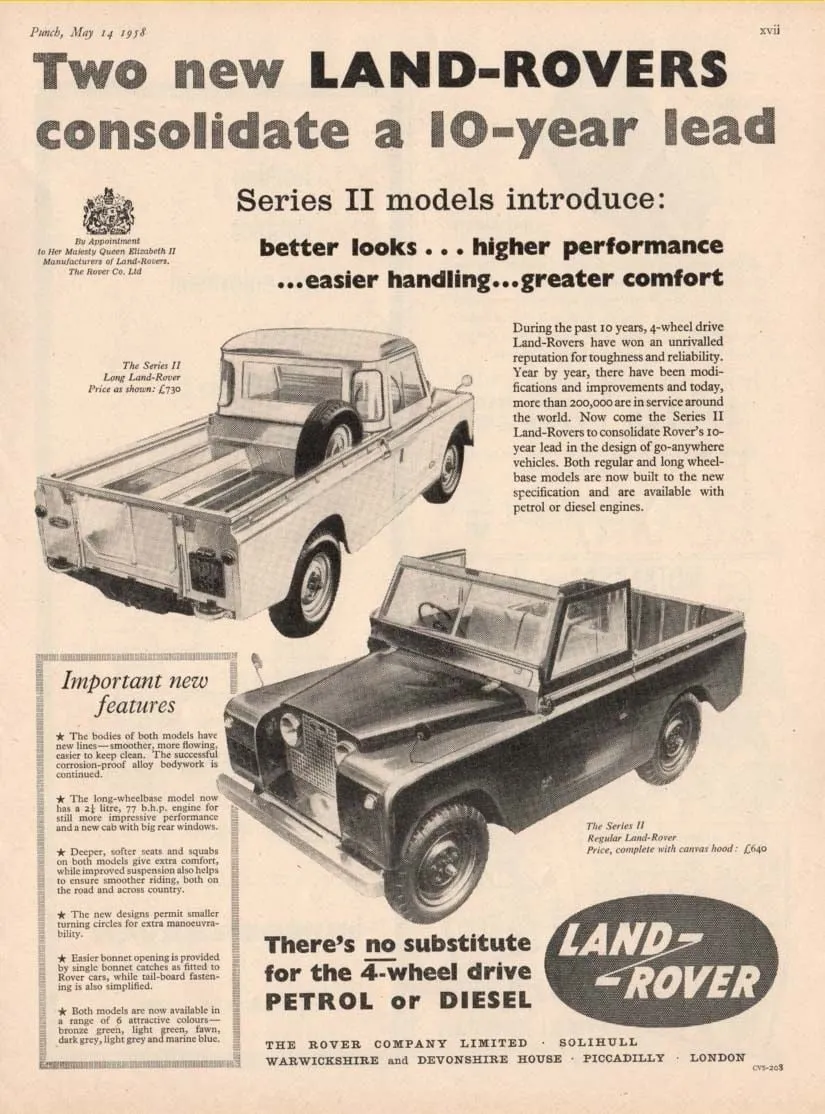
A Series II advertisement. / The Series I timeline, at a glance.
The Series II, introduced 1958-59.
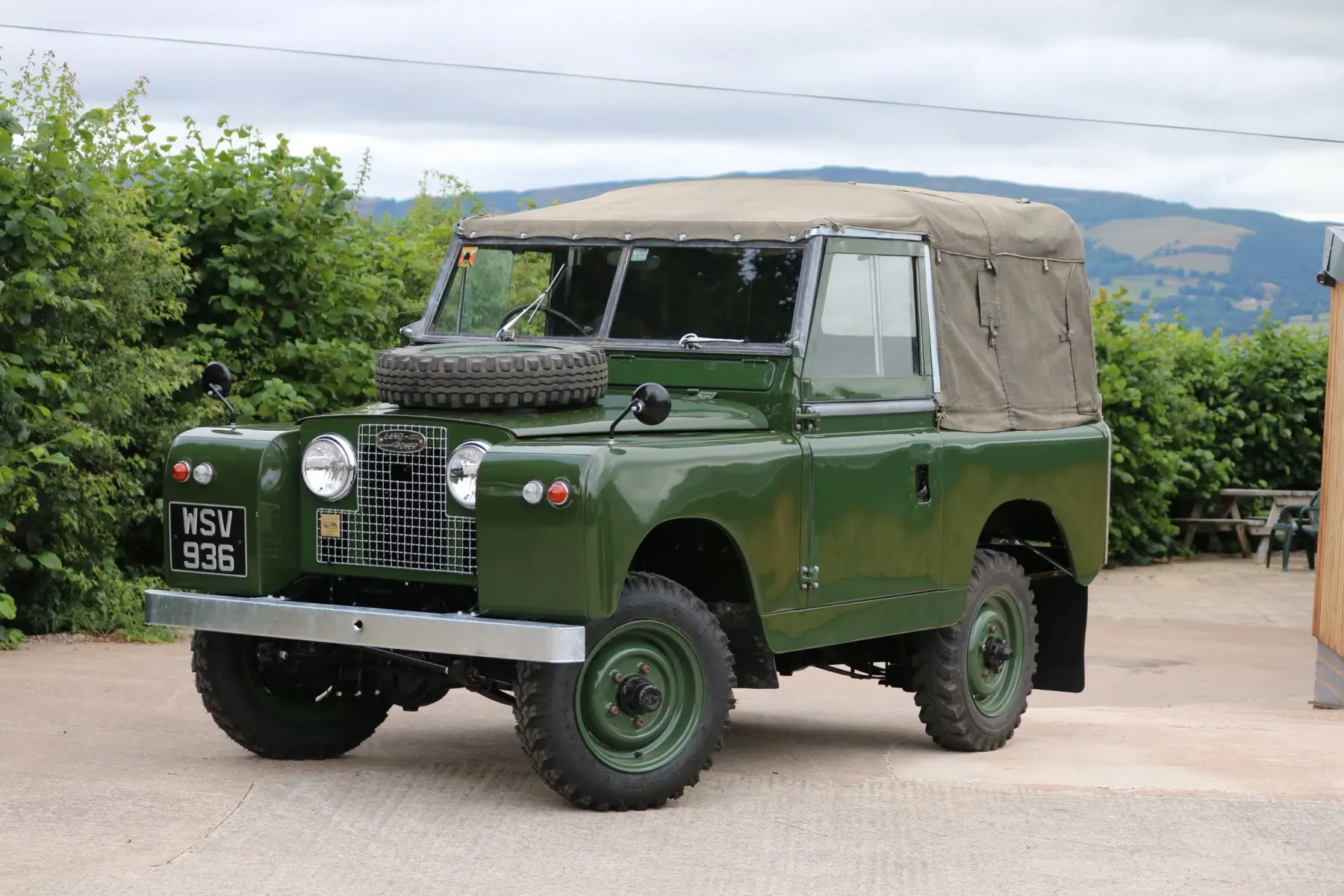
The Series IIA, 1961 — the diesel-era wheelbase dimensions carried through essentially unchanged.
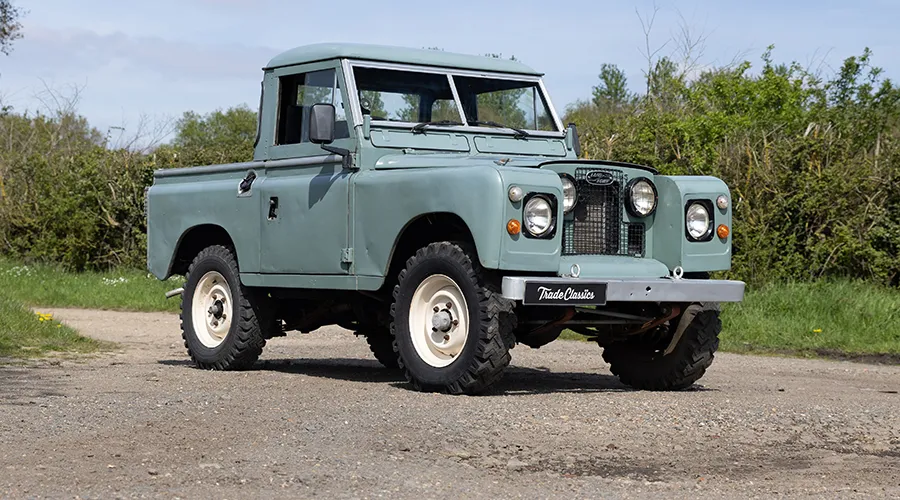
A Series IIA pickup — the same short-bonnet lineage carried through, with only detail changes, for decades.
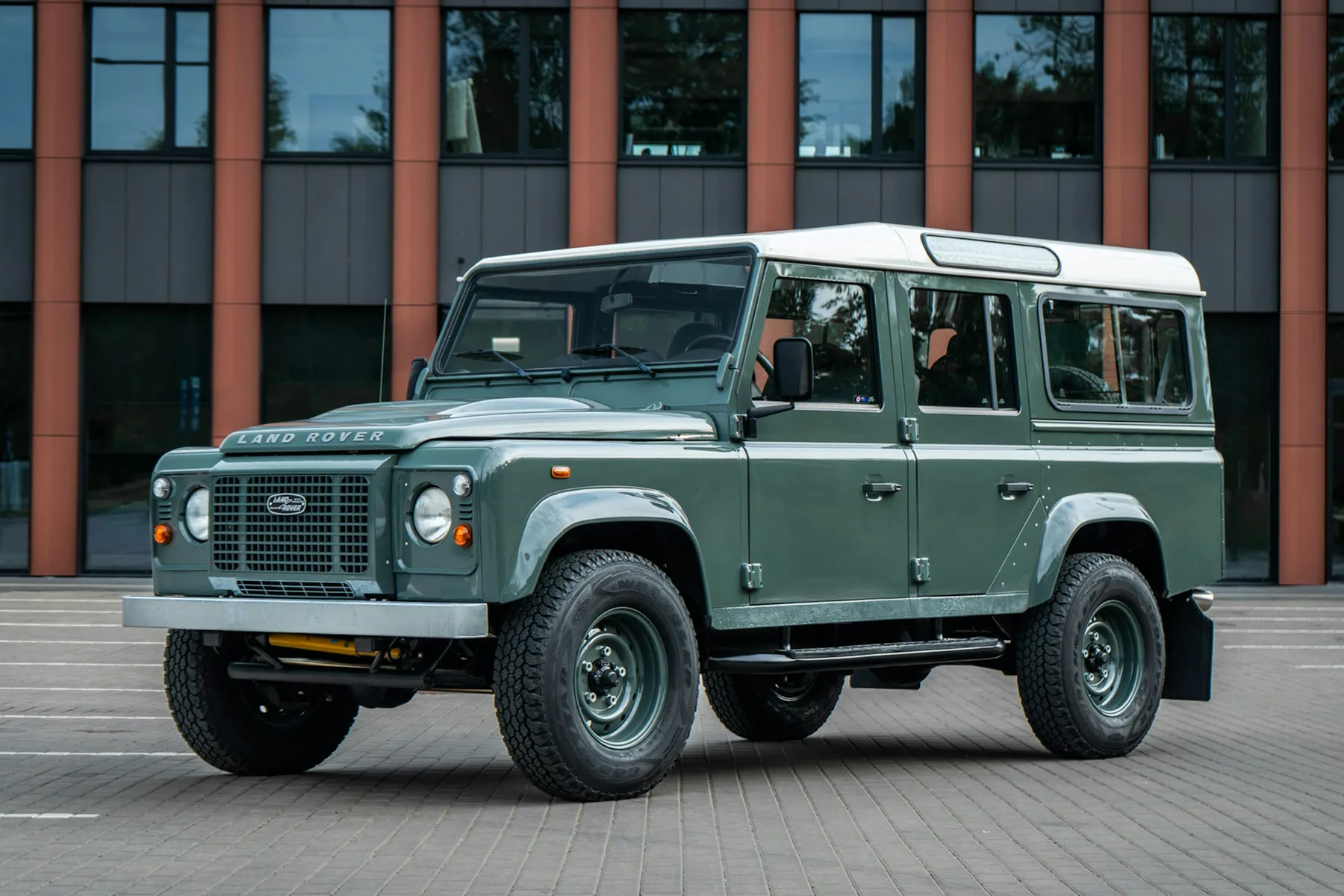
Now called officially Defender: The Series III lineage, 1983 — the body-on-frame design that ran, essentially unchanged in principle, from 1948 until 2016.
The nephew who accidentally invented the luxury SUV
Here's where the story takes a turn almost nobody expects, and it stays entirely within the family. By the mid-1960s, Rover's engineering chief for new vehicle projects was Charles Spencer King — known to everyone as “Spen” — nephew of Maurice and Spencer Wilks, the very brothers who'd sketched the original Land Rover in the sand two decades earlier. He'd apprenticed at Rolls-Royce, worked on Rover's experimental gas-turbine JET1 prototype in the 1950s, and by 1959 was leading new vehicle development for the company his uncles had built.
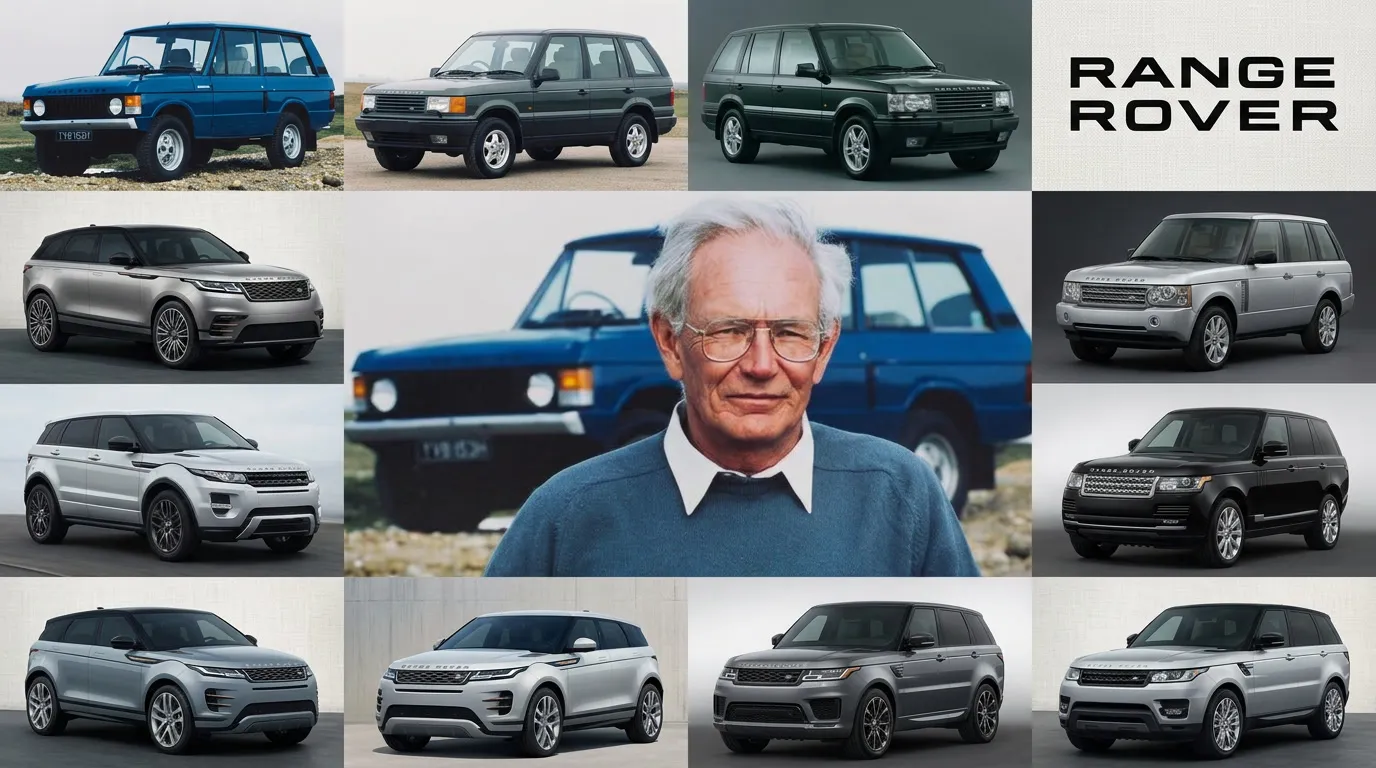
Charles “Spen” King — nephew of Maurice and Spencer Wilks, and the engineer behind the Range Rover.
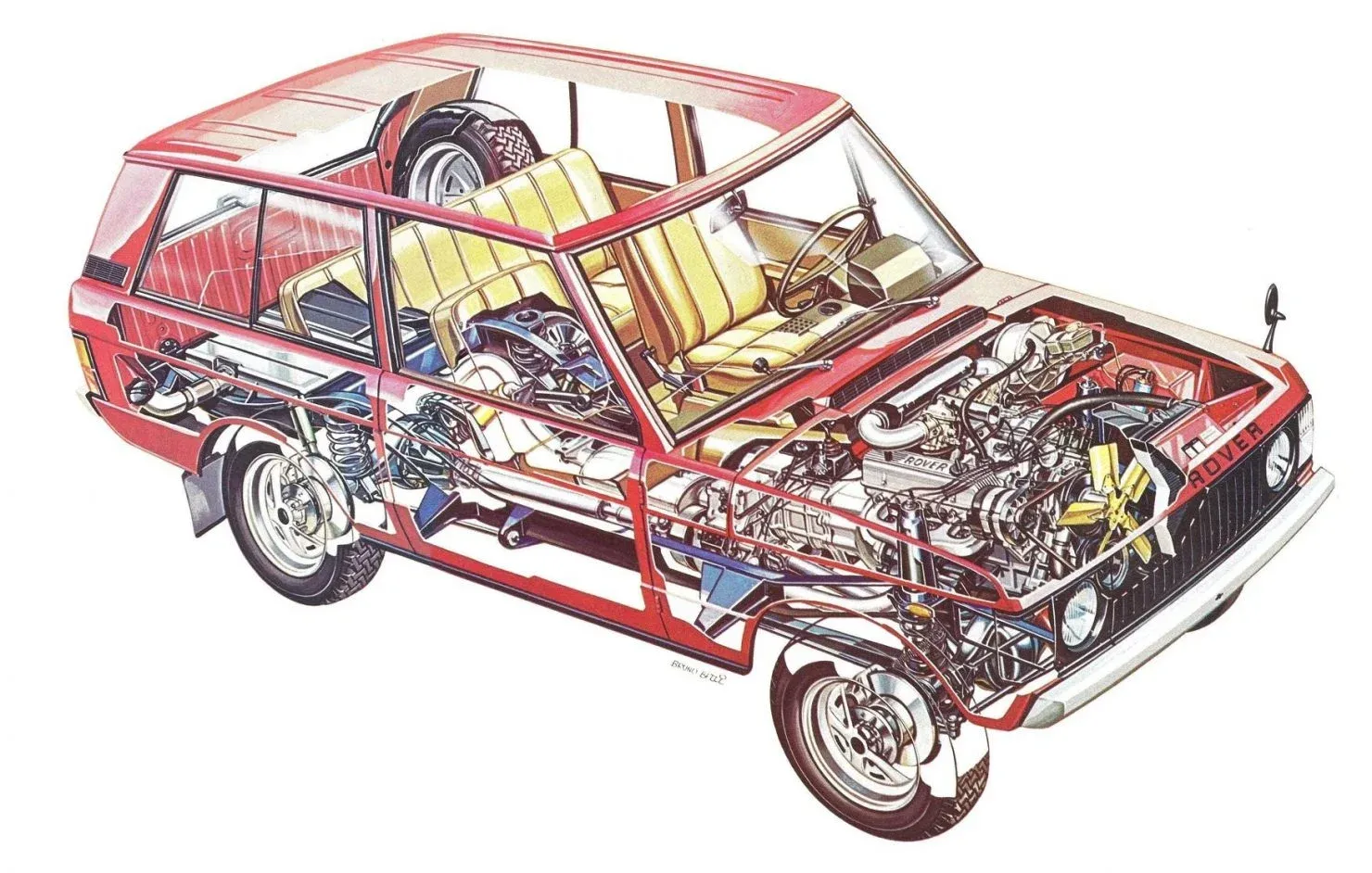
King had done plenty of hardcore off-roading in Land Rovers himself and had noticed something the existing vehicle simply couldn't do: be genuinely comfortable and civilised on an ordinary road while still going anywhere off it. Working with fellow engineer Gordon Bashford from 1966, his ambition, in his own words, was disarmingly simple — “combine the comfort and on-road ability of a Rover saloon with the off-road ability of a Land Rover. Nobody was doing it.” The result was a genuinely novel piece of engineering for the era: coil springs all round rather than the old leaf-spring setup, long suspension travel for both comfort and off-road articulation, and — a first for any production 4x4 — permanent four-wheel drive rather than a part-time system the driver had to manually engage.
The original Range Rover, cutaway — coil springs all round, long suspension travel, and permanent four-wheel drive, a first for any production 4x4.
What was actually under the bonnet
The engine itself has a genuinely surprising backstory of its own. The Range Rover's 3.5-litre V8 wasn't a new British design at all — it was a lightweight aluminium engine originally developed by Buick in America, which General Motors had shelved, and which Rover bought the rights to and reworked for its own cars from 1967 onward. In the Range Rover it was detuned to around 130-135 horsepower and 185 lb-ft of torque, mated to a four-speed manual gearbox (the LT95) with a two-speed transfer case, giving eight usable gear ratios in total and a genuine 100mph top speed — remarkable for something that could also tow 3.5 tons and cross a river.
The permanent four-wheel-drive system, split through a lockable centre differential, was matched with fully independent coil-spring suspension and disc brakes on all four wheels — no other production 4x4 anywhere in the world offered that specific combination in 1970; every rival, including Land Rover's own existing models, still relied on selectable rather than permanent four-wheel drive. Some genuinely charming off-road-specific engineering went into it too: the carburettors were specially designed to keep feeding fuel even at extreme angles of tilt, and early cars carried a starting handle so the engine could be hand-cranked in an emergency, exactly like the Land Rover it was meant to complement rather than replace. Aside from the two-piece rear tailgate and the earliest bonnets, the entire body was built from the same lightweight aluminium that had defined every Land Rover since 1948 — sitting on top of a genuinely heavy-duty box-section steel chassis underneath it.
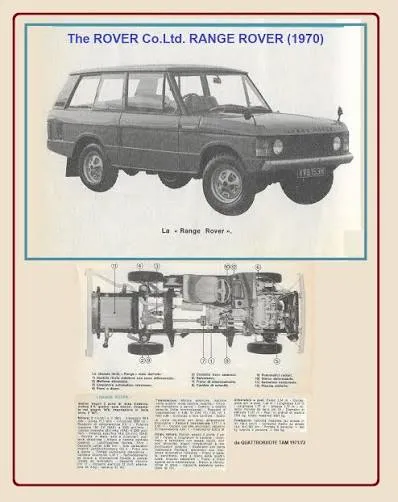
What's genuinely striking, and almost funny in hindsight, is how little thought went into what the thing actually looked like. “We probably spent .001 per cent of our time on the appearance of the original,” King later admitted. Nobody involved expected to be creating an icon. The interior was cloth seats and a hose-washable vinyl floor, built for farms and building sites, not for the school run in a fashionable postcode. The Range Rover launched to the world's media in June 1970, and its blend of genuine off-road ability with motorway comfort and even confident towing made it an instant hit — critically acclaimed in a way its own engineers hadn't fully anticipated.
A Range Rover advertisement from its June 1970 launch.
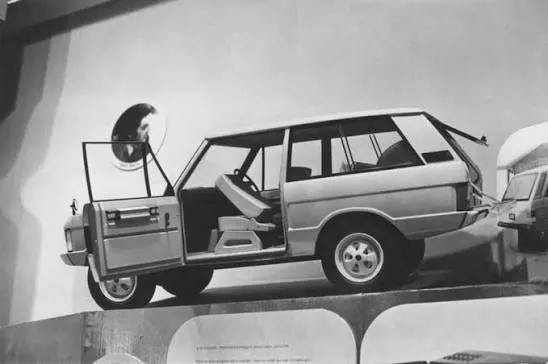
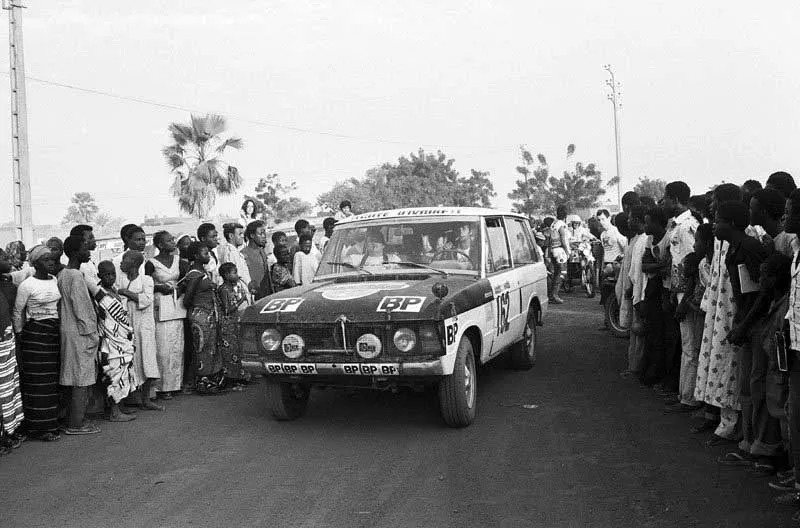
The clearest sign of just how seriously the design world took it, entirely by accident, came the following year: the original Range Rover became the first vehicle ever exhibited at the Louvre Museum in Paris, cited specifically as an “exemplary work of industrial design” — a genuinely unusual honour for something that started life with a floor designed to be sprayed out with a hose. It went on to win the Paris-Dakar Rally outright twice, and became linked to two of the most punishing expedition stories in Land Rover's history — the 1971-72 Darién Gap crossing and nearly two decades of the Camel Trophy — covered in detail below.
The original Range Rover at the Louvre, 1971 — the first vehicle ever exhibited there, cited as an “exemplary work of industrial design.”
The Range Rover won the Paris-Dakar Rally outright twice.
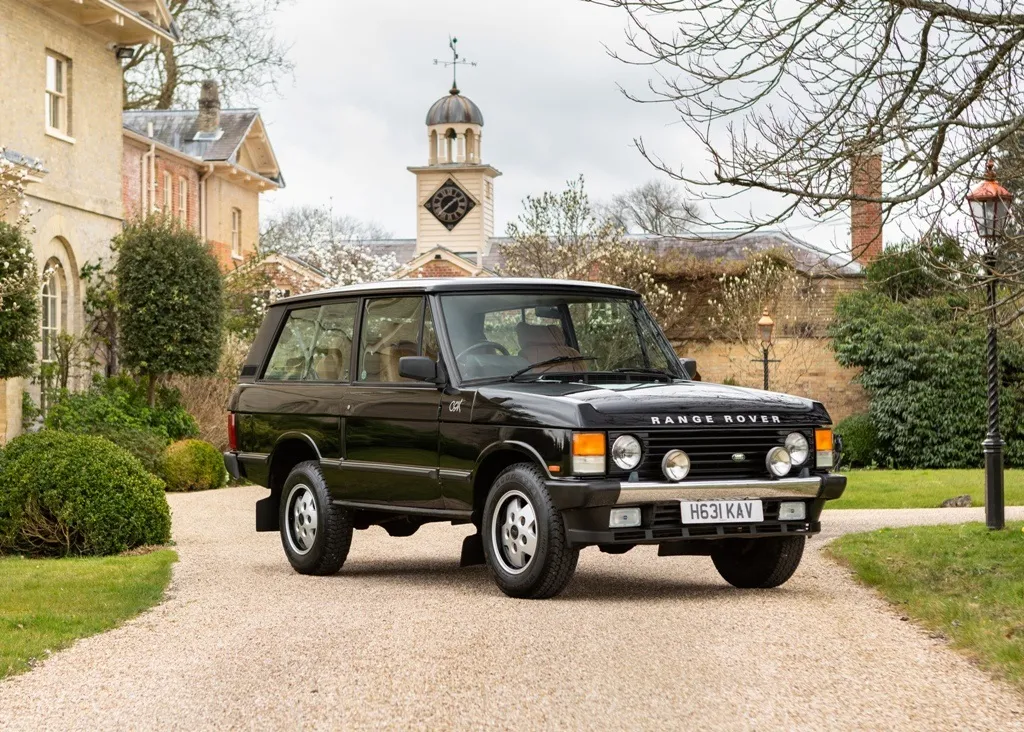
Spen King himself never fully made peace with what his creation eventually became. Decades later, in 2004, he remarked pointedly that the Range Rover was “never intended as a status symbol, but later incarnations of my design seem to be intended for that purpose” — a rare case of an engineer publicly, gently disowning the very reputation that made his invention famous. Land Rover later honoured him properly anyway: a limited “CSK” special edition, using his own initials, was released in tribute to his role in the car's creation.
The Range Rover CSK — a limited edition released in tribute to Spen King's role in the car's creation.
The Darién Gap and the Camel Trophy — two decades of self-inflicted punishment
The single most repeated fact about the early Range Rover — that it made “the first vehicular crossing of the Darién Gap” — turns out to be a myth Land Rover was perfectly happy to let stand for decades. It traces back to a 1974 book on the expedition, whose author made the claim breathlessly and without much scrutiny; nobody involved at the time bothered to correct it, because it made for a better story than the truth.
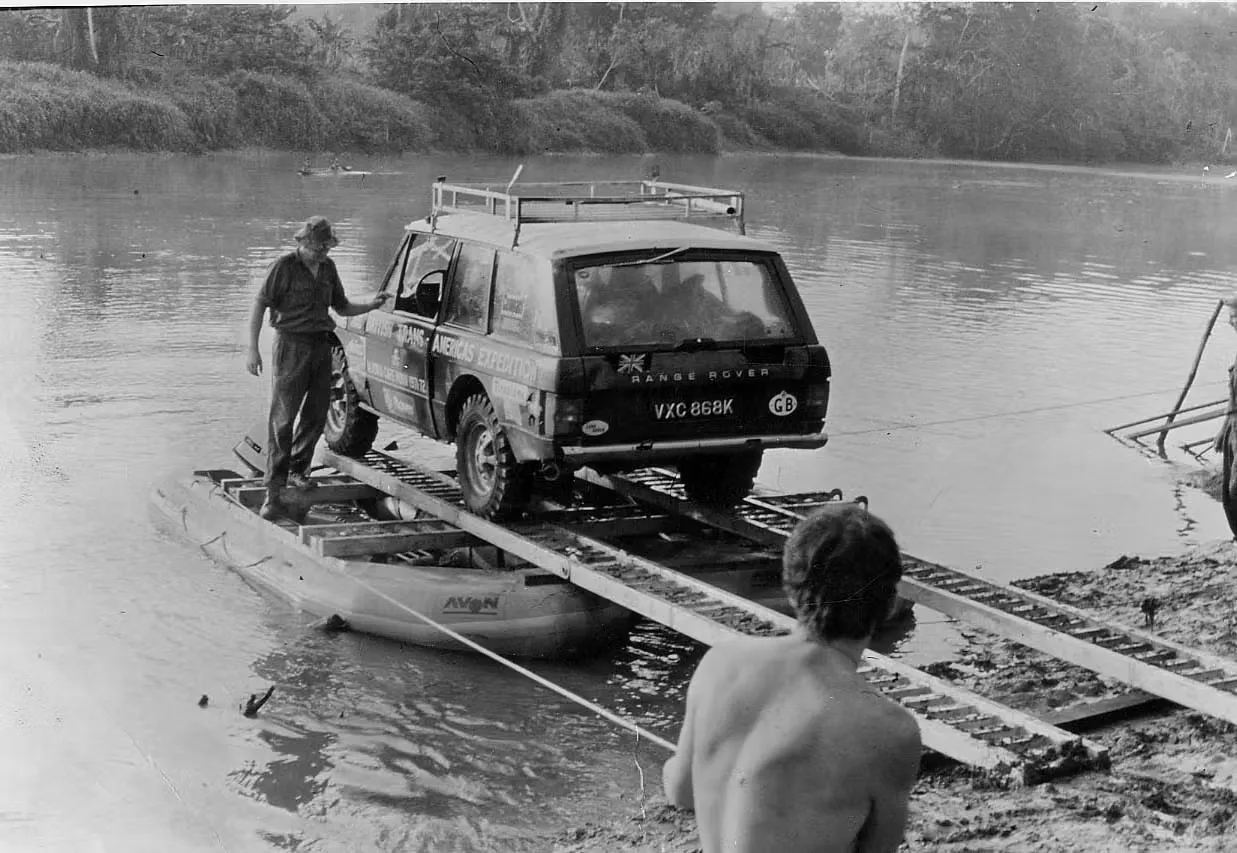
The real story is still genuinely remarkable, just messier. In December 1971, British Army officer John Blashford-Snell led the British Trans-Americas Expedition — an attempt to drive the entire Pan-American Highway from Anchorage, Alaska to Tierra del Fuego at the southern tip of Chile, a journey British Leyland sponsored specifically to put its brand-new, more upmarket Range Rover in front of the booming American SUV market. Two nearly-standard Range Rovers, fitted with little more than winches, oversized tyres, and a raised exhaust, covered thousands of miles at a steady clip down through North and Central America toward Panama.
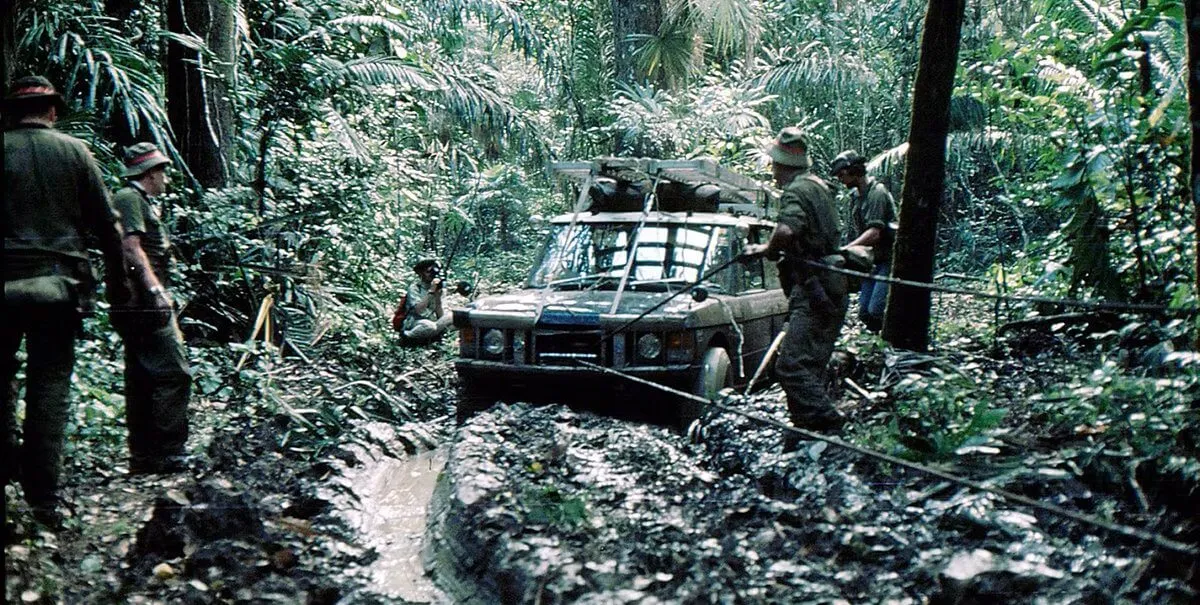
Crossing the notoriously impassable Darién Gap between Panama and Colombia, December 1971.
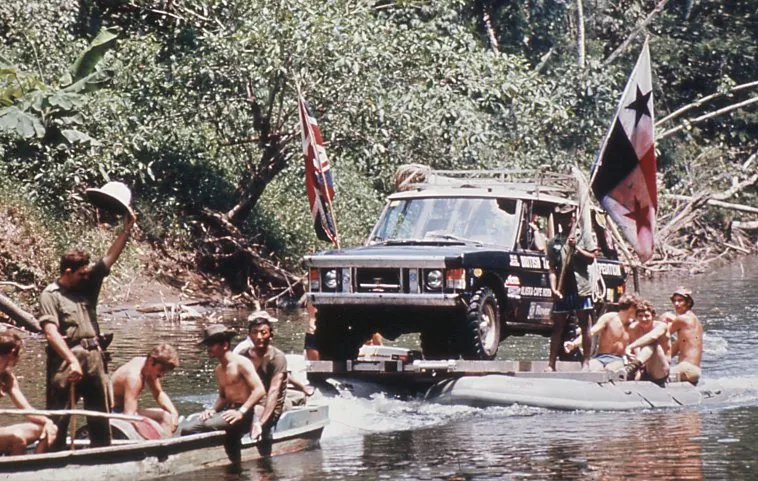
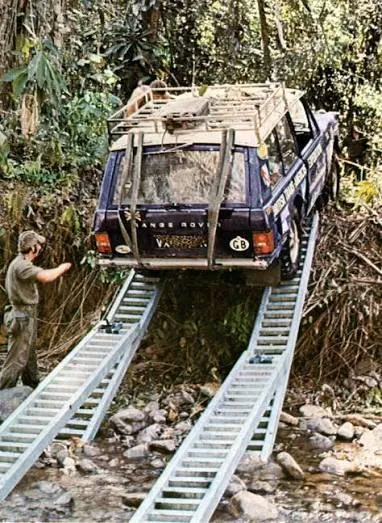
Then came the actual Darién Gap: 250 miles of entirely roadless virgin jungle between Panama and Colombia. This is where the legend and the reality genuinely part ways. The team swelled from a handful of men to around 60 — mostly Royal Engineers — supported by 28 pack ponies, aluminium ladders used both as makeshift bridges over ravines and as rafting platforms across rivers, and regular airdrops from the British Army Air Corps delivering roughly 15,000 gallons of fuel and 20 tons of food and spare parts, since there was, quite literally, no other way to resupply a vehicle in the middle of a swamp. It took 96 to 100 days to cover those 250 miles — an average of barely 2.5 miles a day — and at one particularly bad stretch the expedition had to pause for a full 28 days while engineers back in a distinctly un-tropical Solihull tried to work out why every spare differential they'd brought had already failed in the heat and mud.
The Darién Gap crossing, in progress. / One of the most impassable stretches of terrain on the route.
Fording one of the countless rivers along the route. / The aluminium ladders that made it possible — bridges one moment, rafts the next.
For much of the worst terrain, by some honest retellings, the Range Rovers were barely doing the driving at all — they were more like passengers being winched, dragged, and rafted through the jungle by the human team and a support Land Rover doing the genuinely hard work alongside them. Once clear of the Gap and into South America, the pace changed entirely: the team, racing to make a flight home, pushed the Range Rovers hard down through Chile's high desert roads at 90-100mph for hours at a stretch, covering as much as 800 miles a day before hitting snow in Patagonia. Whatever the exact division of labour back in the jungle, the finished 18,000-mile journey — Alaska to Cape Horn, completed by 10 June 1972 — remains one of the most extraordinary vehicle endurance stunts ever attempted, first-crossing claim or not.
Camel Trophy
A V8 Range Rover at the 1981 Camel Trophy — Land Rover's first year supplying the event, the start of an 18-year relationship.
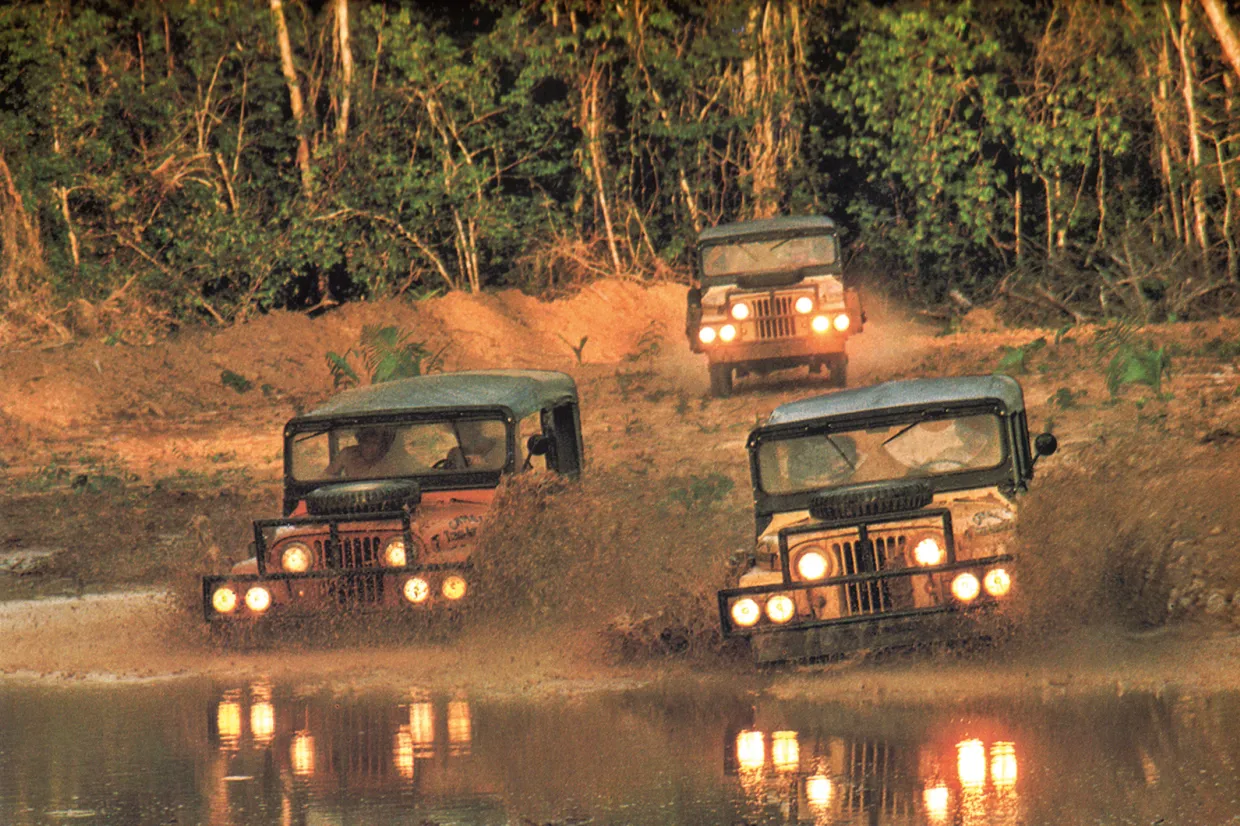
The brand didn't have to wait long to find its next punishing adventure, though this one wasn't even its idea to begin with. The very first Camel Trophy, held in 1980, sent three West German teams into the Amazon Basin's Mato Grosso region — driving Jeep CJ5s, not Land Rovers, and using rented vehicles rather than a manufacturer partnership of any kind. Only after those Jeeps took a genuine battering in the Brazilian jungle did organisers go looking for a more capable, more willing manufacturer partner, finding it in Land Rover, who supplied brand-new V8 Range Rovers for the 1981 event — the actual beginning of what became an 18-year relationship.
The very first Camel Trophy, 1980 — run on rented Jeep CJ5s, a year before Land Rover was ever involved.
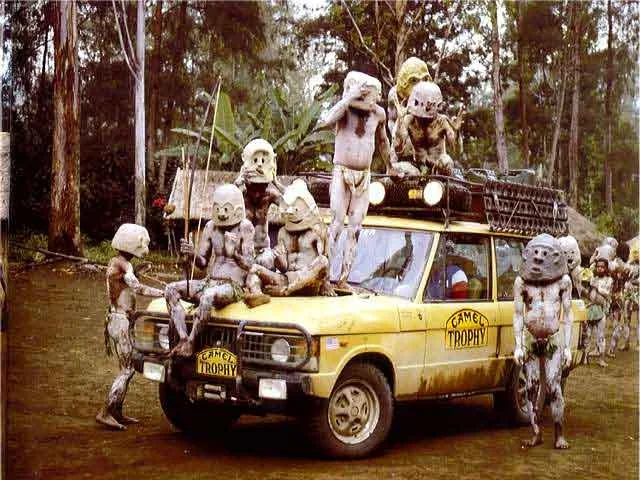
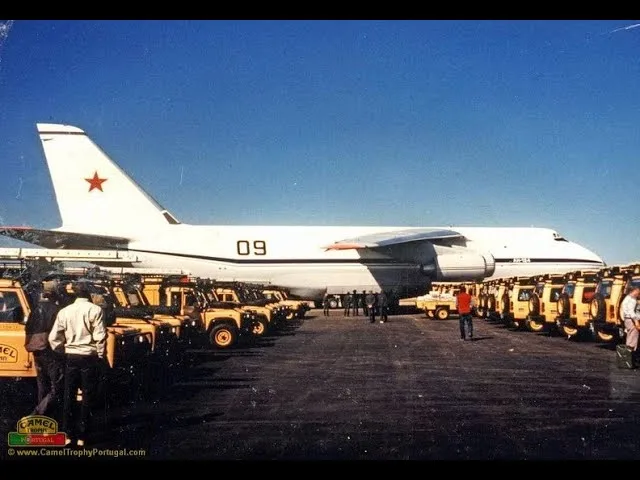
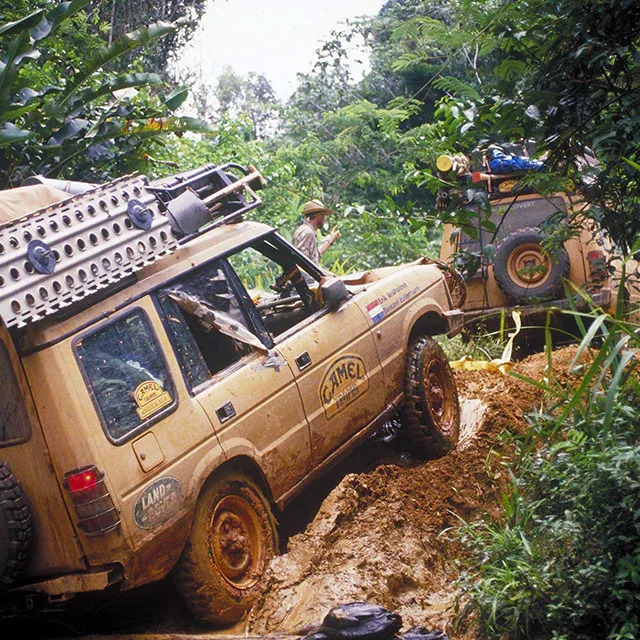
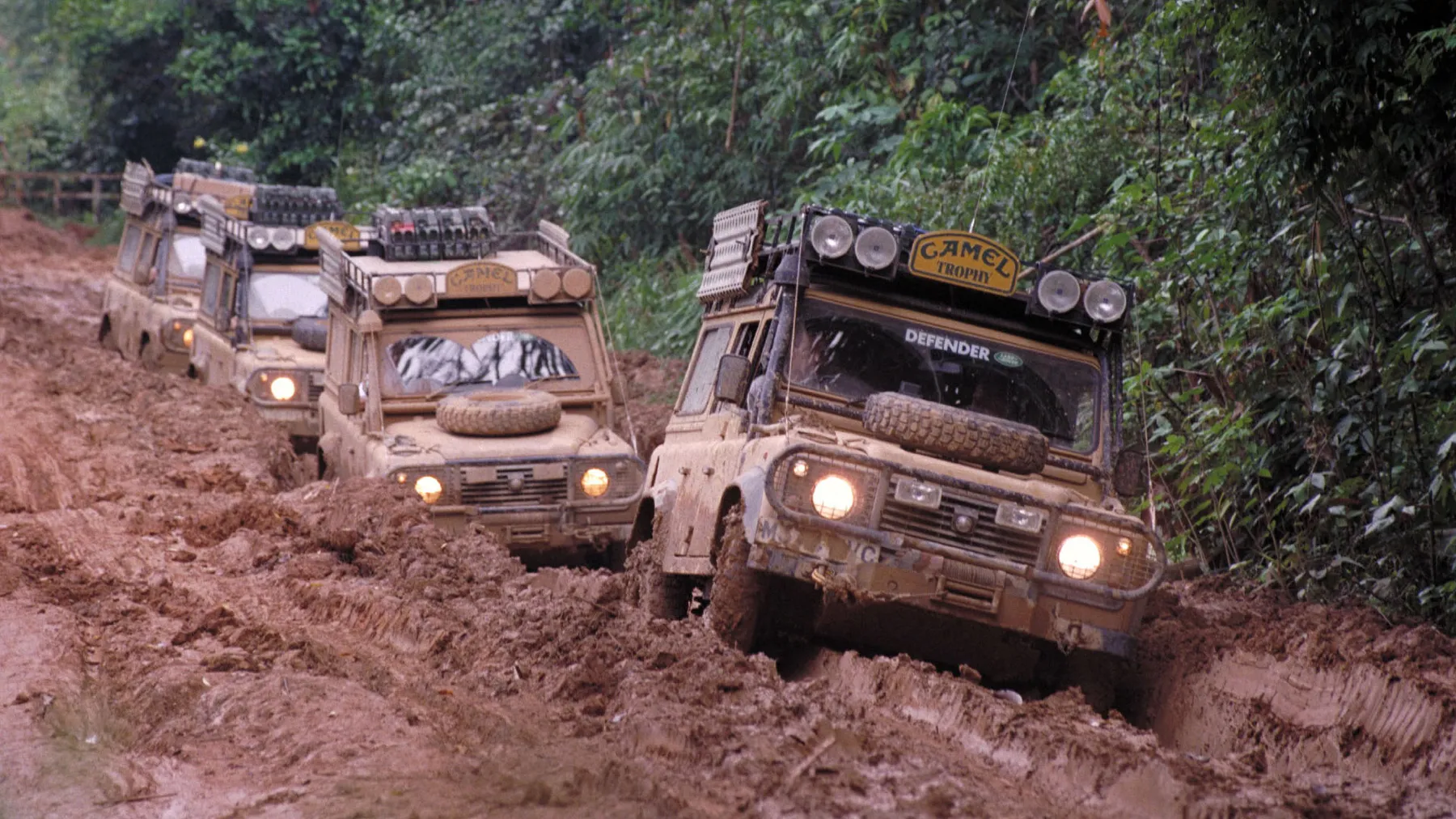
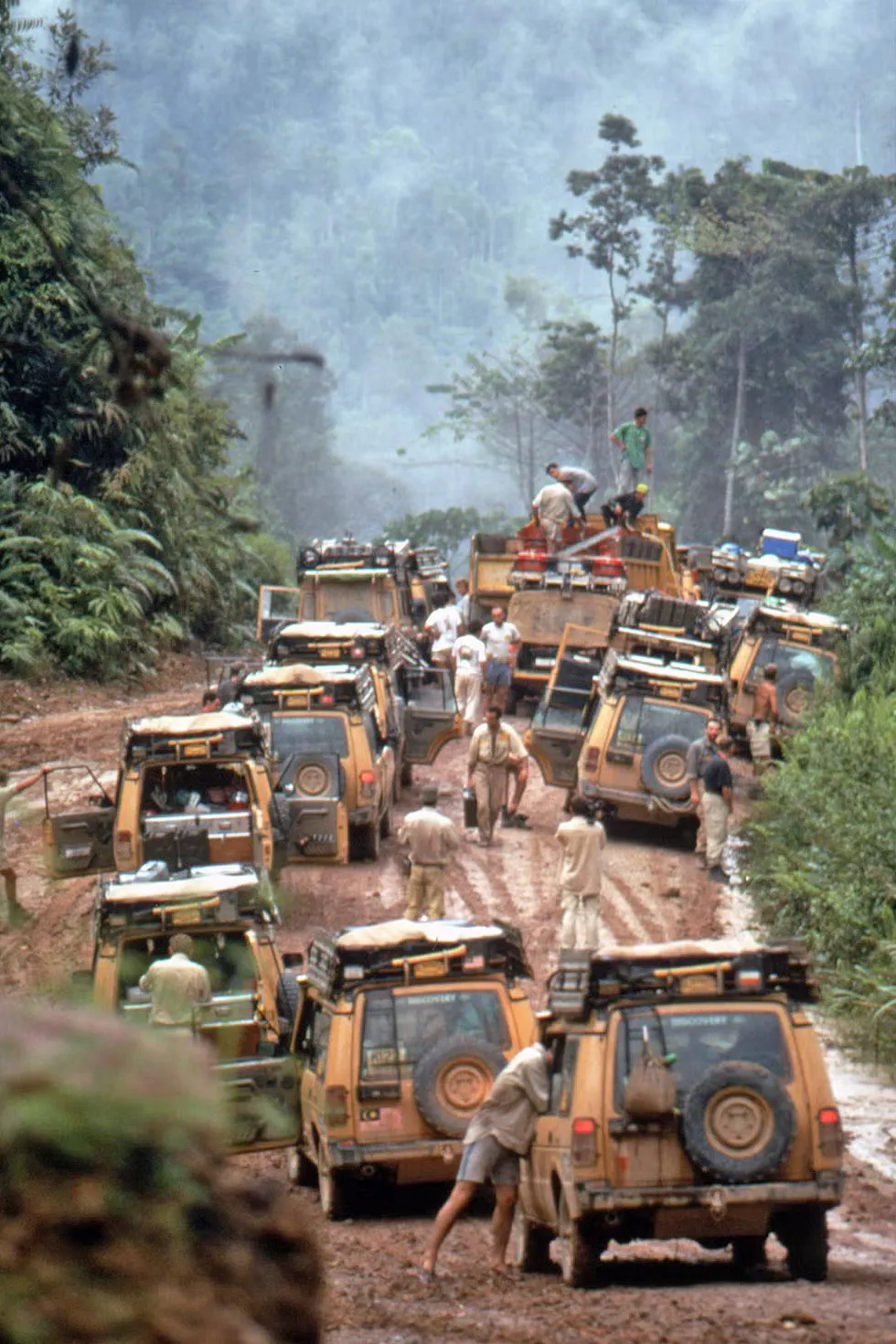
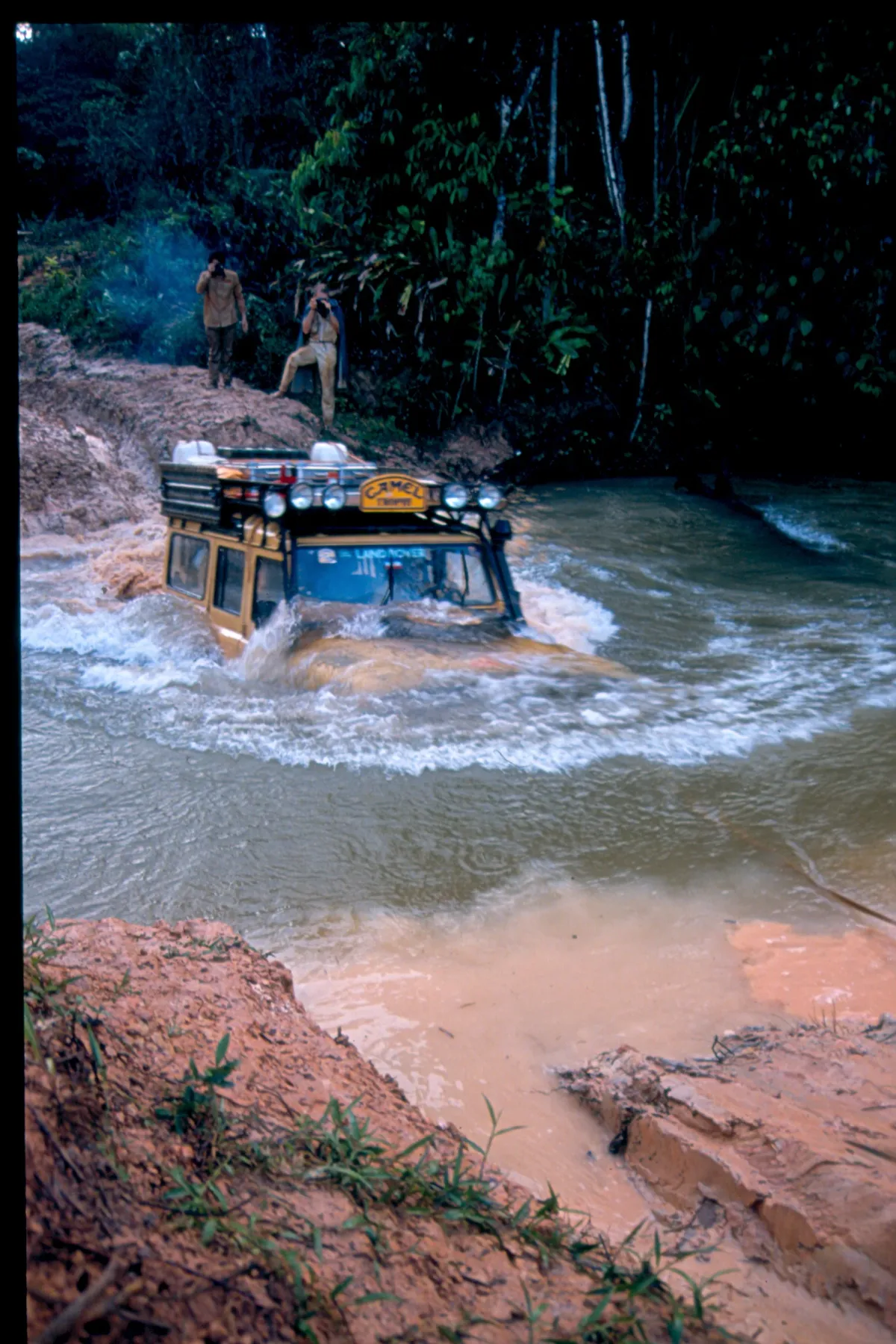
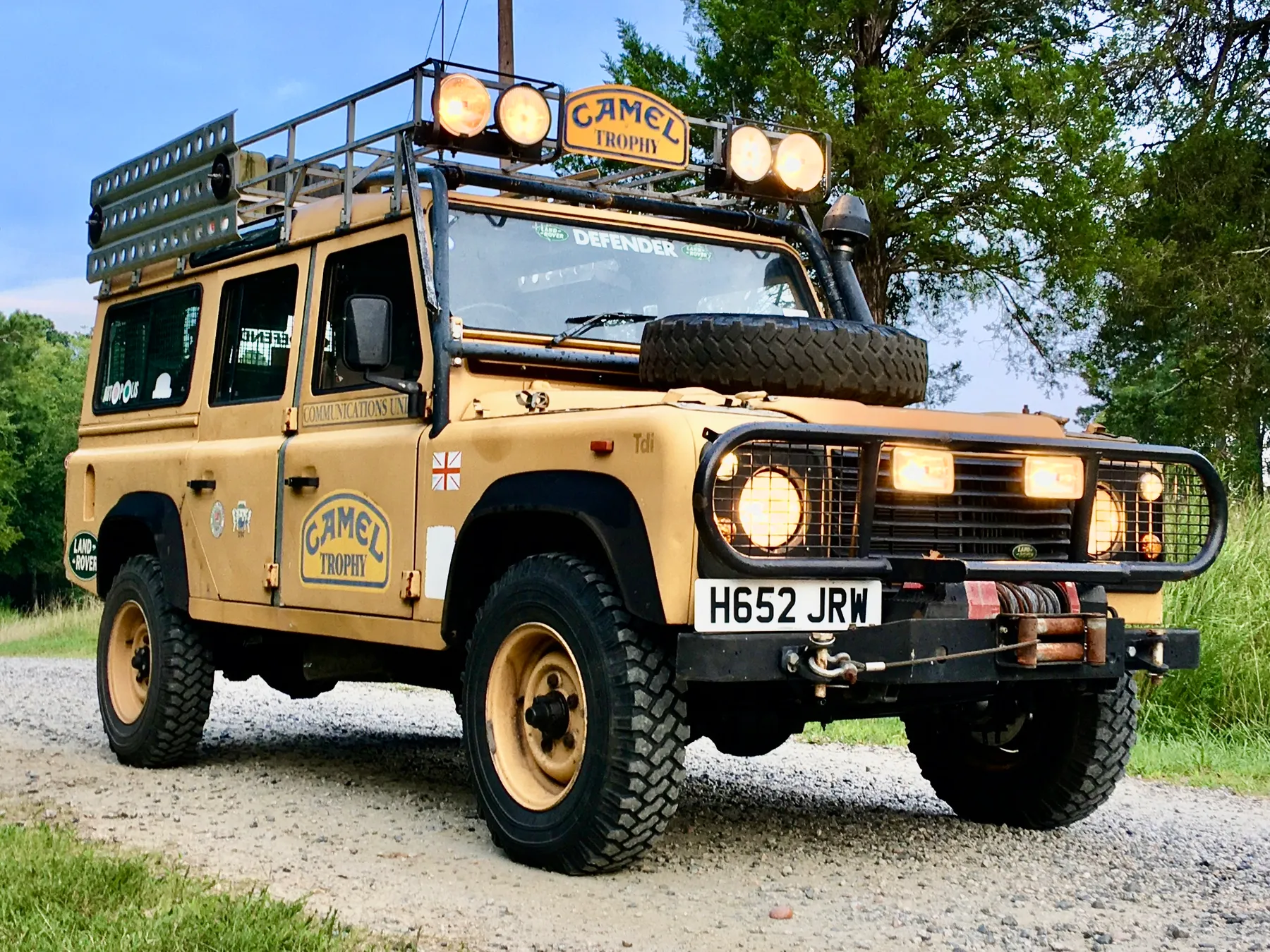
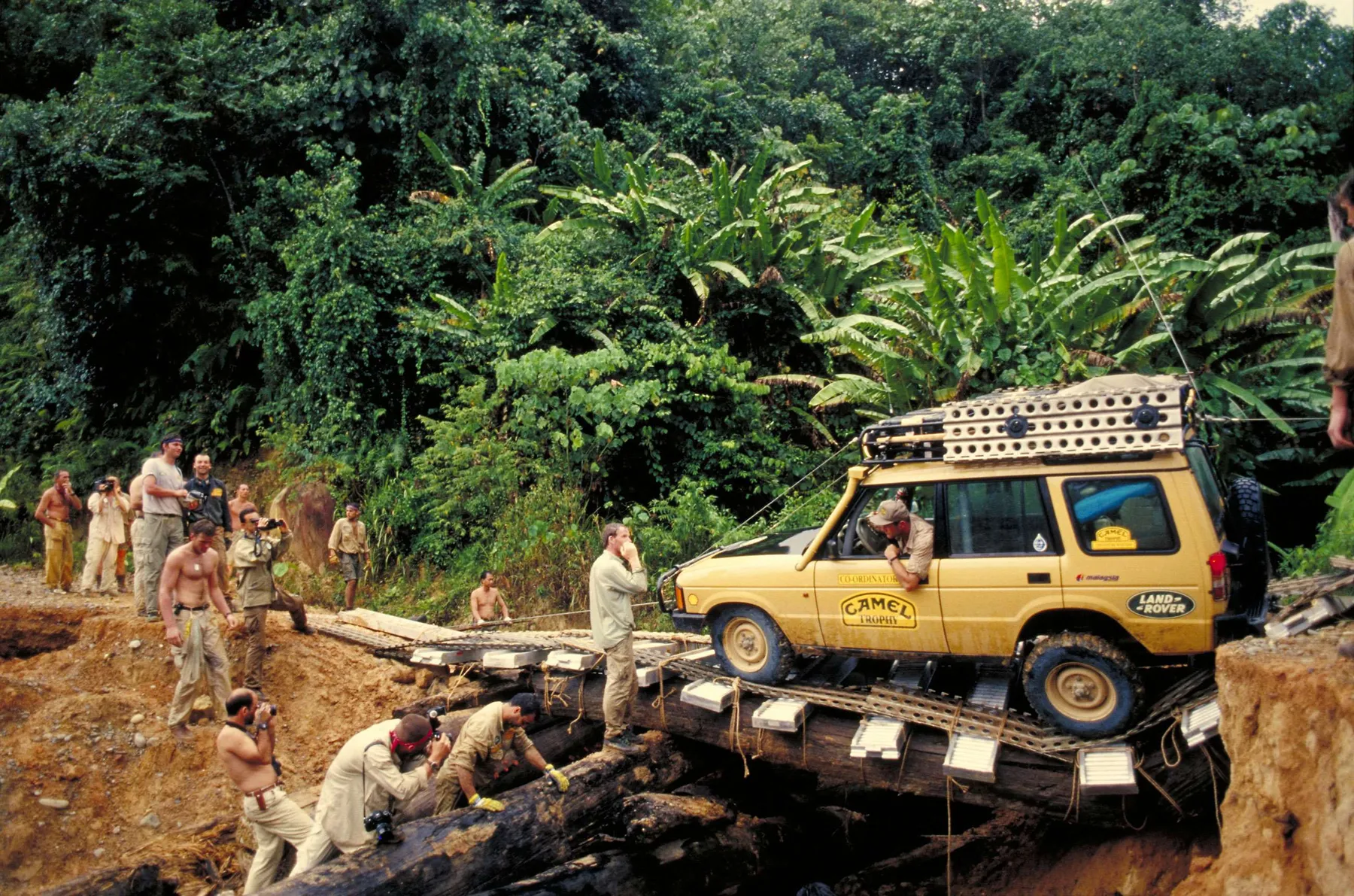
What followed was one of the most punishing brand-partnership stunts in automotive history, and genuinely deserves to be remembered as more than a paint scheme. Vehicles were finished in a distinctive “Sandglow” colour and routinely modified with roof racks, winches, snorkels, and auxiliary lighting for events that ran through some of the most inhospitable terrain on Earth — a continuous, multi-year traverse of the Amazon; a 1990 crossing of the collapsing Soviet Union so significant that Antonov An-124 freighters, each roughly the size of a Boeing 747, landed on British soil for the first time ever specifically to airlift the Land Rovers out to Moscow; and a 1996 first-ever motorised crossing of Kalimantan in Borneo, through jungle so overgrown that convoys sometimes had no choice but to abandon the planned route entirely and improvise a new one. Bridges collapsed mid-crossing on more than one occasion — a Turkish team once found their Land Rover in a riverbed after the bridge beneath it simply gave way.
An Antonov An-124 — each roughly the size of a Boeing 747 — landing on British soil in 1990 specifically to airlift the Land Rovers out to Moscow.
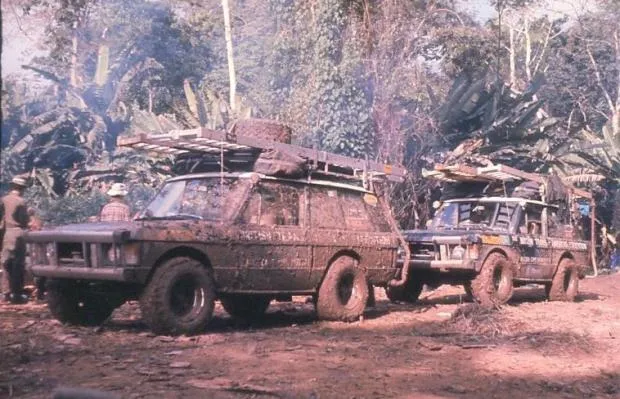
Mud, convoys, genuine wilderness — the format that made Camel Trophy famous.
A Camel Trophy team — vehicles finished in the event's distinctive “Sandglow” colour, modified with roof racks, winches, snorkels, and auxiliary lighting.
The 1993 Camel Trophy. / A river crossing — the kind of obstacle that occasionally took out a bridge entirely.
The event quietly shifted its centre of gravity as Land Rover's own lineup evolved: the Series III gave way to the Defender, and from 1990 onward the newly launched Discovery took over as the primary team vehicle, a role it held for most of the following decade. But the format that made Camel Trophy famous — mud, convoys, genuine wilderness — began drifting away from its own roots through 1997 and 1998, and Land Rover formally ended its 18-year involvement in 1999. One final Camel Trophy ran in 2000, a boat-based event in the South Pacific with no Land Rovers involved at all — a strange, quiet echo of how the whole thing had started twenty years earlier, on vehicles that weren't Land Rovers either.
A Camel Trophy Defender — the vehicle that took over the event as the Series III lineage wound down.
The Discovery, which took over as Camel Trophy's primary team vehicle from 1990 onward.
Six owners in seventy years
The corporate story surrounding both vehicles is almost as remarkable as the vehicles themselves, and reads like a shorthand history of British manufacturing decline and foreign rescue.
Rover itself was absorbed into Leyland Motor Corporation in 1967, which became British Leyland the following year — the sprawling, chronically strike-troubled conglomerate that came to symbolise everything wrong with British industry through the 1970s. The government was ultimately forced to nationalise the ailing group. Land Rover was carved out as its own standalone company in 1978, and in 1986 the wider Rover Group was sold to British Aerospace.
Then, in 1994, German ownership arrived: BMW bought the entire Rover Group, Land Rover included, in a deal that — as covered elsewhere in this series — quickly earned the bitter internal nickname “the English Patient” and very nearly took BMW itself down with it. BMW's Land Rover ownership lasted only six years. In 2000 it sold the brand on to Ford for roughly £1.8 billion, keeping only the Mini brand for itself and offloading the rest of the failing Rover Group to the Phoenix Consortium for a symbolic £10.
Ford folded Land Rover into its Premier Automotive Group alongside Jaguar, which it had separately bought back in 1989. Neither brand made Ford meaningful profit, and when the 2008 global financial crisis hit, Ford — needing cash for its own survival — sold both Jaguar and Land Rover to India's Tata Motors for $2.3 billion, with Ford additionally contributing $600 million toward the two brands' pension obligations as part of the deal. Tata formally established Jaguar Land Rover Limited to hold the combined acquisition, and that remains the ownership structure today: Land Rover operates as a brand under Jaguar Land Rover Automotive PLC, wholly owned by Tata Motors, with its headquarters still in Gaydon, Warwickshire, and its historic production home still at Solihull.
The end of an era, and its unlikely comeback
By January 2016, after a continuous 67-year production run stretching back to that first Series I, the original body-on-frame Defender design could no longer meet increasingly strict modern safety and emissions regulations without compromises Land Rover wasn't willing to make. Production ended on 29 January 2016, with a final tally of just over two million Series and Defender vehicles built at Solihull since 1948 — one of the longest continuous single-lineage production runs in automotive history.
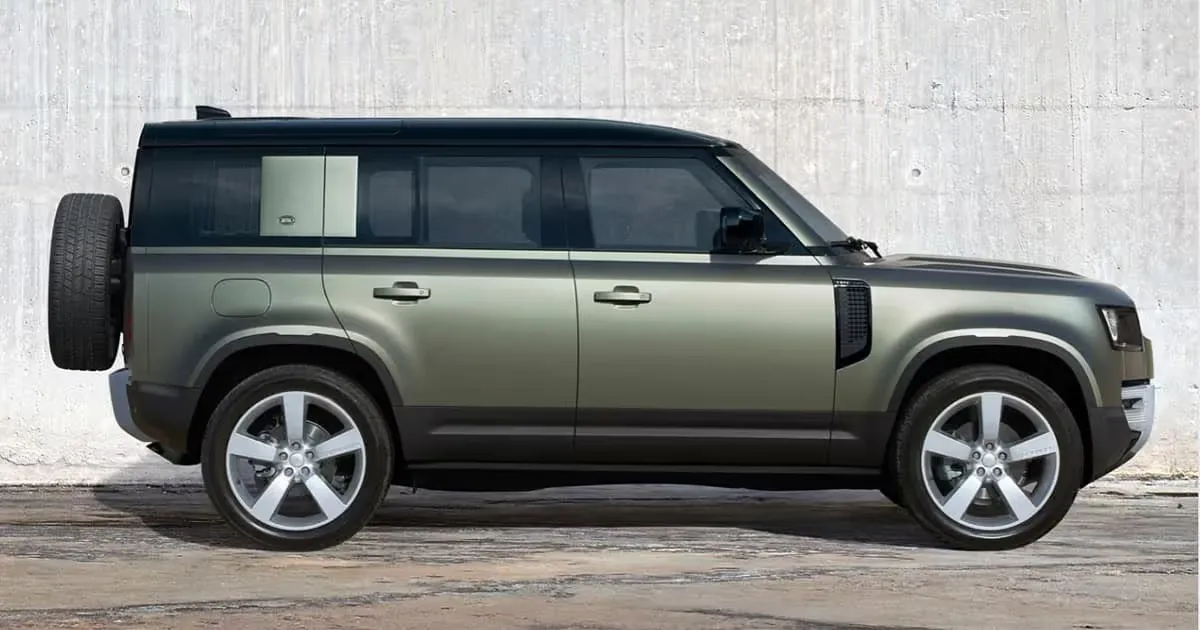
It didn't stay gone for long, at least not in name. In September 2019, Jaguar Land Rover unveiled an entirely reimagined Defender, built on a completely new aluminium monocoque platform with independent suspension all round, replacing the old body-on-frame chassis and live axles that had defined every previous generation. It shared little beyond a boxy silhouette and the name itself with its predecessor. US deliveries, delayed briefly by COVID-19 supply chain disruption, finally began in 2020 and 2021 for the 110 and 90 respectively — the first time Land Rover had officially sold a Defender in America since 1997.
The reimagined 2019 Defender — a new aluminium monocoque platform, sharing little beyond a silhouette with its predecessor.
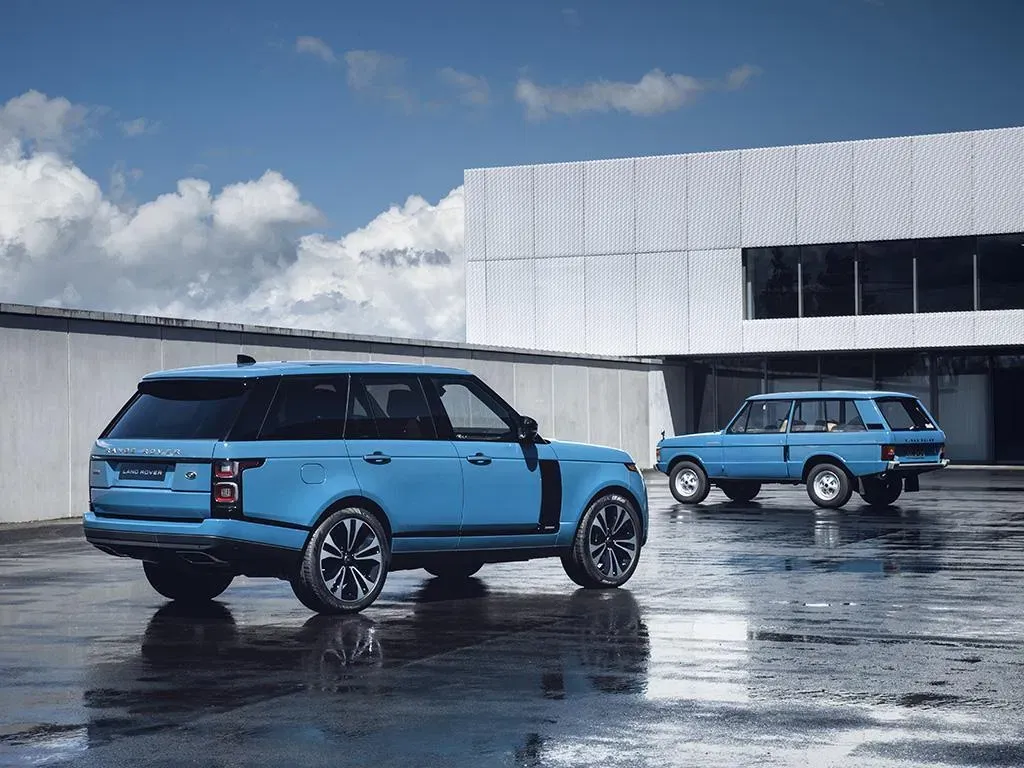
The Range Rover, meanwhile, has followed almost the opposite trajectory to its rough-and-ready cousin — a steady, uninterrupted climb further upmarket with every generation, eventually competing directly against Bentley, Rolls-Royce, and Lamborghini rather than the farm and building-site buyers it was originally engineered for. In 2020, on its 50th anniversary, Land Rover marked the occasion with a limited-run “Range Rover Fifty” edition, restricted to exactly 1,970 examples worldwide — one for the year the original was revealed.
The Range Rover Fifty, 2020 — limited to exactly 1,970 examples worldwide, one for the year the original was revealed.
The bottom line
Both vehicles exist today for strikingly similar reasons: a specific, unglamorous, personal frustration, solved with whatever material or engineering idea happened to be available at the time, by two generations of the same family. Maurice Wilks wasn't trying to build an icon; he was trying to replace a broken-down American Jeep using an alloy he trusted because he'd watched it survive underwater on his own estate. Two decades later, his own nephew wasn't trying to invent the luxury SUV either — he was trying to build a Land Rover comfortable enough to drive to the shops in, and spent, by his own admission, next to no time thinking about how it would look. Between them, uncle and nephew built two of the most enduring names in British automotive history, both born from the same instinct: take what you actually need, build it properly, and let the reputation take care of itself.
Whether you're driving a 1948 Series I, a 1970 Range Rover Classic, or a brand-new Defender, autOracle can help you understand exactly what it needs and what to check before your next MOT.
Know your Land Rover before you buy it.
Series I, Defender, or Range Rover, autOracle reads your car's diagnostics and explains exactly what's going on underneath.
Join autOracle waitlistSources
- Silodrome, “A Quick History of the Land Rover Series 1” — silodrome.com
- FunRover, “Defender body panels are not Birmabright” — funrover.com
- History Points, “Site of first Land Rover drawing, Red Wharf Bay” — historypoints.org
- RoverParts.com, “Early Land Rover History | A Trip to Anglesey, Wales” and “The Wilks Brothers: Fathers of Land Rover” — roverparts.com
- Lookers, “Keeping it in the family: the history of Land Rover” — lookers.co.uk
- The QG, “The Story of Land Rover” — theqg.com
- Grokipedia, “Maurice Wilks” — grokipedia.com
- Wikipedia, “Maurice Wilks,” “Land Rover,” “Land Rover Defender,” “Charles Spencer King” — en.wikipedia.org
- Automobile Fandom, “Land Rover Series” — automobile.fandom.com
- Monarch Defender, “History of the Land Rover Defender: From Sand Sketch to Icon” — monarchdefender.com
- Land Rover Edison, “A Comprehensive History of the Defender SUV” — landroveredison.com
- Land Rover South Orlando, “Land Rover Defender Model Timeline” — landroversouthorlando.com
- ECD Auto Design, “Land Rover Defender by Year Explored” — ecdautodesign.com
- Helderburg, “What year was the last classic defender 110 made” — helderburg.com
- Fox News, “Land Rover brings back the Defender with a high tech modern flair” and “Land Rover Defender returns in 2020” — foxnews.com
- CarBuzz, “Who Owns Land Rover? Understanding The British Luxury Brand” — carbuzz.com
- AOL, “Who Owns Land Rover? Understanding The British Luxury Brand” — aol.com
- The Motley Fool, “Who Owns Jaguar and Land Rover?” — fool.com
- CompaniesHistory.com, “Who Owns Land Rover?” — companieshistory.com
- RichNiches, “Who Owns Land Rover: A Friendly Guide To The Iconic British Brand's Ownership” — richniches.com
- BrandsOwnedBy, “Who Owns Land Rover: Major Shareholders” — brandsownedby.com
- Land Rover Mission Viejo, “Who Owns Land Rover?” — landrovermissionviejo.com
- JLR Corporate / Land Rover Media Newsroom / Jaguar Media Newsroom, “Range Rover Marks 50 Years of All-Terrain Innovation and Luxury” — jlr.com / media.landrover.com / media.jaguar.com
- Goodwood Road & Racing, “The history of Range Rover” — goodwood.com
- Range Rover, “The Range Rover Story” — rangerover.com
- Land Rover Sarasota, “The Amazing Land Rover Origin and History” — landroversarasota.com
- Gulf News, “New Range Rover is a supermodel” — gulfnews.com
- British Motor Museum, “Range Rover Darien Gap Expedition 1971” — shop.britishmotormuseum.co.uk
- Land Rover Monthly, “Celebrating in style” — landrovermonthly.co.uk
- RoverParts.com, “The 1972 Range Rover Darien Gap Expedition,” and “A History of the Land Rover Camel Trophy” — Parts 1 through 6 — roverparts.com
- Hagerty Media, “Range Rover's PR stunt to brave the Darién Gap was a baptism by fire—and swamp” — hagerty.com
- TopSpeed, “The Story of the Darien Breakthrough” — topspeed.com
- The Intercooler, “Crossing the Darien Gap” — the-intercooler.com
- John Carroll, “Making the Range Rover Legend: The 1971–72 British Trans-Americas Expedition” — via Amazon.com
- Diesel World, “The Camel Trophy: Land Rover History” — dieselworldmag.com
- VLC Atelier, “Brief overview of the history of Land Rover... Camel Trophy” — vlcatelier.com
- Wikipedia, “Range Rover Classic,” “Rover V8 engine” — en.wikipedia.org
- Autopedia / Wikicars, “Land Rover Range Rover Classic” — automobile.fandom.com / wikicars.org
- Netcarshow, “Land Rover Range Rover (1970)” — netcarshow.com
- Carfolio, “1970 Rover Range Rover: detailed specifications” — carfolio.com
- Motorious, “How To Buy The Perfect Range Rover Classic” — buy.motorious.com
- John Brown 4x4, “Classic Range Rover Guide: 1970-1994” — johnbrown4x4.com