The V8 Is Back: Inside Stellantis's HEMI Reversal and the Industry-Wide U-Turn on Big Engines
The autOracle Team
Jun 30, 2026
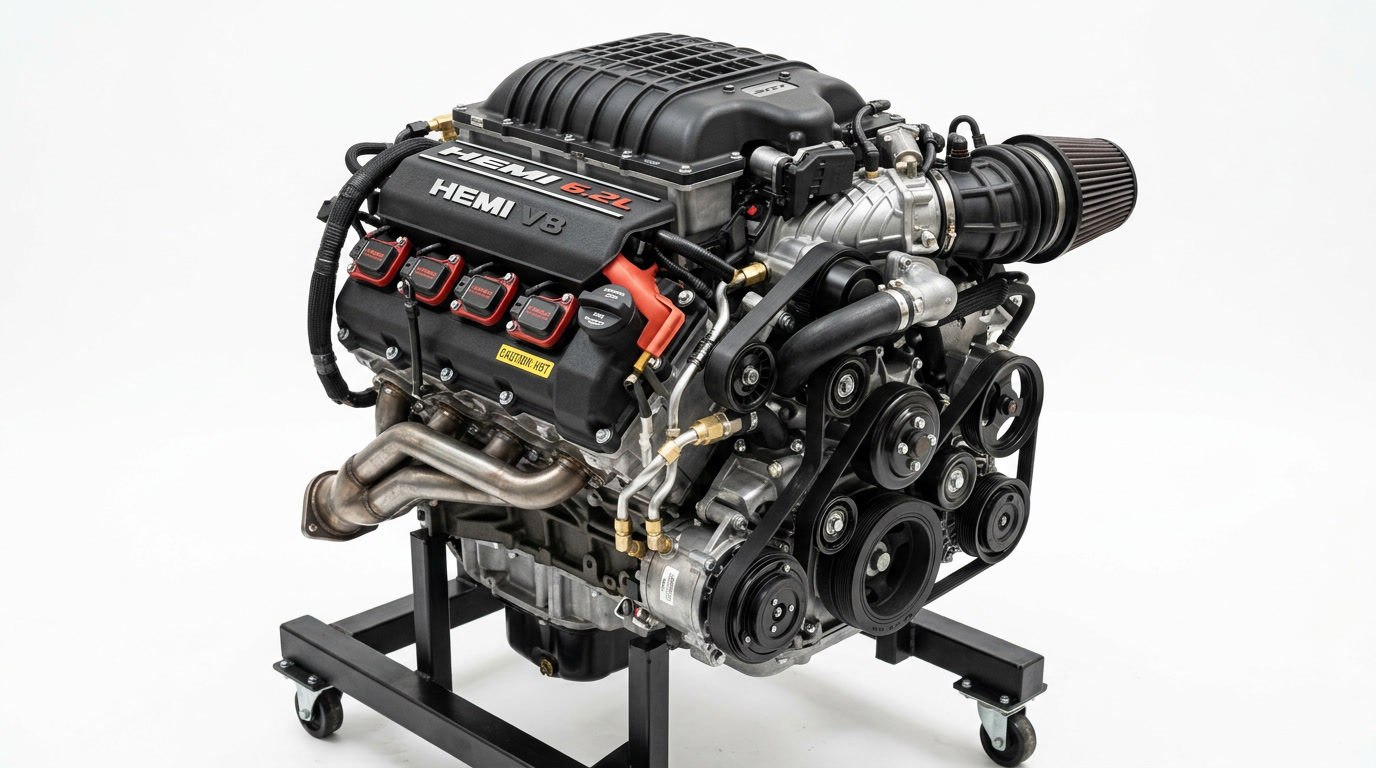
A few years ago, the V8 looked finished. Stellantis killed the HEMI. Mercedes-AMG bet its future on turbocharged hybrid four-cylinders. Every major automaker was racing toward an electric-only roadmap. Now, in 2026, that story has reversed almost completely — and the company that started the retreat from V8s is the same one now scrambling to build them fast enough to keep up with demand.
Stellantis's about-face
Ram revived the 5.7-litre HEMI V8 for the 2026 Ram 1500 by popular demand after dropping it in favour of the 3.0-litre twin-turbo Hurricane inline-six in 2025. Ram CEO Tim Kuniskis didn't dress it up as anything other than a mistake corrected: “Everyone makes mistakes, but how you handle it defines you. Ram screwed up when we dropped the Hemi — we own it and we fixed it.”
The numbers behind that admission are striking. In 2025, Stellantis received roughly 50,000 HEMI orders but could only build about 30,000 engines, a shortfall driven entirely by capacity constraints rather than weak demand. Production of both the Hurricane six-cylinder and all HEMI V8s currently runs through a single facility, the Saltillo Engine Plant in Mexico, and the squeeze became so severe that Hurricane shortages temporarily disrupted Jeep Grand Wagoneer production so engines could be redirected to Ram 1500 assembly instead.
Stellantis isn't easing back in cautiously. The company now plans to build more than 100,000 HEMI engines in 2026, more than tripling last year's output, with Kuniskis estimating the V8 could eventually account for roughly 35% of take rates once supply stabilises. Crucially, expansion plans are no longer limited to Saltillo — Stellantis is actively working to increase HEMI production “regardless of the location,” signalling additional manufacturing capacity is coming.
Why the Hurricane wasn't the open-and-shut replacement Stellantis expected
The Hurricane inline-six, introduced in 2022 as the HEMI's intended successor, isn't a failure on paper. The High Output version makes 540 horsepower and 521 lb-ft of torque in Ram applications — comfortably outpacing the HEMI's 395 hp and 410 lb-ft — and properly equipped, the Hurricane SO tows up to 11,610 lbs, the highest rating in the entire 2026 Ram 1500 lineup. By every conventional performance metric, the turbocharged six beats the naturally aspirated V8.
What it doesn't replicate is character. The HEMI's appeal in 2026 is largely about sound, throttle feel, and familiarity for longtime V8 owners rather than raw capability. Buyers who could get more power and better towing from the Hurricane chose the HEMI anyway, in large enough numbers that Stellantis is now building both engines side by side on most Ram 1500 trims rather than treating the V8 as a legacy holdover.
It isn't just Stellantis
What makes this moment genuinely notable is that Stellantis's reversal isn't an isolated case — it's the most visible example of an industry-wide correction.
General Motors invested $888 million in May 2025 specifically to develop next-generation V8 engines, a commitment large enough to be described as sparking renewed consumer interest in V8 technology on its own. GM is reportedly developing an electrified V8 alongside the conventional version, aimed at trucks and SUVs where towing capacity still matters more than outright efficiency.
Porsche, after reporting a serious profit downturn driven partly by weak Taycan sales and heavy EV development spending, is now developing a new V8 petrol engine based on its current 4.0-litre turbocharged unit, updated to meet emissions and noise regulations into the 2030s — a clear signal the company no longer sees combustion as a dead end to be phased out as quickly as previously planned.
Mercedes-AMG has been arguably the most candid about getting this wrong. The current AMG C63 S E Performance pairs a turbocharged 2.0-litre four-cylinder with a rear electric motor — fast and efficient, but missing the V8 thunder that defined every previous generation of C63. Owners and enthusiasts noticed immediately, and Mercedes has effectively acknowledged the misstep, with reporting suggesting the brand is now moving away from turbo-four hybrids back toward V8s in response to direct customer feedback.
So is this about US policy, or about something else?
It's tempting to credit the V8 revival entirely to American deregulation, and policy genuinely has played a role — but mostly as an accelerant in the US specifically, not as the underlying cause.
The clearest policy shift: the US administration revoked the previous 2030 EV sales target and paused Inflation Reduction Act funding, and in September 2025 the federal EV tax credit was eliminated entirely. That removed real regulatory pressure that had been pushing American automakers toward electrification on a timeline faster than consumers were actually ready for.
But the more fundamental driver, visible well beyond the US, is a straightforward demand correction. US retail EV market share collapsed from 11.2% to 6.6% in roughly a year, global EV registrations fell 3% year-over-year in January 2026, and the broader EV industry has absorbed over $65 billion in losses and writedowns since 2025 as automakers walked back plans built on adoption curves that simply didn't materialise. Honda cancelled three planned North American EV models outright, citing changes in the business environment. Volvo paused parts of its EV roadmap. This is a global recalibration of forecasts against real consumer behaviour, not a phenomenon confined to American regulatory politics.
The honest read: automakers across the board overcommitted to an all-electric timeline between 2021 and 2024, consumer demand didn't keep pace, and the V8 — alongside other combustion and hybrid technology — is what's filling the gap while the industry resets its assumptions. US policy changes have made that reset easier and faster specifically within America, but they aren't the root cause of why Porsche, GM, and Mercedes-AMG are independently arriving at the same conclusion.
The bottom line
The V8 isn't being kept alive out of nostalgia alone — it's being rebuilt because automakers misjudged how fast and how completely buyers would embrace electrification, and the correction is happening everywhere from Mexican engine plants to German performance divisions simultaneously. Stellantis's HEMI U-turn is the loudest version of this story, but it's a symptom of a much broader recalibration, not an isolated American phenomenon driven purely by changing federal policy.
Whether your next car runs a turbocharged six, a revived V8, or something in between, autOracle helps you understand exactly what you're buying and what it's likely to cost to keep running.
Know exactly what's wrong with your car.
Describe your symptoms in plain English and get an instant diagnosis.
Join autOracle waitlistSources
- Autoblog, “HEMI Is Back in a Big Way: Stellantis Targets 100,000+ V8 Engines for 2026” — autoblog.com
- HotCars, “Stellantis Aims To Build 100,000 Hemi Engines In 2026” — hotcars.com
- CarsGuide, “V8s are back on the menu: 2026 RAM 1500 bets on big engines” — carsguide.com.au
- Stellantis Media, Engines/Powertrain Newsroom — media.stellantisnorthamerica.com
- Victorville Motors, “Hurricane SO vs HO: 3.0L Twin-Turbo Specs, HP & 2026 Models” — victorvillemotors.com
- CarBuzz, “Why The Stellantis Hurricane Inline-Six Beats Modern V8s” — carbuzz.com
- CarBuzz, “Every Automaker Bringing Back V8 Engines In 2026 After The EV Backlash” — carbuzz.com
- ActuCars, “A Shifting Future for American Auto Efficiency Standards” — actucars.net
- Grobank, “Car Industry Comeback 2026: V8 Engines Roar Back” — grobank.co.za
- EnkiAI, “EV Manufacturing Crisis 2026: Why Automakers Are Reversing” — enkiai.com
- Automotive Logistics, “EV slowdown and hybrid shift: How Stellantis, Ford, GM and Honda are reshaping automotive logistics” — automotivelogistics.media
